Apache Cases at Harbor Freight vs Pelican: Published Latch and Seal Claims
A latch that clicks shut while a cable crosses the lid gasket can leave equipment exposed to water during transport. Compare Apache cases at Harbor Freight with Pelican by the exact model’s latch, seal and exposure claims, then verify that the packed lid closes with an unobstructed gasket.
Quick specs: which cases and claims are being compared?
This comparison covers Apache 3800, black, SKU 63927, and Pelican 1500 Protector as documented on October 19, 2026. It does not extend their claims to other sizes, series or hardware revisions.
Scroll horizontally to see all columns.
| Input or item | Typical value or source | Why it matters |
|---|---|---|
| Apache 3800 latches | Harbor Freight describes easy-open closures | The wording provides no measured operating or clamping force |
| Apache 3800 seal and valve | Rubber seals; adjustable pressure-relief valve | Closure, seal condition and valve instructions need separate checks |
| Apache 3800 ingress claim | IP65 on the model page | Retain the precise code and the configuration behind it |
| Pelican 1500 latches | Double-throw mechanism on its product page and sheet | A named mechanism is not a numerical force specification |
| Pelican 1500 seal and valve | O-ring lid; automatic pressure-equalization valve | Neither feature supplies a gasket-compression measurement |
| Pelican 1500 ingress claim | IP67 on its generated product sheet | This is the documented model claim, not a prediction for every exposure |
Sources: Harbor Freight’s Apache 3800 page, Pelican’s 1500 page and 1500 product sheet, accessed October 19, 2026. These are manufacturer/seller claims for the documented case configurations; the fetched specifications do not establish comparative performance after wear, damage or modification.
What does the latch name tell you about the lid seal?
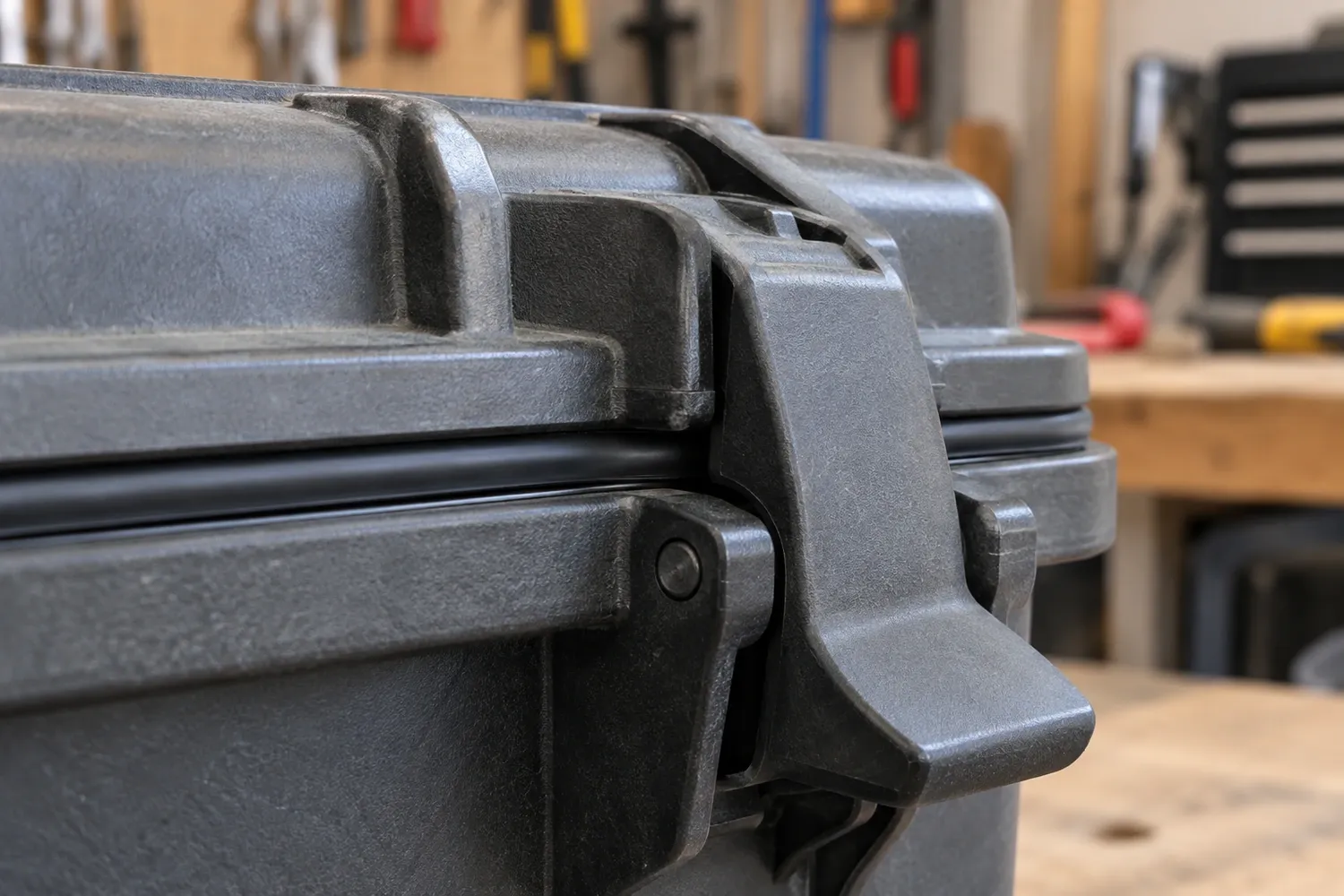
The latch holds the lid in position; the gasket forms the sealing interface. A closure description alone cannot show how evenly the gasket contacts the sealing land around the case.
Harbor Freight’s description does not identify a throw mechanism or give a force curve for the 3800. Pelican names a double-throw mechanism on the 1500. The documents do not provide matched clamp loads, opening forces, compression maps or closure-cycle counts. Claims that one is easier with gloves, retains more force or lasts longer therefore remain unknown from the saved specifications.
A latch can engage while a displaced seal, trapped strap or overfilled insert prevents proper contact elsewhere. Compare the actual receiving samples for obstructions and visible damage, following their instructions. Perceived closing effort is an observation to record, not a calibrated measure of water protection.
How do the published seal and valve claims differ?
The documents describe different sealing components and valve operation, but they do not quantify which assembly retains a seal better after field use.
Scroll horizontally to see all columns.
| Component | Apache 3800 published scope | Pelican 1500 published scope | Dominant Failure Mode & Prevention |
|---|---|---|---|
| Latch | Easy-open closure description | Double-throw closure description | Latch engaged with an obstructed lid → clear the packed perimeter before closing |
| Lid seal | Rubber seals in the specifications | O-ring lid/seal in the page and sheet | Damaged or displaced sealing element → inspect seating and confirm the correct replacement |
| Pressure valve | Adjustable pressure relief | Automatic pressure equalization | Assuming identical operation → retain instructions for the exact valve configuration |
| Ingress code | IP65 on the model page | IP67 in the model sheet | Treating code differences as a universal ranking → match documented exposure to the intended task |
| Seal service | Page directs readers to parts support; exact seal part is unresolved | Sheet lists 1503 replacement O-ring | Substituting an unverified seal → confirm part compatibility before repair |
The comparison uses the model sources above, saved October 19, 2026. Pelican’s sheet describes the lid seal in its overview and uses a broader material label in its materials table; neither supplies a compound specification for chemical compatibility. The fetched Apache page likewise does not establish a seal compound. Material compatibility is unresolved for both.
IP65 and IP67 are different declared codes, not a measured gap in reliability. NEMA’s public IP explanation notes that water numerals 7 or 8 alone do not establish jet protection under 5 or 6. Do not infer an unprinted jet rating, immersion depth or test duration for either case. The exact applicable test clauses and reports were not fetched and remain unknown for this comparison.
What physical threshold makes a closed latch insufficient?
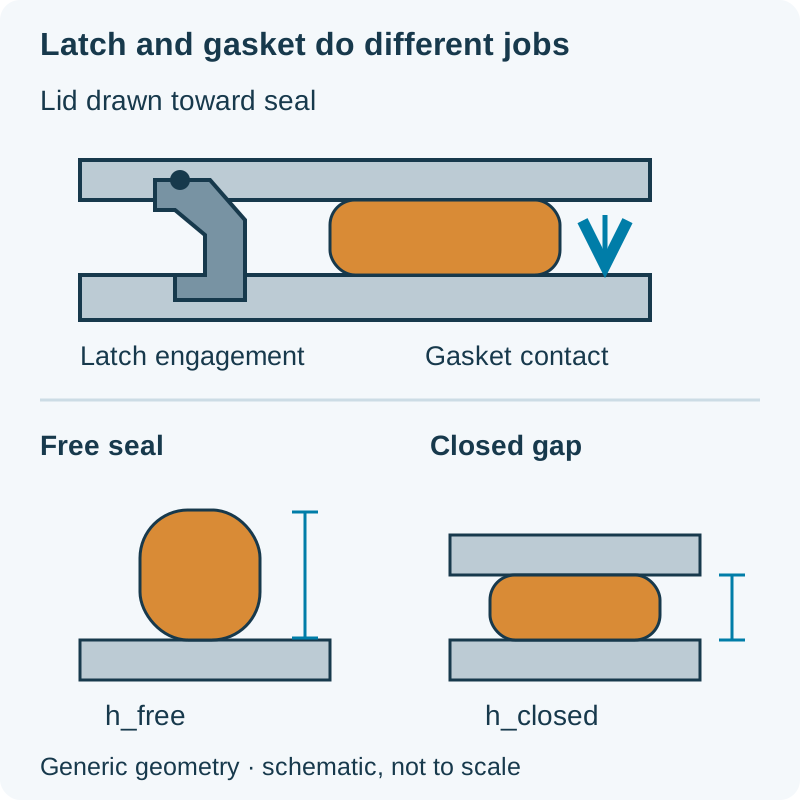
A sealing element needs compression against its mating surface; zero calculated squeeze provides no compression margin. This geometric principle does not supply a manufacturer’s acceptance percentage.
Rules-of-Thumb — contact boundary: if the closed gap at a sealing location is equal to or greater than the free seal height, calculated squeeze is zero or negative. Stop treating latch engagement as evidence of compression there and obtain the correct configuration or manufacturer assessment. Positive squeeze alone also cannot establish a watertight assembly.
For a simplified seal cross-section, use:
S = ((h_free − h_closed) / h_free) × 100%
h_free is the uncompressed seal height in the compression direction; h_closed is the closed gap between the supporting and mating surfaces. This is a geometric illustration, not a measurement procedure for either branded case.
Worked example — assumed geometry, neither model’s dimensions: with h_free = 4 mm and h_closed = 3 mm, S = ((4 − 3) / 4) × 100% = 25%. That percentage demonstrates the arithmetic only. Neither saved case specification publishes this seal height, closed gap or acceptable squeeze target. Do not adjust a latch or substitute a gasket to reproduce it.
What should a receiving comparison record?
Record the case identity and observed condition before deciding whether its documented configuration suits the kit. This keeps a local inspection useful without turning it into an ingress certification.
- Save the exact model, SKU/configuration, source date and closure instructions; do not copy a different series’ latch description.
- Inspect the sealing element and mating surface for damage, displacement and trapped packing material. Record any discrepancy before the case is assigned to a crew.
- Check the packed layout for cables or straps crossing the perimeter and for contents that obstruct lid closure. Stop if closure requires forcing the load down.
- Confirm valve operation and compatible replacement parts through the model’s documentation. Keep unresolved part numbers in the handover record.
Include replacement parts, repair handling time and the cost of taking the kit out of service when comparing ownership costs. The fetched documents provide no matched service-life data, so they cannot support a numerical lifetime-cost advantage. Use the waterproof equipment-case selection checklist for the wider procurement record, or return to the cases and protection hub.
Method and sources
This research-based guide compares saved public Apache 3800 and Pelican 1500 descriptions and the generated Pelican product sheet, accessed October 19, 2026. The NEMA public summary supplies the limited explanation of IP jet-versus-immersion scope. The worked example uses declared hypothetical geometry. Latch forces, wear rates, wall thicknesses, seal compounds and same-condition test results are unknown from these sources; no brand winner follows from them.
Updated October 2026.
Sources and versions
- APACHE 3800 Weatherproof Protective Case, Large, Black (SKU 63927) , Harbor Freight Supports: Model-specific easy-open latch, rubber-seal, adjustable pressure-relief valve and IP65 claims; the page does not publish latch force or a gasket-compression target.
- 1500 Protector Case , Pelican Supports: 1500 double-throw latches, O-ring lid and automatic pressure-equalization valve as described on the saved product page.
- 1500 Protector product sheet (document created October 19, 2026) , Pelican Supports: 1500 IP67, double-throw latch, O-ring seal, automatic valve and 1503 replacement O-ring listing; no gasket-compression or latch-force measurement.
- NEMA Enclosure Types (approved November 2005) , National Electrical Manufacturers Association Supports: IP water numerals 7/8 alone do not establish jet protection under numerals 5/6; no same-condition brand comparison follows from different codes.
Next steps
Choosing a Waterproof Equipment Case: A Procurement Checklist
A procurement checklist for waterproof equipment cases: dimensions, seals, latches, valves, rating claims, test report scope, spares and maintenance documents.