Outdoor Electrical Junction Box: NEMA Type, IP Codes, Gaskets and Cable Glands
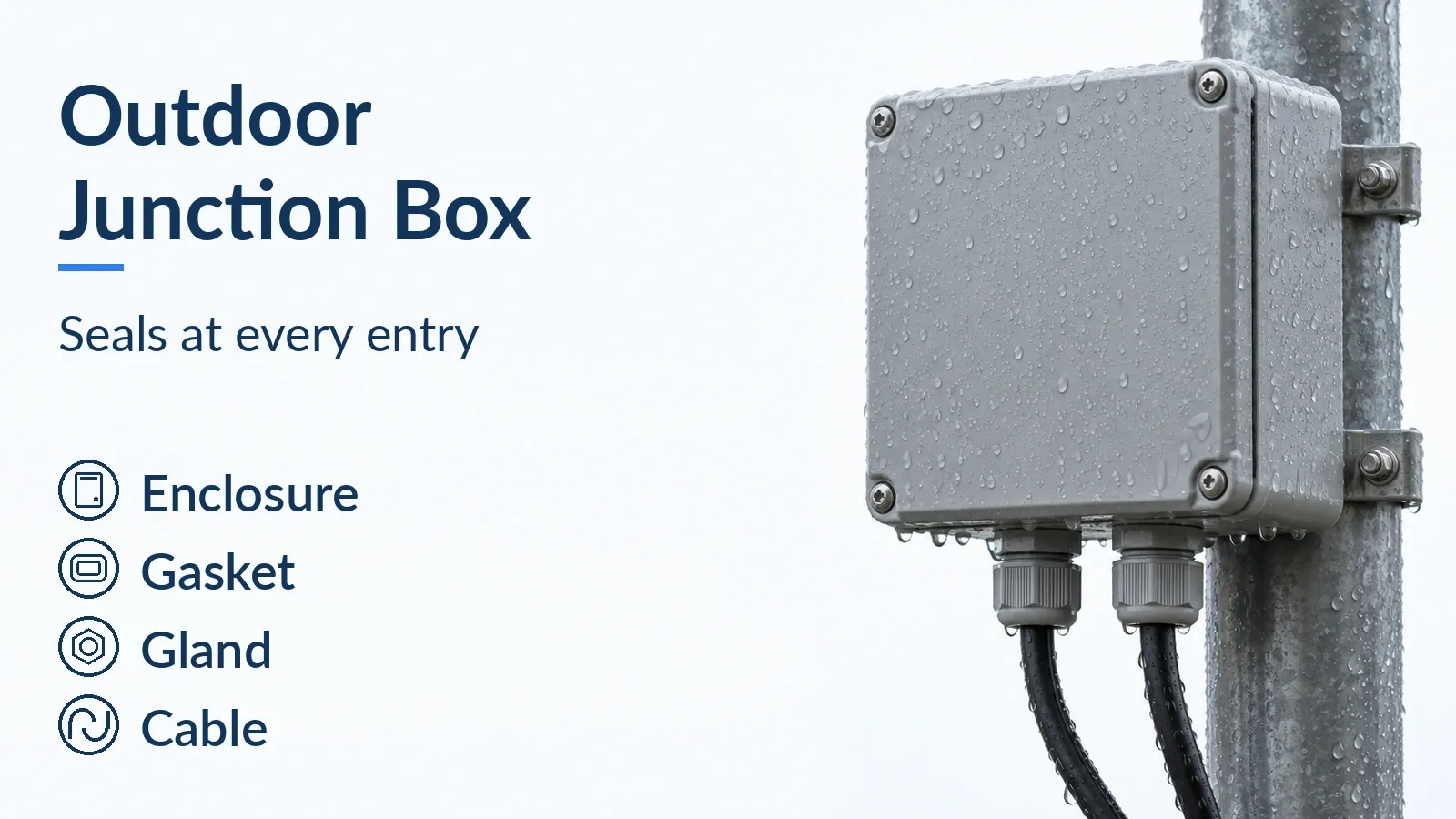
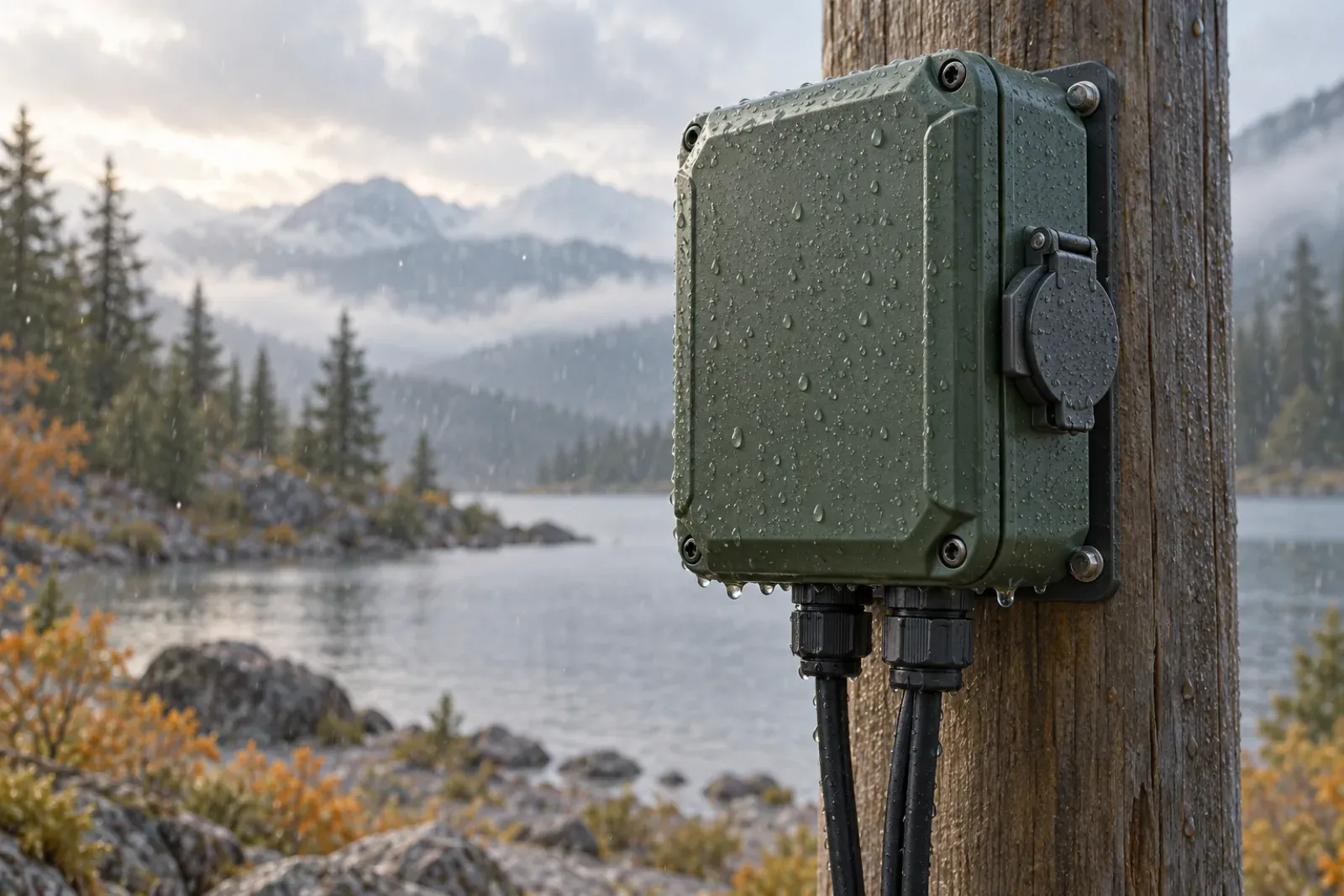
Water entering an outdoor electrical junction box through a mismatched cable gland can damage connections even when the lid gasket looks intact. Specify NEMA Type and IP evidence separately, then verify the gaskets, cable glands and mounting details of the completed enclosure.
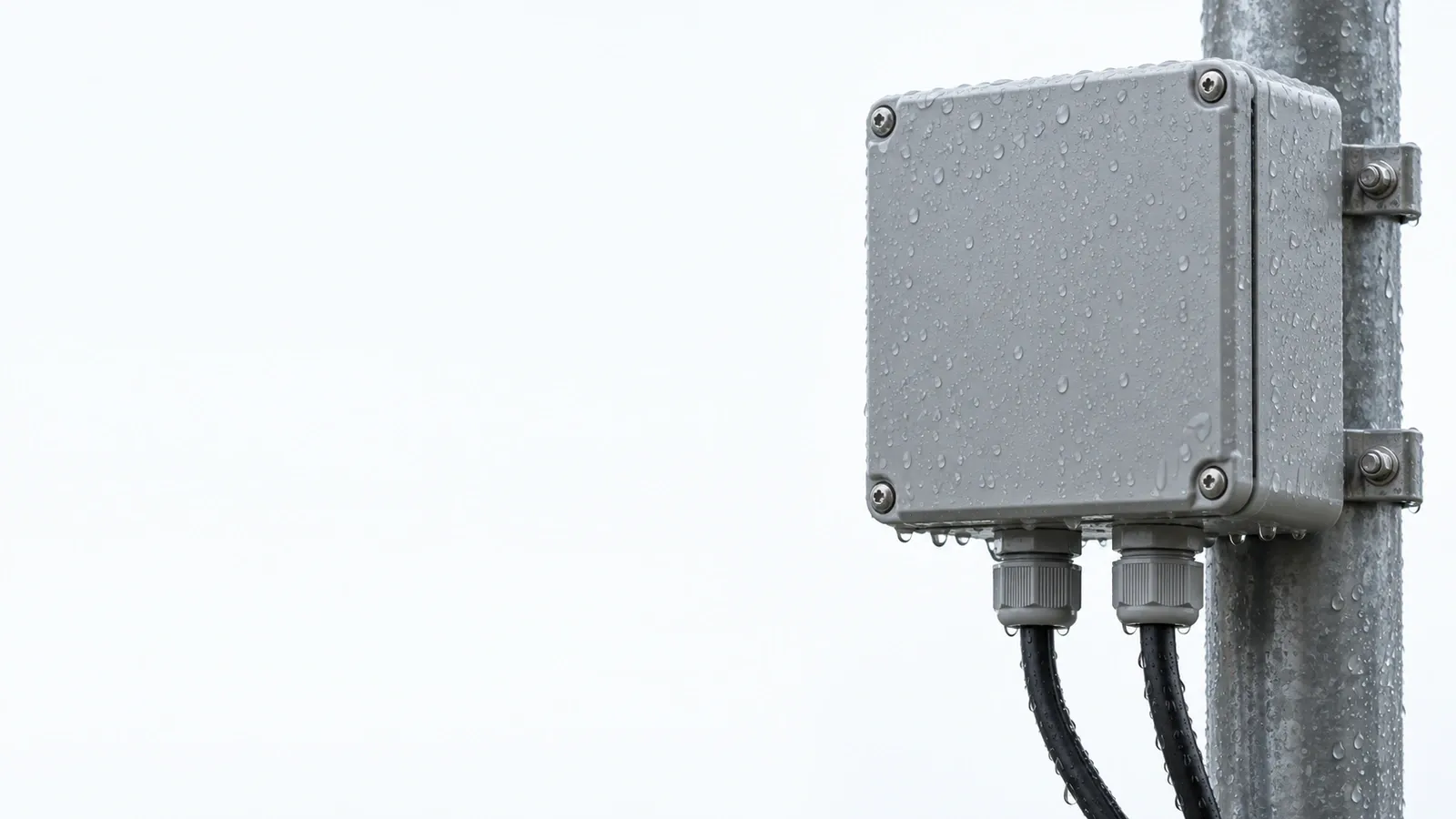
Quick specs: what belongs in the enclosure record?
Record the exact configuration before comparing protection labels; an empty shell and an installed box can have different sealing conditions.
Scroll horizontally to see all columns.
| Input or item | Typical value or source | Why it matters |
|---|---|---|
| Enclosure identity | Exact model, cover and manufacturer instructions | A family description cannot identify the installed assembly |
| Environmental claim | Exact NEMA Type and any separately declared IP code | Avoids treating two classification systems as interchangeable |
| Lid seal | Gasket part, seating surface and closure instructions | The cover needs continuous sealing contact |
| Cable entry | Gland/grommet part, cable-jacket diameter and permitted range | The seal must fit the cable as well as the enclosure opening |
| Product-specific tightening example | icotek KVT-ER cover-lid screws: maximum 2 Nm, per its public page accessed October 19, 2026 | This recommendation applies to those cover screws, not every gland or box |
How do NEMA enclosure Type and IP code differ?
NEMA Type includes environmental and construction considerations that an IP code alone does not establish. The NEMA enclosure FAQ, question 11 explicitly rejects equivalence between the systems.
An IP code separates access/solid-object protection from water protection. IEC’s public IEC 60529 listing identifies the applicable standard; detailed test clauses are unknown in the fetched public listing. Do not fill missing nozzle, pressure, duration or installation requirements from a retailer’s chart. The IP-rating evidence guide covers the wider task of reading a claim.
NEMA’s public Type summary is approved November 2005 and references NEMA 250-2003. The following is a screening comparison from that document, accessed October 19, 2026. Confirm the applicable standard edition in the project’s current enclosure documentation.
Scroll horizontally to see all columns.
| Published Type | Exposure addressed in the public summary | Dominant Failure Mode & Prevention |
|---|---|---|
| Type 3R | Rain, sleet, snow and falling dirt | Selecting a rain enclosure for hose exposure → document the actual cleaning exposure before selection |
| Type 4 | Includes windblown dust, splashing and hose-directed water | Water bypassing a field-added opening → verify fittings and installation conditions |
| Type 4X | Adds corrosion protection to the described water/dust scope | Treating corrosion protection as unlimited chemical resistance → obtain material compatibility for the site |
| Type 6 | Includes occasional temporary submersion at limited depth | Assuming unlimited immersion → obtain the exact permitted conditions |
Source: NEMA Enclosure Types. No IP-equivalence values are assigned here. A Type designation also does not identify who evaluated a product: NEMA’s FAQ distinguishes manufacturer declarations from independent certification.
Where can water bypass the wall and gasket?
The enclosure has separate sealing interfaces at the lid, the gland-to-wall joint and the cable-to-gland joint. Reviewing the lid alone leaves the cable entry unresolved.
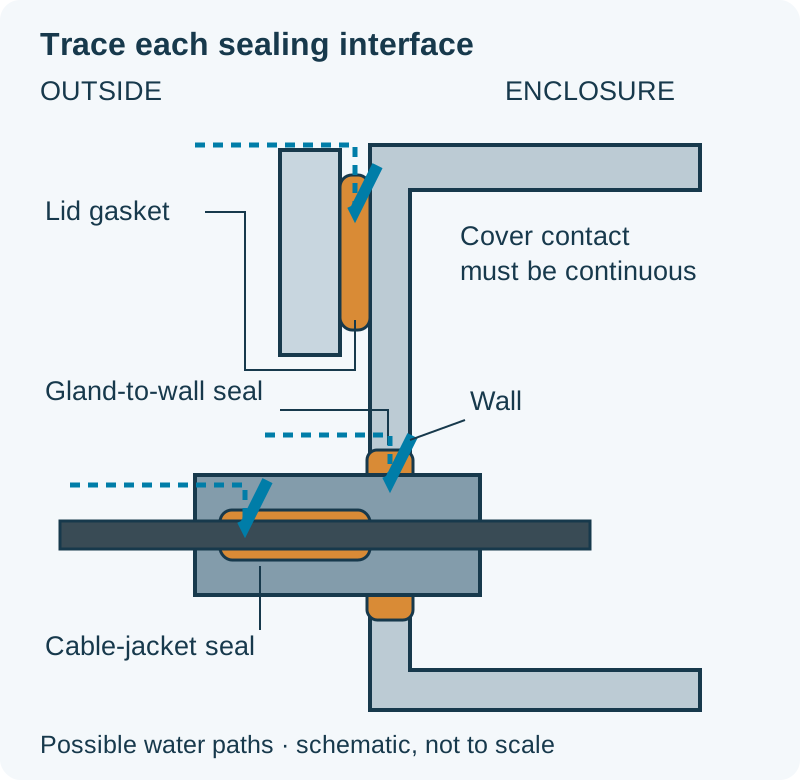
A pinched lid gasket, debris across the sealing face or a cover obstructed by internal wiring can interrupt contact. At a cable entry, the enclosure-wall seal and the cable-jacket seal perform different jobs. A locking nut by itself does not document either seal. Confirm the approved opening, wall fit, seals and cable restraint in the selected manufacturer’s instructions; no universal wall thickness is assumed.
A useful warning appears in icotek’s KVT-ER product page, accessed October 19, 2026: its IP66/IP68 statement depends on an injected gasket and single-hole grommets, while its UL Type 4X statement is for indoor use only. That conditional component claim cannot establish an outdoor Type 4X junction-box assembly. The public page does not establish an IP68 immersion depth or duration for the project; those conditions remain unknown pending the relevant documentation.
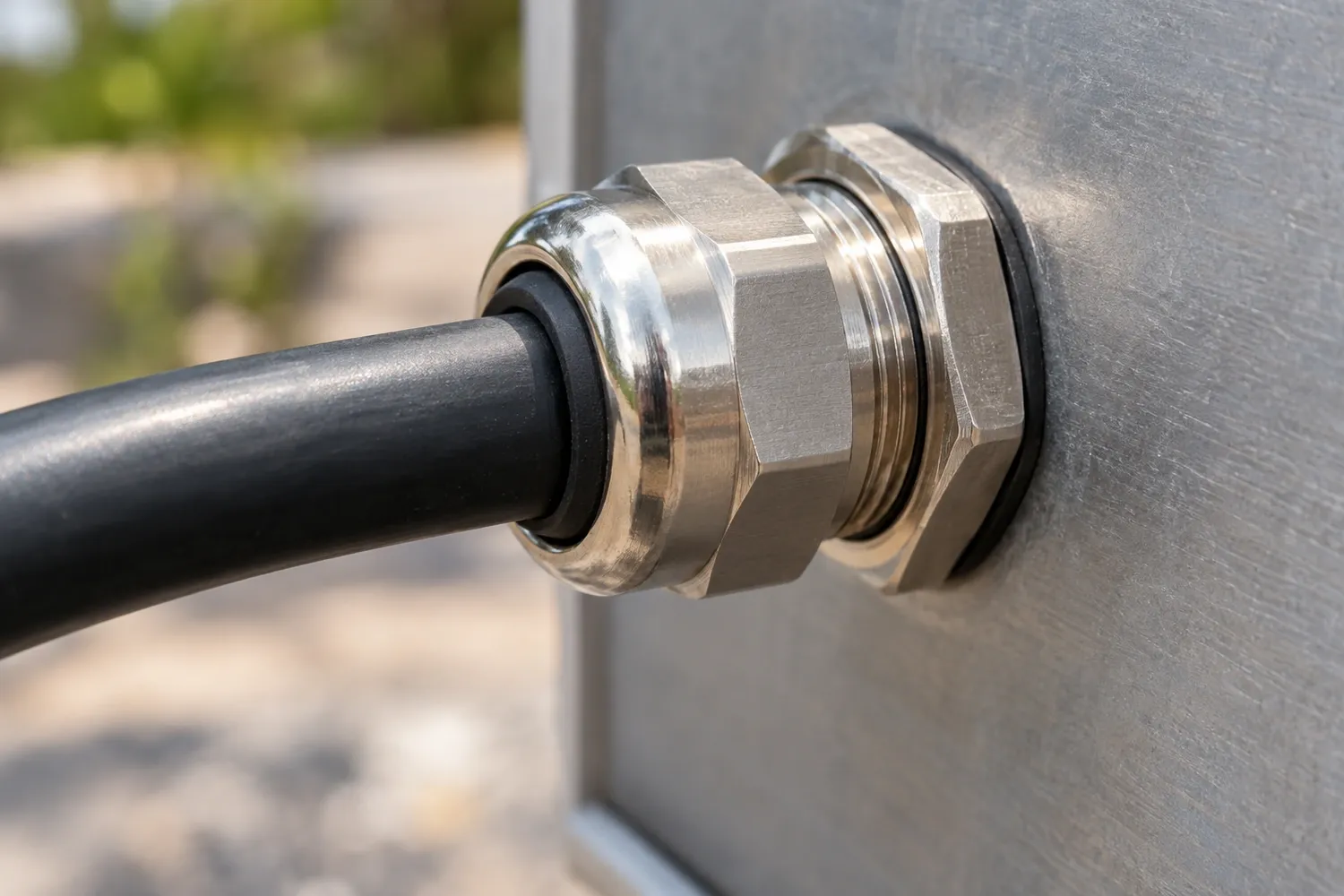
What physical check should stop a gland substitution?
An outside cable diameter beyond the selected seal’s documented range is a reason to change the component selection, not to increase tightening force.
Rules-of-Thumb — diameter boundary: if the cable-jacket diameter is below the specified minimum or above the maximum, reject that gland/grommet pairing. Being inside the range is a dimensional screen; it does not establish the assembly rating or account for an oval, damaged or incompatible jacket.
Use this explicit fit-margin formula, with all diameters in the same units:
m = min(d − d_min, d_max − d)
Here, d is the cable’s outside diameter and d_min/d_max are the selected seal’s documented bounds. A negative m means the diameter is outside the range; zero sits exactly at a boundary and requires the manufacturer’s tolerance guidance.
Worked example — illustrative inputs, not a product specification: assume a seal range of 8–9 mm and a cable diameter of 8.4 mm. Then m = min(8.4 − 8, 9 − 8.4) = 0.4 mm. This result measures distance to the nearest range boundary; it is not gasket squeeze, permissible cable movement or an ingress-test result. Replace every assumed input with the selected parts’ documentation and actual cable measurement.
What should the installer receive before the box is accepted?
Hand over an enclosure-and-entry record with unresolved conditions clearly identified. The cost of an unsuitable gland includes replacement, a return site visit and the time needed to reopen and reseal the enclosure; catalogue labels alone cannot price that work.
Scroll horizontally to see all columns.
| Record field | Evidence to retain | Decision it supports |
|---|---|---|
| Site exposure | Rain, dust, cleaning method, corrosion agents and possible flooding | Whether the declared scope covers the location |
| Shell and lid | Exact enclosure, gasket and closure instructions | Whether the cover configuration is documented |
| Every penetration | Gland, plug or accessory part; cable range; mounting conditions | Whether all water paths have compatible provisions |
| Assembly evidence | Type claim, any IP claim and supporting documentation | Whether component restrictions have been carried into selection |
| Handover | Installation record and owner of unresolved items | Whether the enclosure is ready for project acceptance review |
Keep installation and acceptance with the responsible electrical installer. Drilling an extra drain or mounting hole changes the configuration and needs the enclosure manufacturer’s approved provisions. For the broader equipment-protection reading path, return to the cases and protection hub.
Method and sources
This research-based guide compares the public NEMA FAQ and historical Type summary, IEC’s publication listing and icotek’s conditional cable-entry description, accessed October 19, 2026. The formula is a dimensional screening calculation with explicitly assumed example inputs. No whole-box rating, installation approval or water-test result is inferred from it. Full standard clauses and project-specific enclosure instructions that were not fetched remain unknown.
Updated October 2026.
Sources and versions
- NEMA FAQs: Enclosures , National Electrical Manufacturers Association Supports: Questions 5, 11 and 15: NEMA is not a certification body; IP and Type ratings are not equivalent; installed fittings constrain the assembly Type. Historical NEMA 250 context.
- NEMA Enclosure Types (approved November 2005) , National Electrical Manufacturers Association Supports: Public descriptions of Types 3R, 4, 4X and 6; IP-character meanings and limits. Historical summary, not a current full standard.
- IEC 60529:1989+AMD1:1999+AMD2:2013 CSV , International Electrotechnical Commission Supports: Official publication identity and scope for enclosure degrees of protection (IP Code); the public listing does not provide the full test clauses.
- KVT-ER split cable gland , icotek Supports: Injected gasket and single-hole-grommet conditions for IP66/IP68; UL Type 4X is indoor-only; maximum 2 Nm cover-lid screw recommendation.
Next steps
IP Ratings for Outdoor Equipment: How to Read Protection Claims
How to read an IP rating on outdoor equipment: the code structure, the cited standard, the tested configuration, and the questions to ask before deployment.