Equipment Planning for Displacement Camps: The Mosul Response, 2016–2017
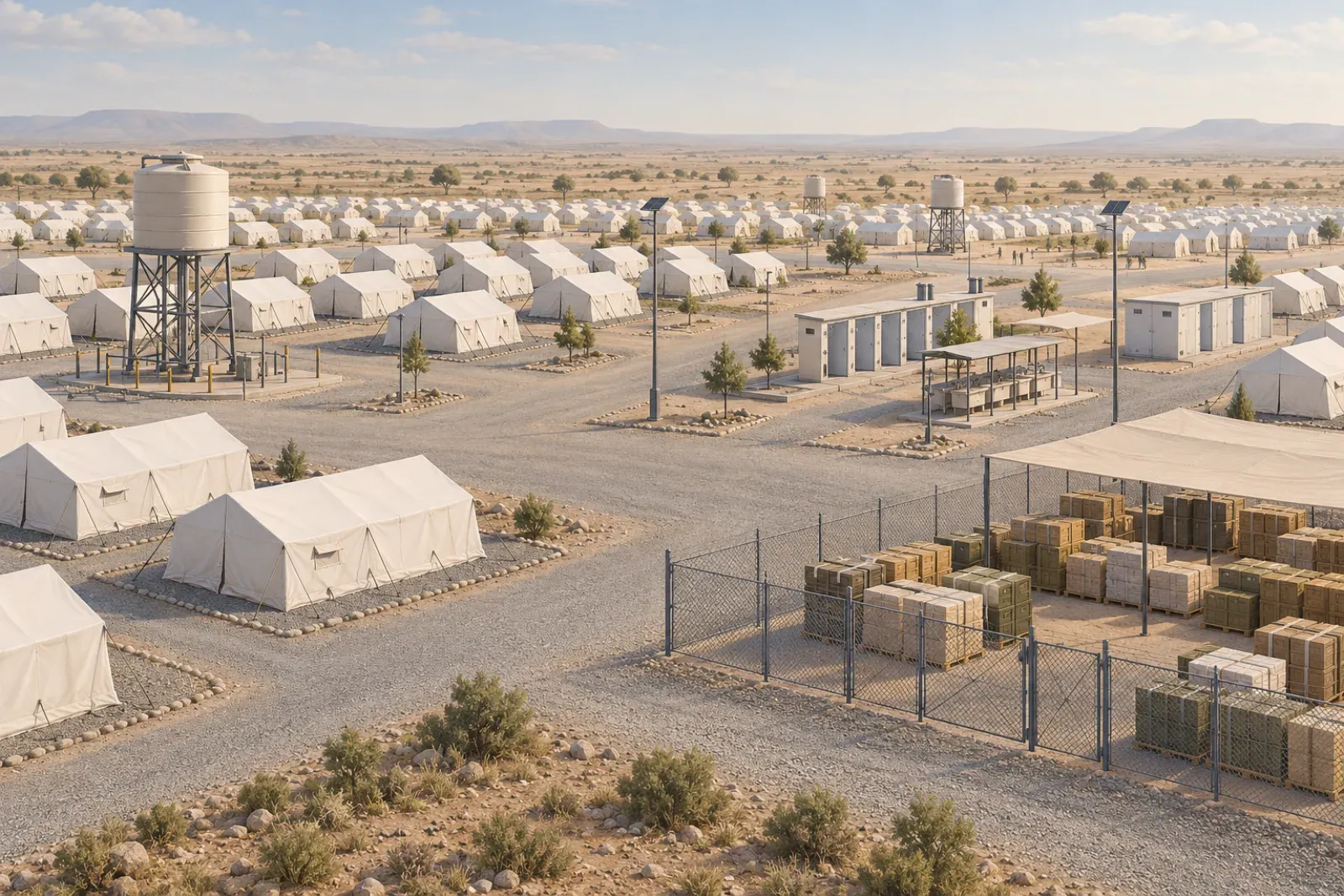
This case study uses the humanitarian camp response around Mosul, Iraq, to show what large temporary camps ask of equipment planning. It is part of the Camp & Site Equipment hub. Every figure comes from the OCHA or UNHCR pages linked beside it. Anything marked “For planners” is SavvySkull’s editorial analysis, not something the response reported. The specific equipment used in the response is not described here, and we do not claim to know it.
What the 2016-2017 response faced
OCHA describes the context as the campaign to retake Mosul from ISIL, which began on 17 October 2016. The end of the campaign was declared on 9 July 2017. Only the humanitarian camp side of that period is covered here.
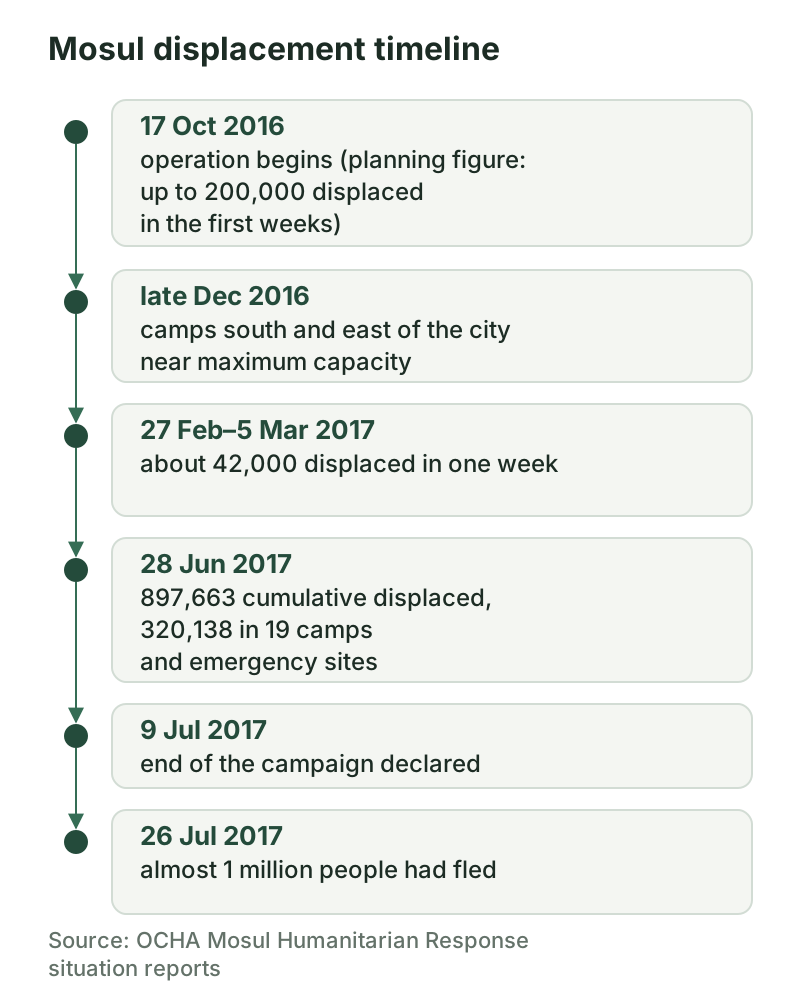
Planning started before the first day. OCHA’s first flash update said planning information indicated up to 200,000 people could be displaced in the first weeks, and that 27 camps and emergency sites had been confirmed by 16 October. Displaced people were to be transported to screening sites and then to designated camps and emergency sites.
Actual displacement went well beyond that. By 28 June 2017, cumulative displacement stood at 897,663. By 26 July, almost 1 million people had fled Mosul City and Ninewa Governorate, which OCHA said surpassed humanitarians’ “worst-case” estimates. The flash update explains that displacement information came from the Displacement Tracking Matrix (DTM), so these figures are tracking estimates, revised as the response went on, rather than exact counts.
Not everyone went to a camp. On 28 June 2017, 320,138 people were living in 19 camps and emergency sites, while 362,699 people, more than 53 per cent of the displaced, stayed with family and friends in host communities. OCHA noted that this strained already vulnerable communities.
Plan for capacity that changes week to week
Camp demand did not rise smoothly. In late December 2016, camps and emergency sites to the south and east of Mosul city were reaching maximum capacity. In the week of 27 February to 5 March 2017, about 42,000 people were displaced, the highest continuous displacement since 17 October 2016, with 13,350 on 3 March alone. In late June, the camps still had space for a further 37,412 people in 7,902 plots.
For planners, the plot is a useful unit of readiness. A plot that is graded, marked and connected to water and sanitation can take a family in hours. A plot that exists only on the plan cannot. Equipment lists that scale in plot-sized steps, with spare plots held in reserve and stock ordered against them, are easier to expand than lists written for one headcount. The same logic favors asking suppliers for staged deliveries and stating surge quantities in the RFQ, rather than a single order sized to the first planning figure.
Translate site standards into equipment
UNHCR’s Emergency Handbook publishes settlement planning standards. The page says it is under revision, so check the current version before using any number below.
- Space: 45 m² per person recommended, of which 30 m² covers shelter plots, roads, paths, education, sanitation and firebreaks, and 15 m² household gardens. Going below about 29 m² per person is strongly discouraged. Ideally no more than 20,000 people per settlement.
- Shelter: a covered living area of at least 3.5 m² per person, and 4.5 to 5.5 m² in cold climates and urban areas.
- Fire and spacing: a 30 m firebreak every 300 m, and at least 2 m between structures, ideally twice the structure height.
- Ground: gradient of 1 to 5 per cent, ideally 2 to 4 per cent.
- Sanitation: communal toilets at 1 per 50 persons in the emergency phase, within 50 m of shelters, and showers at 1 per 50 persons.
- Water: one tap stand per 500 persons, rising to one per 250 or fewer as the emergency stabilizes, with water at most 500 m from the household.
- Logistics: one distribution center per 5,000 persons, and 15 to 20 m² of storage per 100 persons.
UNHCR also sets out planning modules: a family of 4 to 6 persons, a community of 16 families (about 80), a block of 16 communities (about 1,250), a sector of 4 blocks (about 5,000), and a settlement of 4 sectors (up to 20,000).
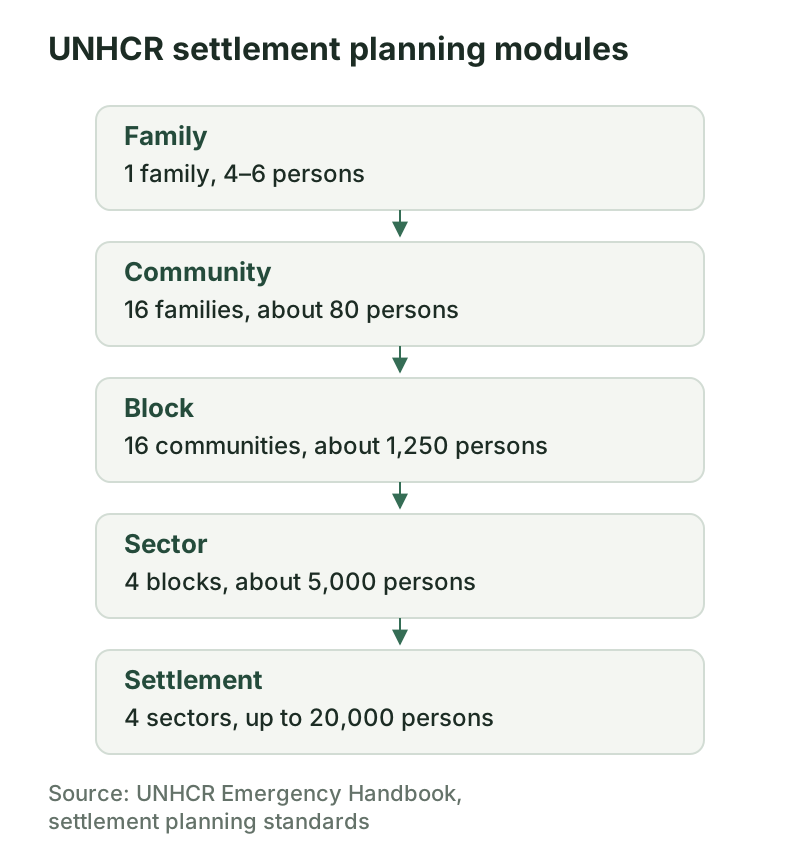
For planners, the modules work as a bill-of-materials unit. If a block of about 1,250 people needs a known number of toilets, tap stands and firebreak gaps, equipment quantities can be priced per block and multiplied, which is easier to audit than a single site-wide total. The ratios also work as an acceptance check: count what has been delivered per block and compare it with the ratio. Local authorities and agencies may set different figures, which take priority.
Plan for both seasons
The reports show a camp passing through both extremes. In the winter report, 1,654 families received essential household items to cope with winter weather, including carpets, blankets, stoves and heaters, and authorities coordinated delivery of 72,000 liters of kerosene to Qayarra Airstrip and Jad’ah camps.
By June 2017 the problem was heat. OCHA reported that meals were left in soaring temperatures for hours, until sunset, during the fasting period, and that water trucks were held up at checkpoints at a time of soaring temperatures.
For planners, three habits follow. Treat heaters and stoves as a system with their fuel, since a heater is only as useful as the delivery that keeps it supplied. Plan shade, water points and cold or covered food storage for summer before the season arrives. And check that the covered area and the heating or cooling plan agree, because UNHCR’s covered-area figure rises in cold climates. Power for pumps, lighting and charging belongs in the same conversation, and sizing a power supply starts from a load list.
Reception, distribution and servicing
OCHA’s reports describe reception as a flow. Displaced people moved first through screening, mostly Hammam al Alil in the March week, where food and water were distributed to everyone passing through. Those who then went to camps and emergency sites received a tented plot, basic household supplies, hygiene kits and 30-day food rations.
For planners, reception works best as its own small site with its own equipment list: shade, water, food handling and queuing space, sized for the busiest day rather than the average one. The reported 13,350 people on a single day shows that peak load, not the weekly mean, sets the requirement.
Water shows the cost of depending on one delivery method. By late June, OCHA reported that water trucking had been scaled down and that re-establishing a functioning city-wide network remained a key concern. By late July, water issues remained critical outside camps and in Mosul city.
For planners, a camp should know which water source each tap stand depends on, and what happens when that source slows. Equipment that needs servicing, such as pumps, tanks and lights, needs a named owner and a spare-parts plan from the start. The maintenance planning guide shows how to build that schedule from model manuals. To turn the needs into a campground-style inventory by function, use the campground equipment checklist.
A planning checklist for large temporary camps
The table links each planning input to a published figure or reported condition, and then to a question for planners. The questions are SavvySkull’s editorial analysis. They are not statements about equipment that was used in the response. Use the Checklists & Templates page for related templates.
| Planning input | Source figure or reported condition | Equipment question for planners |
|---|---|---|
| Capacity expansion | 37,412 spare places in 7,902 plots while camps neared capacity elsewhere | Which equipment is pre-positioned per spare plot, and which is ordered on demand? |
| Reception and screening | Food and water for everyone passing through the screening site | What shade, water and food-handling kit fits a peak day? |
| Standard household kit | Tented plot, household supplies, hygiene kits, 30-day food rations | What is in the kit, who counts it, and where is stock held? |
| Winter | Carpets, blankets, stoves, heaters; 72,000 liters of kerosene | Can fuel delivery keep up with every heater issued? |
| Summer heat | Meals left in soaring temperatures for hours | What shade, water and cold or covered storage is in place? |
| Water trucking vs. networks | Trucking scaled down; network a key concern | What tanks and tap stands cover a delivery gap? |
| Sanitation | 1 toilet and 1 shower per 50 persons; toilets within 50 m of shelters | How many units per block, and who services them? |
| Firebreaks and road lighting | 30 m firebreak every 300 m; at least 2 m between structures | Where do lights go along roads and breaks? (Editorial analysis; see work lights.) |
| Power for site services | No power figure is published in these sources | What loads need power, and what supply covers them? (Sizing.) |
| Storage | 15 to 20 m² per 100 persons; one distribution center per 5,000 | Is there enough covered storage for stock and spares? |
| Servicing and maintenance | Hostilities lasted nearly nine months and displaced almost one million people | Who services what, and with which spares? (Maintenance plan.) |
| Procurement | Displacement surpassed initial planning figures | Does the RFQ allow staged delivery and surge quantities? |
Limits of this analysis: it relies on published agency summaries, not site records, so it cannot say what worked or failed on any one site. Standards and local rules change, so confirm current figures before you buy.
Sources and versions
- OCHA Iraq Flash Update #1: Mosul humanitarian response , UN OCHA via ReliefWeb Supports: Planning figure of up to 200,000 displaced, 27 confirmed camps and emergency sites, screening-site flow, the DTM as the source of displacement information
- Iraq: Mosul Humanitarian Response Situation Report #14 , UN OCHA via ReliefWeb Supports: Camps near maximum capacity, winter household items for 1,654 families, 72,000 liters of kerosene delivered
- Iraq: Mosul Humanitarian Response Situation Report No. 23 , UN OCHA via ReliefWeb Supports: About 42,000 displaced in one week, standard arrival package, screening-site food and water
- Iraq: Mosul Humanitarian Response Situation Report No. 38 , UN OCHA via ReliefWeb Supports: Cumulative displacement, camp population and spare plots, host-community share, heat and meal handling, water trucking and network concerns
- Iraq: Mosul Humanitarian Response Situation Report No. 39 , UN OCHA via ReliefWeb Supports: End of the campaign declared on 9 July, displacement above planning figures, water trucks held at checkpoints in heat
- Iraq: Mosul Humanitarian Response Situation Report No. 40 , UN OCHA via ReliefWeb Supports: Almost 1 million people had fled, above worst-case estimates; water issues remained critical
- Site planning (camps), Emergency Handbook , UNHCR Supports: Settlement planning standards: space per person, firebreaks, gradient, sanitation, water, distribution, storage and planning modules
Next steps
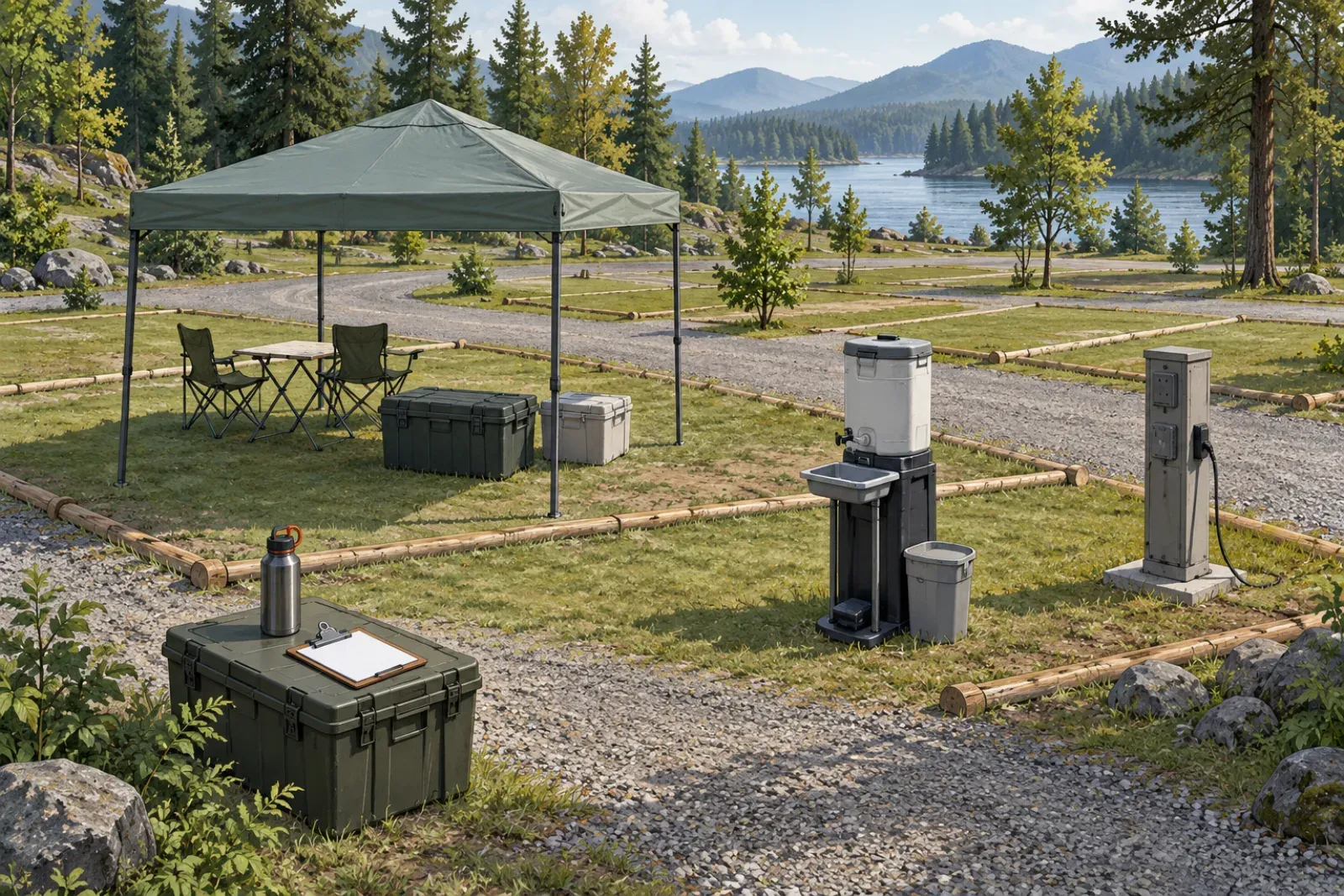
Campground Equipment Planning: Building a Procurement Checklist
Plan campground equipment by function: map zones and users, classify items as essential, optional or site-dependent, assign servicing, and build a procurement plan.

How to Write an RFQ for Outdoor Equipment
How to write a request for quotation for outdoor equipment: measurable requirements, documents, commercial terms and a response table that makes quotes comparable.
Outdoor Equipment Maintenance: Building a Practical Schedule
Build an outdoor equipment maintenance schedule from model manuals: equipment register, trigger types, task types, roles, records, and a downloadable template.
How to Size a Portable Power Station for Outdoor Work
Size a portable power station for outdoor work: list loads, check continuous and surge watts, estimate watt-hours with stated assumptions, and verify charging.