LiFePO4 vs Lithium Ion: Cycle Life & Field Safety
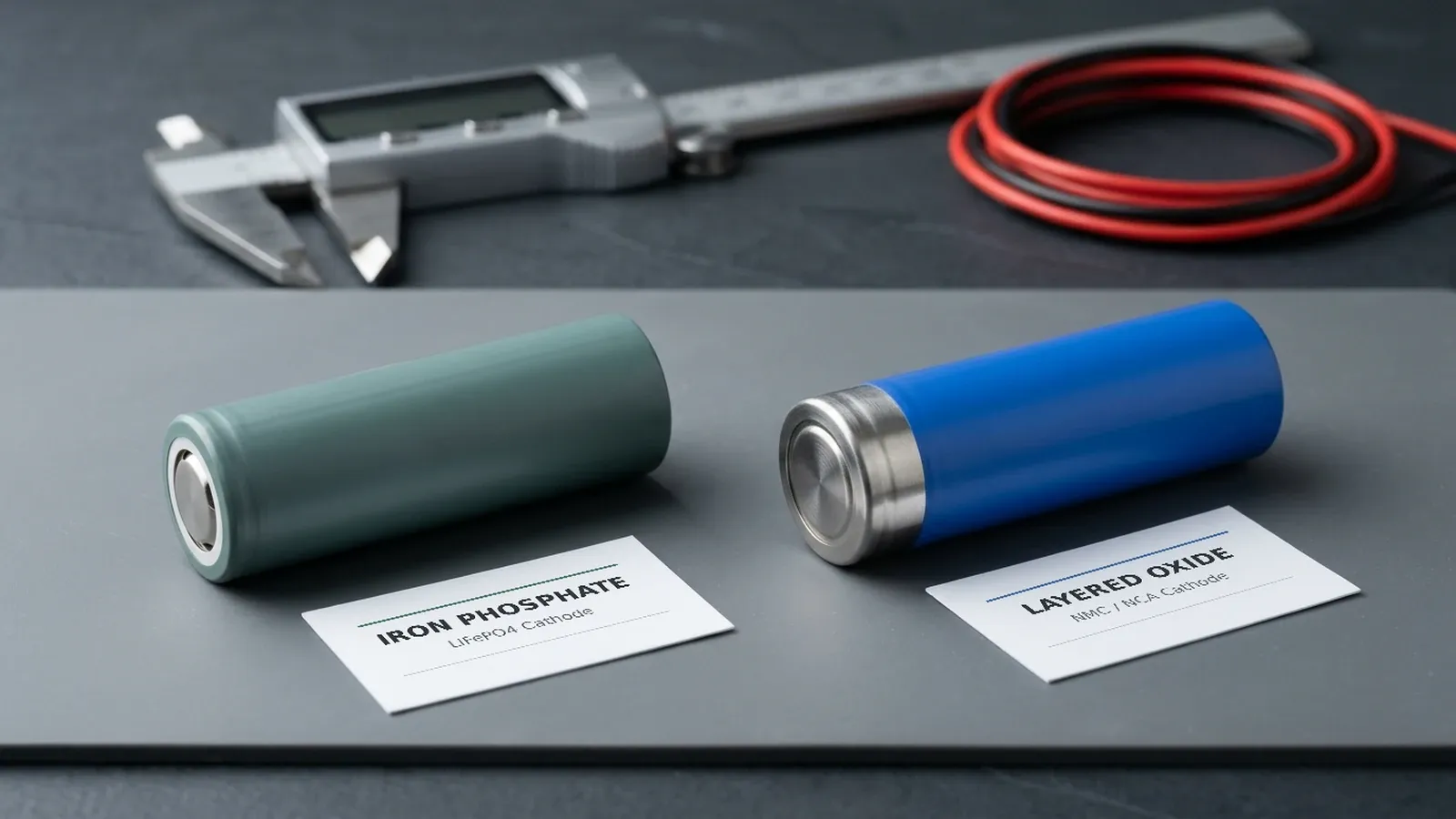
A lithium iron phosphate (LiFePO4 or LFP) battery is a type of lithium-ion battery that stores energy through reversible lithium-ion intercalation between a lithium iron phosphate cathode and a graphitic carbon anode on a metallic backing. Rechargeable lithium-ion varieties are categorized by their cathode material, so choosing lifepo4 vs lithium ion on a spec sheet actually compares LFP against layered-oxide cathodes such as nickel manganese cobalt oxide (NMC) and nickel cobalt aluminum oxide (NCA).
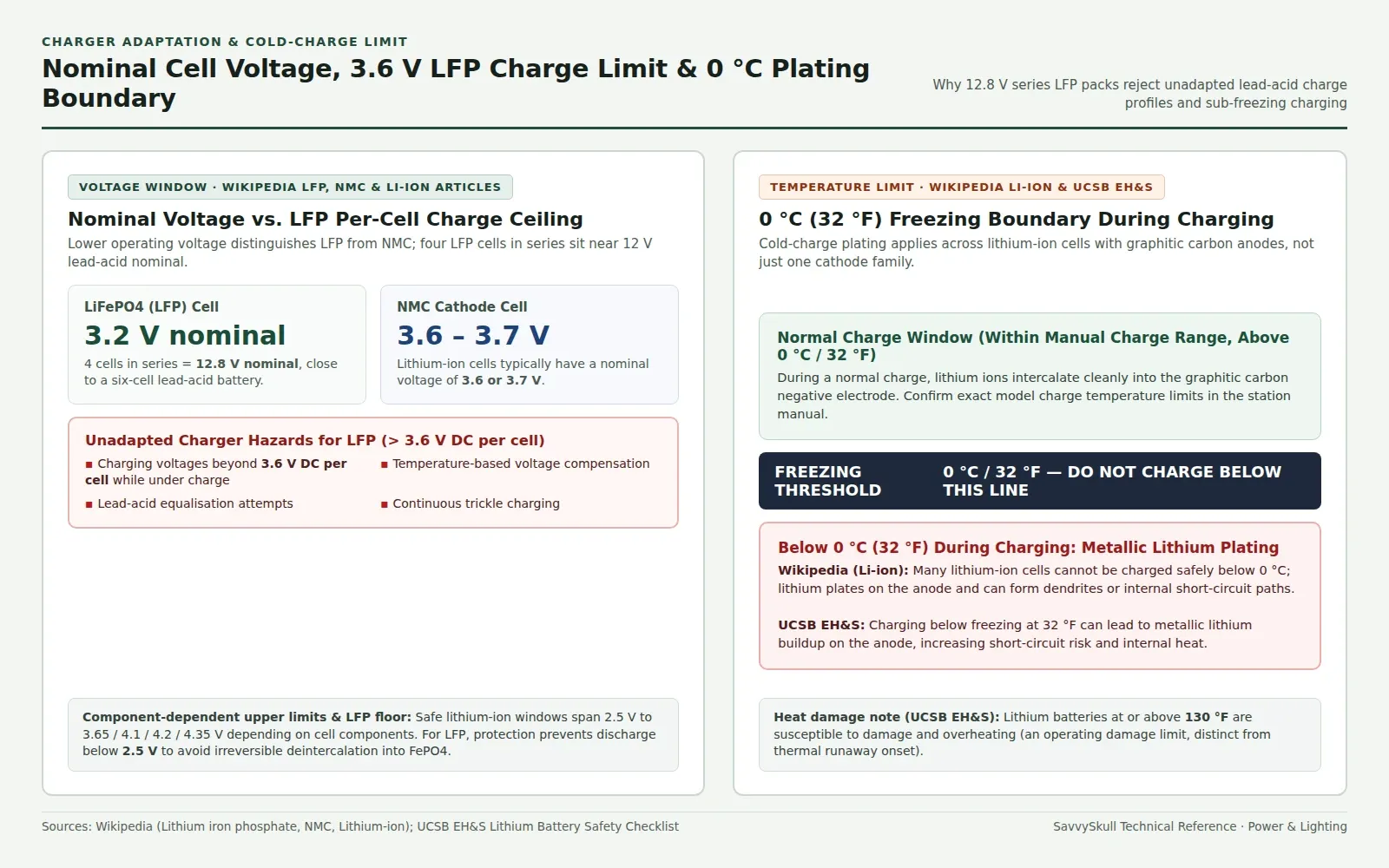
LFP cells have lower specific energy and a lower operating voltage than NMC and NCA cells. Wikipedia gives LFP a nominal 3.2 V output, whereas its lithium-ion article states that lithium-ion cells typically have a nominal voltage of 3.6 or 3.7 V, and its NMC article gives 3.6–3.7 V as the cell voltage for NMC cathodes. Four 3.2 V LFP cells in series reach a nominal 12.8 V, close to six-cell lead-acid batteries, yet an unadapted charger can damage LFP cells through voltages beyond 3.6 V DC per cell while under charge, temperature-based voltage compensation, equalisation attempts, or continuous trickle charging. Many types of lithium-ion cells also cannot be charged safely below 0 °C because lithium can plate on the anode and create internal short-circuit paths.
Because of low cost, high safety, low toxicity, and long cycle life, LFP batteries serve in vehicles, utility-scale stationary storage, and backup power, while NCA is a high-energy lithium-ion chemistry used in electric vehicle batteries and LFP, lithium manganese oxide, and NMC may offer longer life and a higher discharge rate. Within the Power & Lighting hub, pair this chemistry comparison with the portable power station sizing guide for daily watt-hour calculations and the cold-weather portable power station guide for model-specific winter operating tables.
Scroll horizontally to see all columns.
| Comparison point | LiFePO4 (LFP) cathode | NMC and NCA layered-oxide cathodes | Source and operating qualification |
|---|---|---|---|
| Cathode family within lithium-ion | Lithium iron phosphate polyanion cathode with graphitic carbon anode | Nickel manganese cobalt oxide (NMC) or nickel cobalt aluminum oxide (NCA) | Wikipedia LFP, Lithium-ion, NMC, and NCA articles |
| Nominal cell voltage | 3.2 V nominal (12.8 V for four cells in series) | 3.6–3.7 V cell voltage for NMC; lithium-ion cells typically 3.6 or 3.7 V | Wikipedia LFP, NMC, and Lithium-ion articles |
| Cycle-life ranges | Infobox: 2,500 to >9,000 cycles; text: >3,000 under most conditions and >10,000 under optimal conditions | NMC text: about 1,000 to 2,300 cycles depending on conditions | Wikipedia LFP article; Sandia notes cycle count to 80% capacity varies with conditions |
| Gravimetric energy (Wikipedia) | Infobox: 95–172 W⋅h/kg (340–620 kJ/kg); volumetric 227–396 W⋅h/L | Body text: lower specific energy than NMC and NCA; the infobox gives no NMC or NCA Wh/kg | Wikipedia LFP article |
| Gravimetric energy (Savannah River slide) | 90 – 120 Wh/kg on the LFP bullet | 150 – 220 Wh/kg on the NMC bullet; 200 – 260 Wh/kg on the NCA bullet | SRNS-TR-2023-00604 attachment slide |
| Thermal-runaway slide threshold | 518°F (270°C) on the LFP slide bullet | 410°F (210°C) on the NMC bullet; 302°F (150°C) on the NCA bullet | SRNS-TR-2023-00604 slide; report body notes state of charge affects onset temperature |
| Cold-charge anode limit | Subject to lithium-ion anode plating rules below freezing | Subject to lithium-ion anode plating rules below freezing | Wikipedia Li-ion (below 0 °C) and UCSB EH&S (below 32°F) |
Which Battery Is Better for Field and Backup Power, LiFePO4 or Lithium-Ion?
Neither cathode chemistry wins every deployment: LFP fits repeated cycling and stationary backup power, whereas NMC and NCA trade cycle count for higher specific energy when pack mass is constrained. Replacing a lithium cobalt oxide positive electrode with a lithium metal phosphate such as LFP improves cycle counts, shelf life, and safety while lowering capacity.
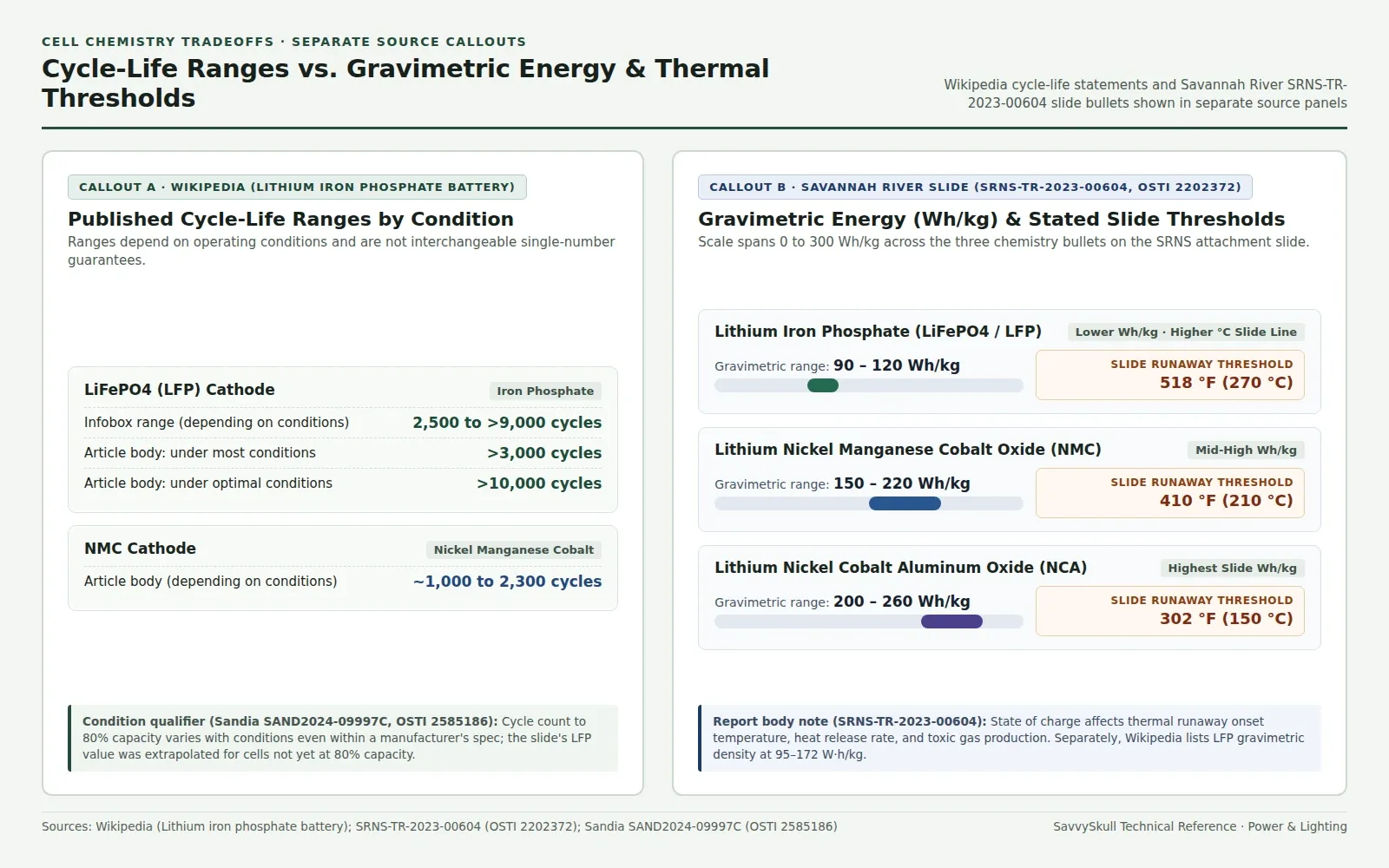
Published cycle counts span wide intervals because cell degradation shifts with operating depth, charge rate, and temperature. On Wikipedia’s LFP page, the article text states that LFP offers a considerably longer cycle life than other lithium-ion chemistries, supporting more than 3,000 cycles under most conditions and more than 10,000 cycles under optimal conditions, while NMC batteries support about 1,000 to 2,300 cycles depending on conditions. On the same Wikipedia LFP page, the specification infobox lists cycle life from 2,500 to more than 9,000 cycles depending on conditions. Wikipedia also cites a 2024 study in the Journal of The Electrochemical Society showing that operating LFP cells at lower average states of charge mitigates capacity degradation from lithium inventory loss and iron dissolution, extending lifespan in stationary grid storage.
Government laboratory records add important qualifiers to headline cycle claims. In Sandia National Laboratories presentation SAND2024-09997C, prepared for the U.S. Department of Energy’s National Nuclear Security Administration under contract DE-NA0003525, the degradation slide notes that cycle count to 80% capacity varies with conditions even within a manufacturer’s specification, and that the LFP cycle figure on that slide was extrapolated because those LFP cells had not yet reached 80% capacity. That same Sandia slide notes that LFP and NMC exhibit an inverse dependence on temperature without naming a universal winner across hot environments. When your priority is calculating how many watt-hours a shift needs before choosing a pack, work through the load table in the portable power station sizing guide.
What Are the Disadvantages of LiFePO4 Batteries in Weight and Cold Weather?
Evaluating lifepo4 battery pros and cons starts with three practical limitations: lower specific energy than NMC and NCA, cold-charge lithium plating shared across graphite-anode lithium-ion cells, and a flat voltage curve that masks state of charge.
Published energy-density ranges differ by reference document and stay separate. Wikipedia’s LFP infobox lists a gravimetric energy density of 95–172 W⋅h/kg (340–620 kJ/kg) and a volumetric energy density of 227–396 W⋅h/L (820–1,430 kJ/L). Separately, the attachment slides in the Savannah River fire-protection report SRNS-TR-2023-00604 list gravimetric ranges of 90 – 120 Wh/kg for Lithium Iron Phosphate (LiFePO4 or LFP), 150 – 220 Wh/kg for Lithium Nickel Manganese Cobalt Oxide (NMC), and 200 – 260 Wh/kg for Lithium Nickel Cobalt Aluminum Oxide (NCA or Li-aluminum). An NREL-affiliated thermal-front manuscript notes that LFP cells show lower specific energy, and NASA Glenn’s evaluation of A123 M1 26650 cells notes excellent recharge rate capability, with specific energy and energy density lower than typical lithium-ion cell chemistries.
At the active-material level, cathode specific capacity is distinct from whole-pack energy density. Arumugam Manthiram and John B. Goodenough identified the polyanion class of lithium-ion cathode materials, and Padhi et al. identified LiFePO4 in that class in 1996, where Wikipedia notes market acceptance driven by low cost, non-toxicity, natural abundance of iron, thermal stability, safety characteristics, and a specific capacity of 170 mA·h/g (610 C/g), while noting that intrinsically low electrical conductivity was the main obstacle to commercialization. Separately, Wikipedia’s NCA article notes that NCA capacity is higher than lithium cobalt oxide (LiCoO2) at 148 mAh/g, lithium iron phosphate (LiFePO4) at 165 mAh/g, and NMC 333 (LiNi0.33Mn0.33Co0.33O2) at 170 mAh/g.
Cold-weather charging limits apply across graphite-anode lithium-ion chemistries rather than acting as an LFP-only quirk. During a normal battery charge, lithium ions intercalate into graphite, whereas charging too fast or at too low a temperature causes lithium metal to plate on the negative electrode, forming dendrites that can penetrate the separator, internally short-circuit the cell, and cause high electric current, heating, and ignition. Wikipedia notes that many types of lithium-ion cells cannot be charged safely below 0 °C because anode lithium plating can create internal short-circuit paths, and the UCSB Environmental Health and Safety lithium-battery checklist states that temperatures below freezing at 32°F during charging can lead to metallic lithium plating on the anode, increasing short-circuit risk and internal heat. An NREL fast-charge paper adds that addressing Li-plating is crucial because it depletes usable lithium and causes deterioration and safety issues, and Sandia’s SAND2024-09997C deck notes increased caution around cells that potentially experienced Li plating. In NASA Glenn’s A123 M1 26650 evaluation, one procedural footnote recorded that the tested cell would not charge at a 10C rate at −20 °C. Check unit-specific winter discharge, charge, and recovery limits in the cold-weather portable power station guide.
In day-to-day meter checks, LFP cells also exhibit an exceptionally flat open-circuit voltage (OCV) plateau between roughly 20% and 80% state of charge, keeping cell voltage nearly constant across most of the working range and making simple voltage readings a poor fuel gauge.
What Happens If You Charge a LiFePO4 Battery With a Regular Charger?
Connecting a four-cell LFP battery to an unadapted lead-acid or higher-voltage lithium-ion charger risks overvoltage stress because nominal pack voltage hides sharp per-cell ceiling differences. Because a single LFP cell has a nominal 3.2 V output, four cells connected in series produce a nominal 12.8 V, which comes close to the nominal voltage of six-cell lead-acid batteries.
Wikipedia notes that charging systems for LFP packs need to be adapted so they do not damage LFP cells through excessive charging voltages beyond 3.6 volts DC per cell while under charge, temperature-based voltage compensation, equalisation attempts, or continuous trickle charging. At the bottom of the cycle, a protection system also has to prevent any LFP cell from discharging below 2.5 V, or severe damage will occur in most instances due to irreversible deintercalation of LiFePO4 into FePO4. Across the broader lithium-ion family, Wikipedia notes that cells are susceptible to stress outside safe voltage ranges between 2.5 V and 3.65, 4.1, 4.2, or 4.35 V depending on cell components, so a charger built for a 4.1 V or 4.2 V layered-oxide cell exceeds the LFP ceiling.
Laboratory cell evaluations document their own specific test windows separately from general pack protection rules. In NASA Glenn’s report on A123 M1 26650 lithium iron phosphate cells for an advanced Lunar surface space suit application, the cell nameplate table lists 3.3 volts under Nominal Voltage (C/2) and a voltage range of 3.6 to 2 volts, with a footnote stating that higher voltages can be attained at the sacrifice of cycle life. In that specific NASA Glenn test procedure, the cell was charged to 3.6 V with voltage held to a taper limit of C/50 and discharged at C/2 to 2.0 V at the charge temperature.
How Do LiFePO4 and Lithium-Ion Compare on Thermal Stability and Fire Risk?
LiFePO4 offers thermal and chemical stability over other lithium-ion chemistries, yet an LFP battery can still catch fire under extreme conditions from overcharging issues, very high thermal temperatures, or catastrophic physical damage. Compared with layered-oxide cathode materials such as lithium cobalt oxide (LiCoO2) and NMC, which release oxygen upon heating, Wikipedia notes that LFP generally has higher decomposition temperatures. Volts.ca likewise notes that the iron-phosphate bond is stronger and more stable than the oxide bonds used in NMC or NCA, translating to safer operation and longer service life.
Wikipedia notes that in a stable active condition the LFP chemical composition does not combust when exposed to normal ambient air and is less prone to causing a fire, while also stating that LFP batteries can still catch fire under extreme conditions from overcharging issues, very high thermal temperatures, or catastrophic physical damage. UCSB Environmental Health and Safety explains that lithium-ion batteries can overheat, catch fire, and explode due to thermal runaway, which occurs when a cell enters an uncontrollable, self-heating state, and Wikipedia notes that overheated or overcharged Li-ion batteries may suffer thermal runaway and cell rupture.
Published temperature numbers describe distinct events and test conditions:
- Ambient heat damage limit: UCSB Environmental Health and Safety states that lithium batteries at or above 130°F are susceptible to damage and overheating.
- Savannah River attachment-slide thresholds: SRNS-TR-2023-00604 states in its report body that state of charge affects thermal runaway onset temperature, heat release rate, and toxic gas production, while its attachment slide lists stated Thermal Runaway Threshold lines of 518°F (270°C) on the LFP bullet, 410°F (210°C) on the NMC bullet, 302°F (150°C) on the NCA bullet, and 302°F (150°C) on the separate LCO bullet.
- Peak runaway reaction temperature: Wikipedia states that during thermal runaway, internal degradation and oxidization processes can keep cell temperatures above 500 °C, with the possibility of igniting secondary combustibles and causing leakage, explosion, or fire in extreme cases.
Calorimetry records also highlight remaining testing gaps on aged iron-phosphate cells. Using an LCO/graphite cell example, Sandia’s SAND2024-09997C presentation separates self-heating onset temperature from thermal runaway onset temperature, prints a note of little LFP data on its calorimetry summary, lists LFP cathodes among study gaps, and observes that while batteries can last a long time and degrade in different ways, testing is not complete on how their safety profiles change over time. For fire and vehicle test frameworks, Wikipedia notes that batteries are tested according to the UL 9540A fire standard, and the Savannah River slide lists UL 2580 for batteries used in electric vehicles.
How Does LiFePO4 vs Lithium-Ion Charging Voltage Differ?
Per-cell voltage separates iron-phosphate packs from layered-oxide packs at every stage of charger selection. Wikipedia gives LFP a lower operating voltage than other lithium-ion types at a nominal 3.2 V per cell (12.8 V across four series cells), gives 3.6–3.7 V as the cell voltage for NMC cathodes, and states that lithium-ion cells typically have a nominal voltage of 3.6 or 3.7 volts.
Separately, NASA Glenn’s nameplate table for the A123 M1 26650 LFP cell lists 3.3 volts under Nominal Voltage (C/2) and a range of 3.6 to 2 volts.
Upper charge ceilings depend on cell components rather than following one universal lithium number. Wikipedia lists safe lithium-ion operating limits between 2.5 V and 3.65, 4.1, 4.2, or 4.35 V depending on cell components, and notes that unadapted chargers can damage LFP cells when charging voltages move beyond 3.6 V DC per cell while under charge. Separately, NASA Glenn’s A123 M1 26650 evaluation procedure charged that cell to 3.6 V with a voltage hold to a C/50 taper limit.
Scroll horizontally to see all columns.
| Voltage parameter | Published figure | Source document and scope |
|---|---|---|
| LFP nominal cell and four-cell series voltage | 3.2 V per cell; 12.8 V for four cells in series | Wikipedia, Lithium iron phosphate battery |
| NMC cathode cell voltage | 3.6–3.7 V | Wikipedia, Lithium nickel manganese cobalt oxides |
| Typical lithium-ion nominal voltage | Typically 3.6 or 3.7 V | Wikipedia, Lithium-ion battery |
| A123 M1 26650 LFP nameplate voltage | 3.3 volts under Nominal Voltage (C/2); 3.6 to 2 volts (higher voltages sacrifice cycle life) | NASA Glenn A123 M1 26650 cell evaluation |
| LFP charger adaptation ceiling | Avoid voltages beyond 3.6 V DC per cell while under charge, temperature compensation, equalisation, or trickle charge | Wikipedia, Lithium iron phosphate battery |
| Component-dependent Li-ion window | Between 2.5 V and 3.65 / 4.1 / 4.2 or 4.35 V depending on cell components | Wikipedia, Lithium-ion battery |
| LFP low-voltage protection floor | 2.5 V minimum per cell against irreversible deintercalation of LiFePO4 into FePO4 | Wikipedia, Lithium iron phosphate battery |
| A123 M1 26650 test procedure floor | Charged to 3.6 V (C/50 taper) and discharged at C/2 to 2.0 V at charge temperature | NASA Glenn A123 M1 26650 cell evaluation |
How Does LiFePO4 vs Lithium-Ion Weight Affect Portable Gear Transport?
Lower specific energy means an LFP cell assembly carries more mass for the same stored energy than an NMC or NCA assembly. Wikipedia’s LFP infobox lists gravimetric energy density at 95–172 W⋅h/kg (340–620 kJ/kg) and volumetric energy density at 227–396 W⋅h/L (820–1,430 kJ/L). On a separate attachment slide, the Savannah River fire-protection report lists 90 – 120 Wh/kg for LFP, 150 – 220 Wh/kg for NMC, and 200 – 260 Wh/kg for NCA.
That mass tradeoff directly shapes human-carried field equipment. NASA Glenn evaluated the A123 M1 26650 LFP cell for an advanced Lunar surface space suit application that an astronaut carries, noting that while the cells showed excellent recharge rate capability, their specific energy and energy density were lower than typical lithium-ion cell chemistries. On outdoor worksites and staging benches, stationary backup units and vehicle-carried power stations can take advantage of LFP cycle life and thermal stability, whereas a kit carried on foot by one person makes specific energy a primary selection constraint alongside the watt-hour totals from the portable power station sizing guide.
Field Cell-Chemistry Intake Check
Record each equipment parameter from the unit housing label and operator manual before pairing a charger or assigning a carry crew, and keep the sheet with your Power & Lighting hub staging records.
Scroll horizontally to see all columns.
| Check item | Where to read it | Operational check before dispatch |
|---|---|---|
| Cathode chemistry named on label | Pack housing nameplate or manual specification table | Identify LiFePO4 (LFP), NMC, NCA, or another named lithium-ion cathode |
| Nominal pack and cell voltage | Specification table in the unit manual | Distinguish 3.2 V per-cell (12.8 V four-cell series) LFP packs from 3.6–3.7 V NMC cells |
| Charge voltage ceiling | Charger output label and battery manual | Verify LFP systems stay at or below 3.6 V DC per cell while under charge, with no temperature-based voltage compensation, equalisation, or continuous trickle |
| Charger chemistry profile match | Charger manual and mode selector | Confirm the charger is dedicated or adapted to the exact cell chemistry on the label |
| Minimum charge temperature | Manual charging temperature row and local thermometer | Do not charge below 0 °C (32°F), because charging there can plate metallic lithium on the anode; check model winter rules |
| Discharge cutoff and carry assignment | Protection system cutoff row and crew transport plan | Confirm 2.5 V per-cell LFP protection cutoff and assign one-person carry versus cart or vehicle |
Frequently Asked Questions
Is LiFePO4 a lithium-ion battery?
Yes. Wikipedia defines a lithium iron phosphate (LiFePO4 or LFP) battery as a type of lithium-ion battery that uses lithium iron phosphate as the cathode material and a graphitic carbon electrode with a metallic backing as the anode, within the broader lithium-ion family categorized by cathode materials.
Can a LiFePO4 battery catch fire?
Yes. Although Wikipedia notes that LFP has higher decomposition temperatures than layered oxides such as LiCoO2 and NMC and does not combust in normal ambient air when in a stable active condition, LFP batteries can still catch fire under extreme conditions including overcharging issues, very high thermal temperatures, or catastrophic physical damage.
Why can lead-acid chargers damage a 12.8 V LiFePO4 battery?
Four 3.2 V LFP cells in series sit at a nominal 12.8 V, close to a six-cell lead-acid battery, yet Wikipedia notes that unadapted charging systems can damage LFP cells through charging voltages beyond 3.6 V DC per cell, temperature-based voltage compensation, equalisation attempts, or continuous trickle charging.
Why is charging lithium-ion batteries below 0 °C (32°F) unsafe?
Wikipedia states that many types of lithium-ion cells cannot be charged safely below 0 °C because lithium plates on the anode and can form dendrites and internal short-circuit paths, and UCSB Environmental Health and Safety notes that charging below freezing at 32°F can cause metallic lithium buildup on the anode that increases short-circuit risk and internal heat.
Sources and versions
- Lithium iron phosphate battery , Wikipedia Supports: LiFePO4 cathode and graphitic carbon anode definition, 3.2 V nominal and 12.8 V four-cell series voltage, 3.6 V DC per-cell charge adaptation rule, 2.5 V discharge protection floor, cycle-life ranges, energy density ranges, flat open-circuit voltage (OCV) plateau between roughly 20% and 80% SOC, and decomposition stability.
- Lithium-ion battery , Wikipedia Supports: Reversible lithium-ion intercalation, categorization by cathode material, typical 3.6 or 3.7 V nominal voltage, safe voltage windows by cell components, graphite intercalation and anode lithium plating below 0 °C, UL 9540A fire testing, and thermal runaway temperatures above 500 °C.
- Lithium nickel manganese cobalt oxides , Wikipedia Supports: Cell voltage of 3.6 to 3.7 V for lithium-ion batteries using NMC cathodes.
- Lithium nickel cobalt aluminium oxides , Wikipedia Supports: Cathode specific capacity comparison contrasting NCA against LiCoO2 at 148 mAh/g, LiFePO4 at 165 mAh/g, and NMC 333 at 170 mAh/g.
- Savannah River Fire Protection Report SRNS-TR-2023-00604 , Savannah River Nuclear Solutions / U.S. Department of Energy OSTI Supports: State-of-charge influence on thermal runaway onset temperature, heat release rate, and toxic gas production; attachment slide Wh/kg ranges and stated thermal runaway thresholds for LFP, NMC, NCA, and LCO; and UL 2580 electric vehicle battery standard reference.
- Thermal-Front Propagation Manuscript , NREL-Affiliated Public Access Manuscript / U.S. Department of Energy OSTI Supports: LFP cells show lower specific energy.
- Fast-Charge Lithium-Plating Paper , National Renewable Energy Laboratory / U.S. Department of Energy OSTI Supports: Lithium plating during fast charging depletes usable lithium and causes cell deterioration and safety issues.
- SAND2024-09997C Battery Degradation and Safety Presentation , Sandia National Laboratories / U.S. Department of Energy OSTI Supports: Condition-dependent cycle count to 80% capacity within manufacturer specifications, extrapolated LFP cycle value, inverse temperature dependence between LFP and NMC, self-heating versus thermal runaway onset definitions, and limited LFP calorimetry data.
- Lithium Iron Phosphate Cell Performance Evaluations , NASA Glenn Research Center Supports: Evaluation of A123 M1 26650 lithium iron phosphate cells for a Lunar surface space suit application, lower specific energy and energy density with excellent recharge rate capability, 3.3 V at C/2 nameplate and 3.6 V to 2 V range, 3.6 V charge and 2.0 V C/2 discharge procedure, and 10C at -20 °C non-charge test note.
- Lithium-Ion Battery Fires: What You Need to Know , UCSB Environmental Health and Safety Supports: Thermal runaway self-heating definition, susceptibility to damage and overheating at or above 130 °F, and metallic lithium plating on the anode when charging below freezing at 32 °F.
Next steps

Portable Power & Lighting
Work out how much portable power and light an outdoor site needs, then compare options and put the requirement into a purchase request.
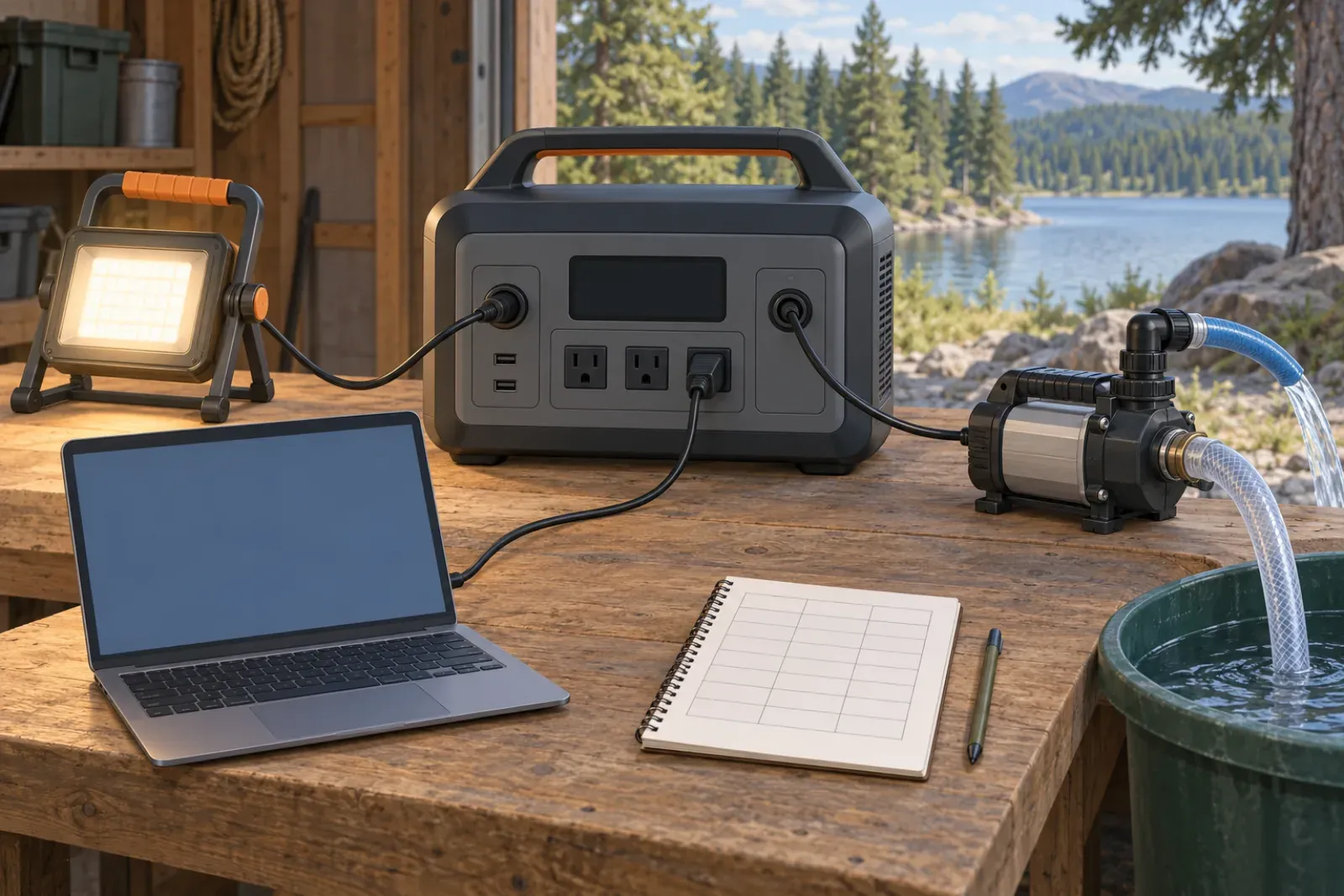
How to Size a Portable Power Station for Outdoor Work
Size a portable power station for outdoor work: list loads, check continuous and surge watts, estimate watt-hours from the hours and the loss and reserve you write down, and verify charging.
Portable Power Stations Below −15°C: A Winter Shift and Charging Plan
Plan a winter shift below −15°C using three model manuals: separate discharge, charging, storage and cold-protection recovery, then record each handover.