Portable Power Station for Camping: Overnight Load Worksheet, 12V Fridge Draw, and Solar Recharging
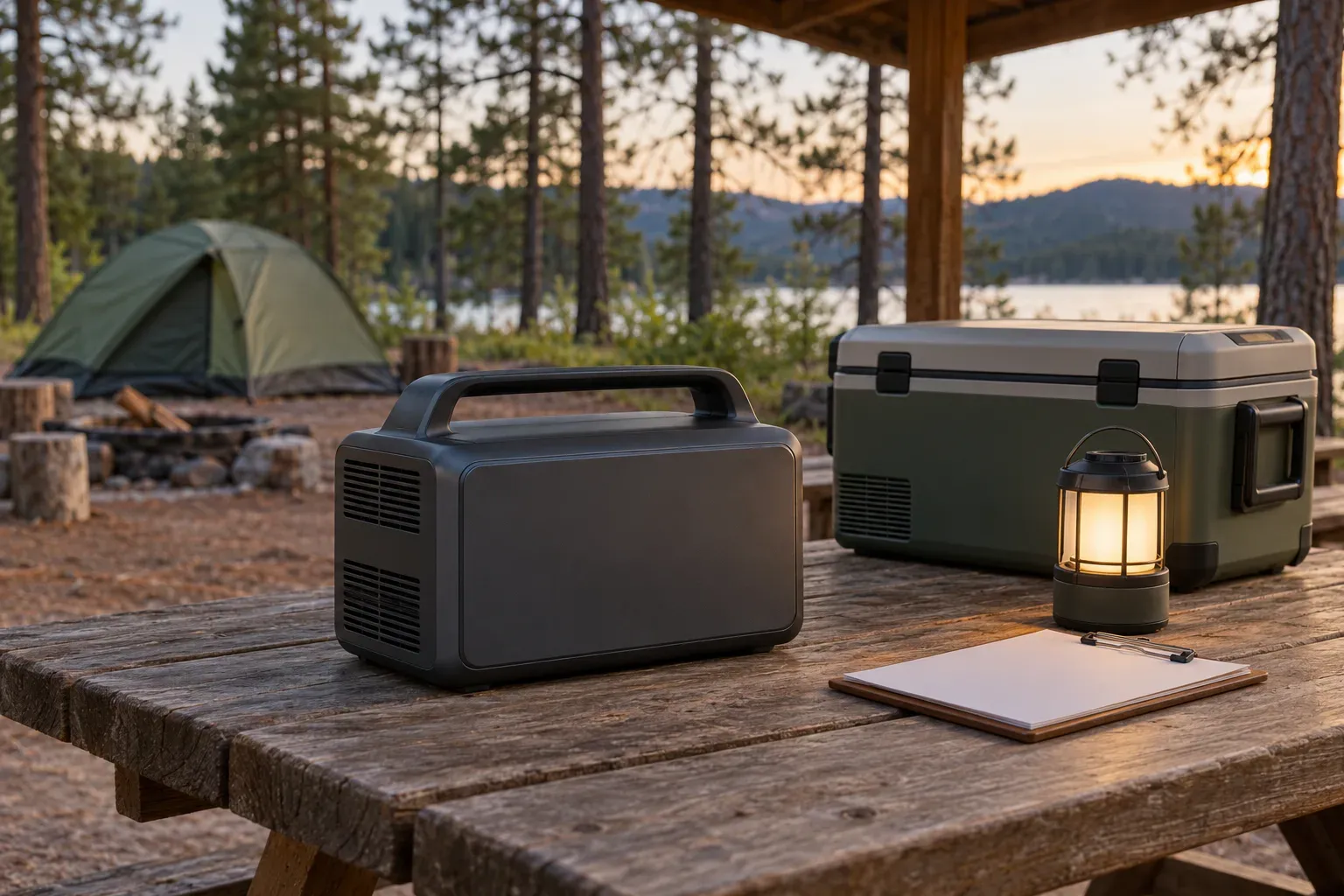
A portable power station for camping needs enough usable energy for the whole night and the right outputs for every device. Start with the loads below, then choose capacity, carrying weight and a recharge method that fit the trip.
Scroll horizontally to see all columns.
| Overnight load | Record before choosing a station | Check separately |
|---|---|---|
| 12V compressor fridge | Ambient temperature, setpoint, cooldown and measured overnight Wh | DC port rating, cable and compressor startup |
| CPAP | Exact model, prescribed settings, tubing, humidifier and adapter | Approved supply route and backup arrangement |
| Lighting | Brightness mode, quantity and hours actually used | Charging route or continuous external supply |
| Phone and communications | Device, charging sessions and overnight operating schedule | USB profile, adapter and overlapping loads |
Use the Power & Lighting guides to plan the wider kit. For this overnight record, keep energy used, power required at one moment, and energy restored tomorrow as separate checks.
Build an overnight load worksheet
Give each device its own row, including the cable or adapter it will use. An all-night connection does not necessarily mean an all-night constant load: a fridge cycles, and a phone’s charging demand changes.
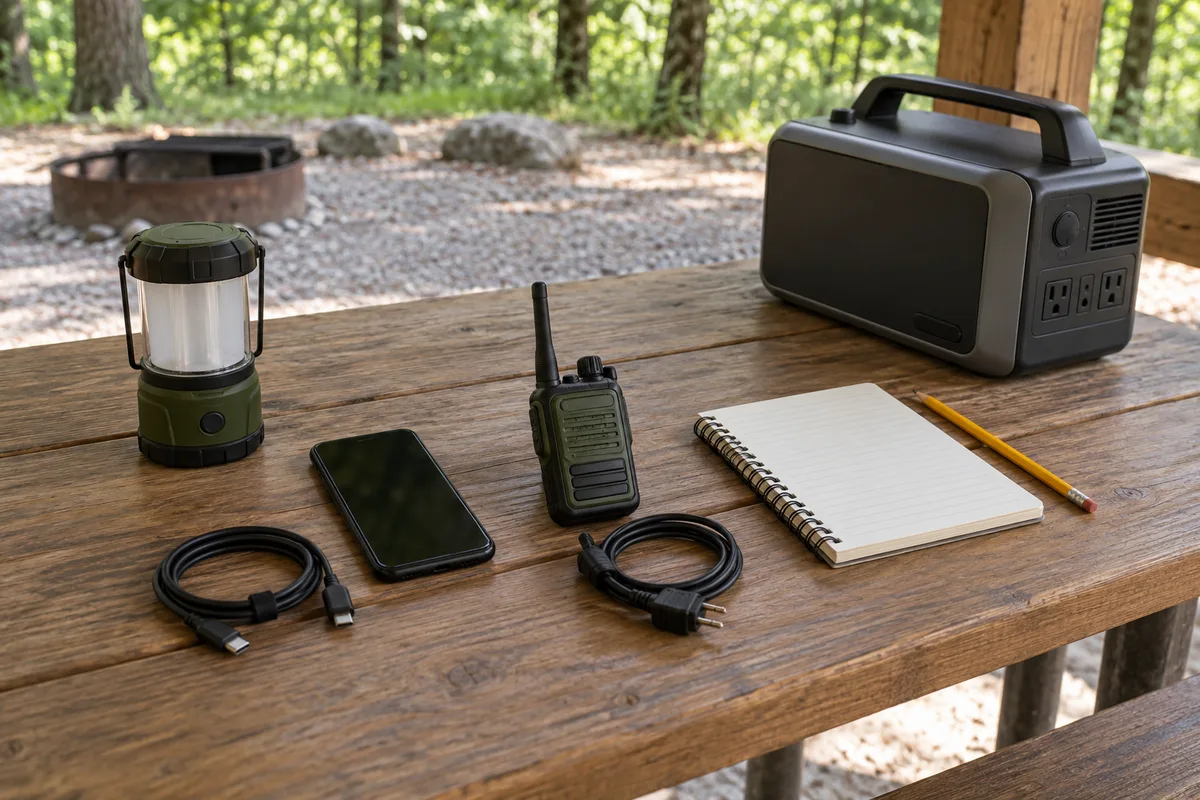
Download the overnight load worksheet, or start with this compact record. The CSV adds startup demand, voltage, connector, measurement location and essential-load priority.
Scroll horizontally to see all columns.
| Device and quantity | Port / adapter | Setting and conditions | Connected / operating hours | Measured Wh |
|---|---|---|---|---|
| Fridge | ||||
| CPAP | ||||
| Lighting | ||||
| Phone / radio | ||||
| Other load |
The U.S. Energy Information Administration’s Measuring electricity distinguishes power from energy. For a constant load, energy (Wh) = power (W) × operating time (h). For changing loads, use measured average power over the same interval or a meter’s accumulated Wh.
Write where each reading was taken: at the device, at the station’s output, or from a documented battery-energy measurement. A device-side reading leaves upstream conversion and station overhead to account for. Bring the rows to a consistent measurement point before summing them, then use the power station capacity-sizing method to account for losses and reserve. A watt-hour meter must suit the voltage, current and connector of the circuit being measured.
Measure a 12V fridge through its cycles
Use average consumption across the planned night to estimate fridge energy. Keep maximum input current for checking electrical compatibility. Dometic’s How do I calculate how much power a CFX3 will draw? makes this distinction and ties consumption figures to ambient and internal temperatures.
For an overnight measurement, record the fridge model, setpoint, ambient conditions, contents and lid openings. Include initial cooldown if the power station will supply it. A run beginning with an already-cold fridge answers a different planning question from cooling a warm load after arrival.
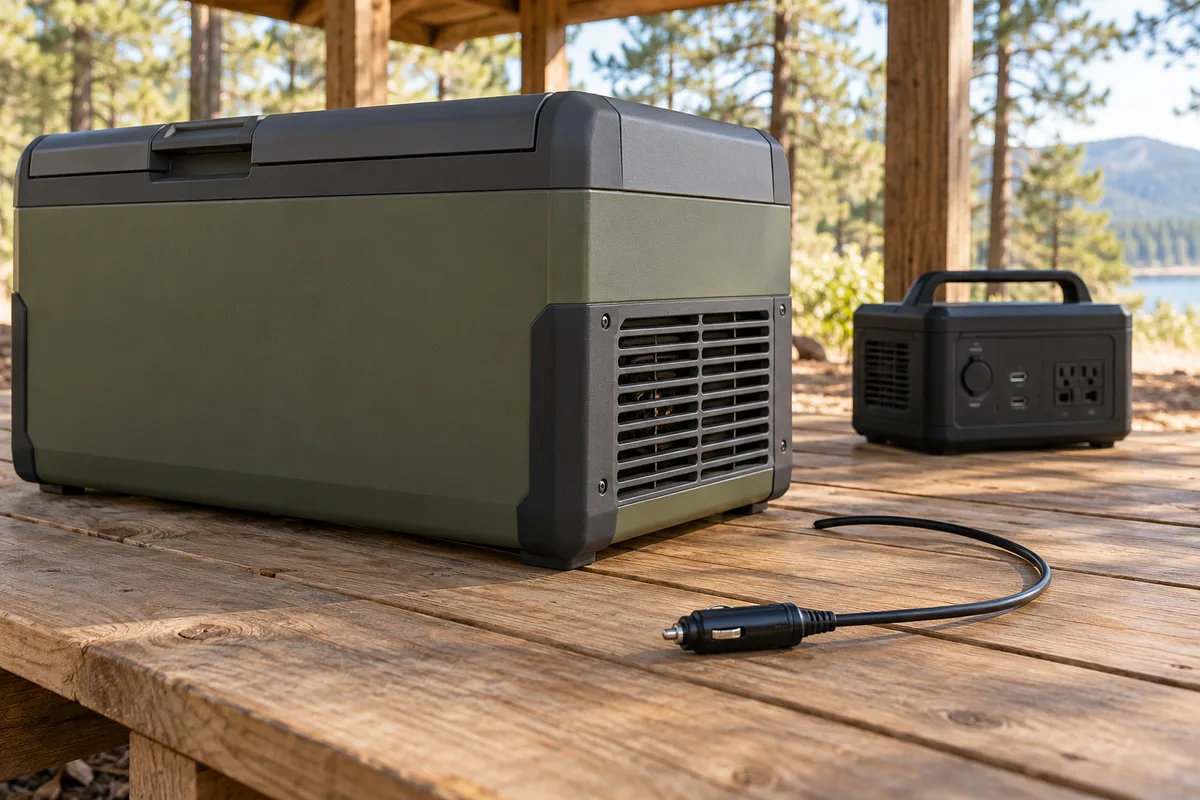
If you record compressor on-time, the duty fraction is d = on-time ÷ observed time. With measured on and off power, calculate:
Overnight Wh = [Pon × d + Poff × (1 − d)] × hours
Both power readings use watts; the duty fraction has no unit. The off-state term accounts for power consumed while the compressor is idle. If your meter already gives total overnight Wh, use that total directly. Applying duty cycle again would undercount energy.
Next check the fridge’s input voltage, maximum current and startup requirement against the specific station port and cable. A satisfactory energy total cannot establish whether the compressor will start.
Match CPAP energy to the actual setup
Keep the CPAP model, pressure, tubing, humidification and approved power adapter together in the worksheet. ResMed’s Battery Guide, edition 198103/7 (2018-08), shows how much the configuration can change the supply requirement.
Its page 7 converter tables list the following for AirSense 10 CPAP, Elite, AutoSet and AutoSet for Her at 10 cm H₂O, using the appropriate ResMed DC-to-DC converter:
Scroll horizontally to see all columns.
| Listed configuration | Current at 12V supply | Derived energy over 8 hours |
|---|---|---|
| SlimLine tubing | 0.93 A | About 89 Wh |
| SlimLine tubing and humidifier at setting 4 | 2.30 A | About 221 Wh |
The second row gives 12 V × 2.30 A × 8 h = 220.8 Wh, rounded to 221 Wh. These energy figures apply at the table’s 12V supply point. Account for the power station’s delivery losses and reserve when choosing its rated capacity. The guide’s separate battery-size column already includes a 50% safety margin.
Use the instructions for your exact machine and approved adapter. Size around the therapy setup you use; discuss treatment or comfort-setting changes with your care provider. Arrange a backup power plan with your equipment provider, and check both manufacturers’ medical-use restrictions before the trip.
Check ports and overnight shutoff
Check every output individually, then check the loads that overlap. A large AC rating does not increase the current available from a smaller DC socket.
The EcoFlow DELTA 2 User Manual provides a useful exact-model example:
Scroll horizontally to see all columns.
| DELTA 2 output | Manual limit |
|---|---|
| Car outlet | 12.6 V, 10 A, 126 W maximum |
| DC5521 output | 12.6 V, 3 A, 38 W maximum per port |
A compatible DC route can avoid an AC conversion stage, but adapters and the station still consume energy. To compare AC and DC, keep the device settings, duration and measurement location the same, and account for station overhead. Record the chosen route beside the load total.
Sleep settings deserve their own check. The DELTA 2 manual warns that intermittent refrigerator loads can trigger AC timeout; for continuous refrigeration of valuable contents, it directs the user to set that interval to never and regularly check battery level. Check the equivalent output-timeout behavior on your station and confirm that the load stays powered through its idle periods before departure.
Match a solar panel to the power station
Choose a solar panel to charge a power station by its electrical characteristics and the station’s input limits. The panel’s wattage is only one part of compatibility.
Scroll horizontally to see all columns.
| Check | What to compare |
|---|---|
| Voltage | Panel operating voltage and worst-case cold open-circuit voltage against the permitted input range |
| Current | Panel/array current and the station’s specified input-current conditions |
| Power | Panel/array rating and the station’s maximum solar input |
| Connection | Exact connector, polarity and approved cable/adapter |
| Conditions | Station charging temperature, placement and environmental instructions |
For example, the DELTA 2 manual specifies 11–60 V, 15 A maximum and 500 W maximum solar input. Separately, the EcoFlow 110W Lightweight Portable Solar Panel User Manual lists these values for model EF-FOLD-110-LW:
Scroll horizontally to see all columns.
| Panel parameter | Manual value |
|---|---|
| Rated power under standard test conditions (STC) | 110 W |
| Open-circuit voltage, Voc, under STC | 23.5 V |
| Short-circuit current, Isc, under STC | 6.1 A |
| Voc temperature coefficient | −0.25%/°C |
The negative voltage coefficient means colder cells can raise Voc. Check the complete proposed panel arrangement against the input limits at the expected cold condition, using the manufacturers’ design instructions. Keep battery charging temperature as a separate check; the cold-weather charging guide explains the model-specific operating and recovery conditions.
Plan tomorrow’s solar recovery
Budget recovered energy over the available charging window. A panel’s rated watts multiplied by sunrise-to-sunset hours will overstate recovery whenever the panel cannot hold that rated output.
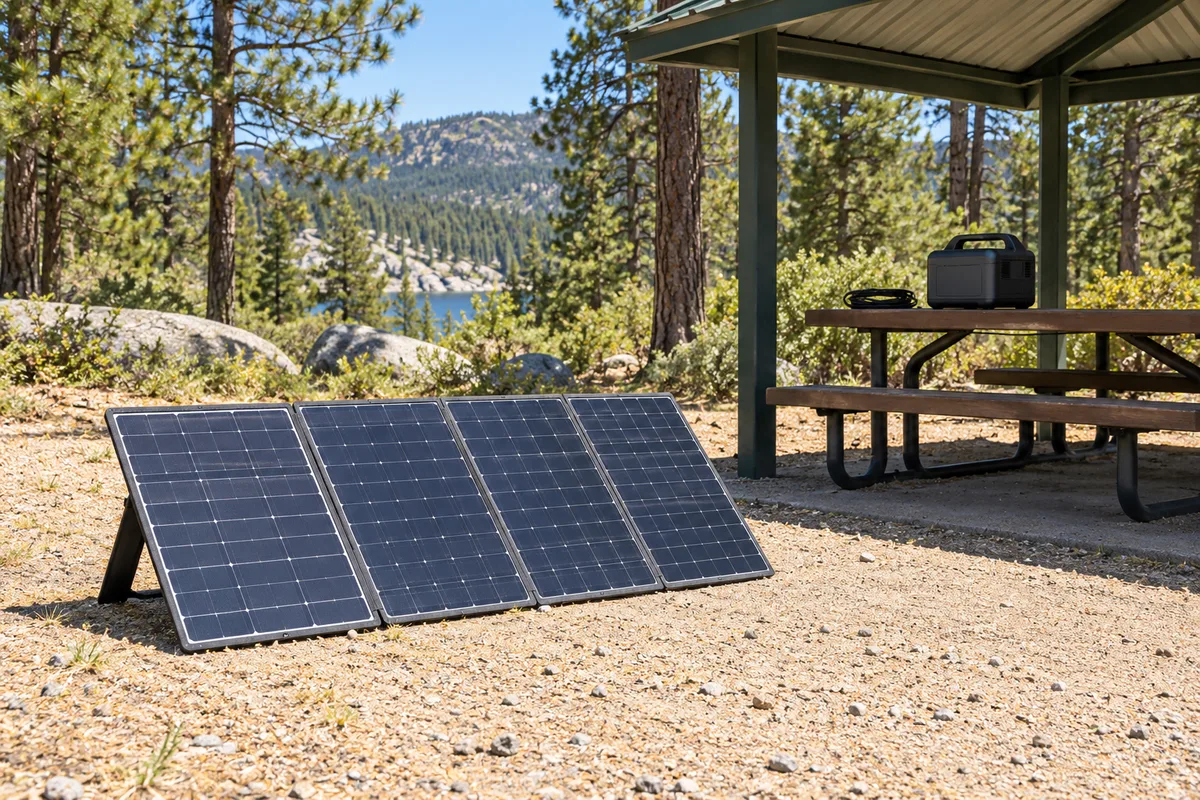
The national laboratory presentation Technology Tips for Solar + Storage REAP Application Reviews distinguishes instantaneous sunlight intensity from accumulated daily solar energy. A planning relationship is:
Estimated gross solar Wh = panel rated W × equivalent full-sun hours
Use full-sun hours appropriate to the location, season and panel orientation. Then account for shading, conversion losses and charging limits. The 110W panel manual defines its STC rating at 1,000 W/m² irradiance and 25°C cell temperature; campsite output changes with sunlight, angle, shading and temperature.
For the next-night decision, use the recharge and readiness log. Record the actual charging window, energy accepted, measurement location and daytime loads. If the station reports only instantaneous input watts, that reading alone does not give the day’s Wh.
At a consistent battery-energy measurement point, the balance is energy at dusk = energy at dawn + energy stored during charging − daytime energy used. If your charge figure is measured upstream of the battery, account for charging losses first. If it already reports net battery gain, avoid subtracting daytime use twice. Compare dusk energy with the coming night’s requirement and reserve; retain a practical wall-charge, replacement-battery or other approved supply option when recovery falls short.
Choose a small camping or RV power station
The best portable power station for camping is the one that meets the completed load record, travels comfortably and can be replenished on the trip. A small portable power station makes sense when its usable energy, output limits and reserve all cover the planned equipment.
Use this order when comparing candidates:
- Confirm each connection. Match voltage, connector, adapter, startup demand and any shared-port limits.
- Check the overnight total. Include the actual fridge conditions, CPAP configuration, lighting and communications schedule.
- Allow for the chosen route and reserve. Compare energy at the same measurement point, then translate it into required capacity.
- Check unattended behavior. Verify timeout settings and establish battery checks and backup arrangements for essential loads.
- Plan replenishment and carrying. Check charging access, panel compatibility, weather fallback, unit weight and space for cables.
For RV trips, apply this worksheet to individual portable loads such as a cooler, CPAP and chargers. Supplying the RV’s installed electrical system requires a separate assessment of the inlet, wiring and power equipment. Decide which arrangement you need before choosing by an RV label.
Keep the completed worksheets with the kit and repeat the measurement when devices or operating conditions change. Both CSVs are also available through Resources and checklists.
Downloads
- Camping overnight load worksheet (CSV) CSV Record device settings, output routes, startup demand, operating times and measured energy.
- Camping recharge and readiness log (CSV) CSV Record solar input checks, energy recovered, next-night needs and fallback arrangements.
Sources and versions
- Measuring electricity , U.S. Energy Information Administration Supports: Power in watts and energy over time in watt-hours.
- How do I calculate how much power a CFX3 will draw? , Dometic Supports: Average consumption versus maximum input current, with ambient and internal temperature conditions.
- Battery Guide 198103/7, 2018-08, pp. 6–7 , ResMed Supports: AirSense 10 converter-table currents, tubing and humidification configurations, eight-hour basis and battery-sizing margin.
- DELTA 2 User Manual, output/input specifications and AC timeout instructions , EcoFlow Supports: Car and DC5521 port limits, solar input limits, refrigerator timeout behavior and medical-equipment restrictions.
- 110W Lightweight Portable Solar Panel User Manual, model EF-FOLD-110-LW , EcoFlow Supports: STC power, open-circuit voltage, short-circuit current, voltage temperature coefficient and real-output conditions.
- Technology Tips for Solar + Storage REAP Application Reviews, 2024, slides 6 and 14 , National Renewable Energy Laboratory Supports: Irradiance, daily irradiation and estimating gross photovoltaic energy from rated power and solar resource.
Next steps
How to Size a Portable Power Station for Outdoor Work
Size a portable power station for outdoor work: list loads, check continuous and surge watts, estimate watt-hours from the hours and the loss and reserve you write down, and verify charging.
Portable Power Stations Below −15°C: A Winter Shift and Charging Plan
Plan a winter shift below −15°C using three model manuals: separate discharge, charging, storage and cold-protection recovery, then record each handover.
Portable Power & Lighting
Work out how much portable power and light an outdoor site needs, then compare options and put the requirement into a purchase request.