Hard Case Sizes Chart & Measurement Guide: Interior Dimensions, Lid-to-Base Depth Split, and Foam Wall Margins
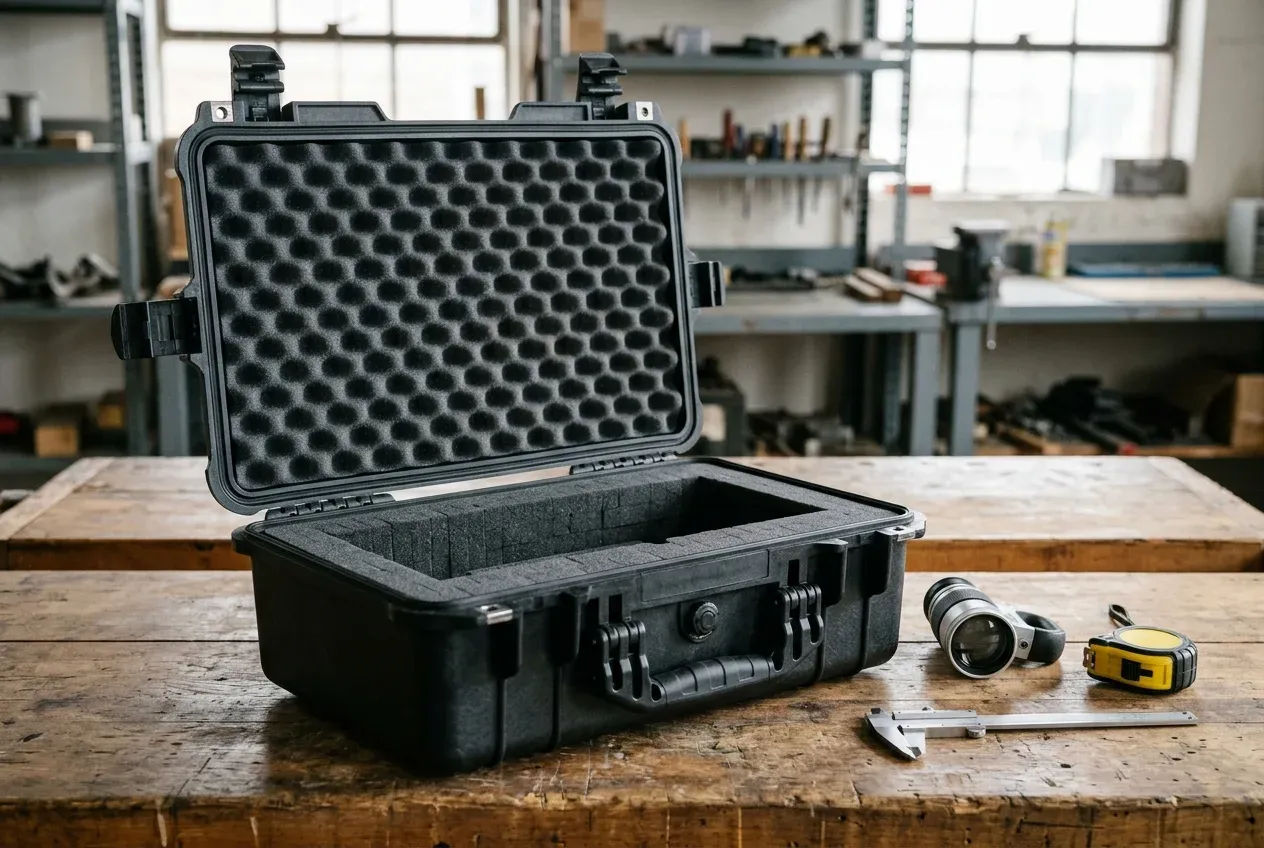
Reading a pelican case sizes chart requires separating outer shell measurements from usable interior foam clearance. Manufacturer catalog tables list the bare internal cavity of an empty polymer shell, whereas field instruments, cameras, and test kits sit inside cushioning layers that consume horizontal and vertical space on every side.
Verify these physical measurement boundaries before selecting a case model:
- Bare equipment length, width, and height measured in the exact orientation the gear will ride inside the shell.
- Perimeter cushioning wall thickness around the item based on whether the case uses pre-scored cubed foam, solid foam slabs, or laminated corrugated dividers.
- Vertical depth split between the shallow upper lid cavity and the deeper lower base cavity rather than combined total interior depth alone.
- Interior bottom-corner wheel housings and central retractable-handle channels that intrude into the floor of wheeled shells.
- Catalog edition differences and dimensional manufacturing tolerances when machining custom inserts or mounting brackets.
Browse the Cases & Protection guides to pair this dimensional sizing workflow with seal verification, transport planning, and kit-specific fit checks.
Scroll horizontally to see all columns.
| Measurement check | Catalog or drawing field to inspect | What to record on your sizing worksheet |
|---|---|---|
| Equipment envelope | Physical tape or caliper measurement of the complete unpacked item and attached fittings | Item length, width, height, and preferred stowage orientation inside the tray |
| Perimeter wall margin | Insert specification sheet or military packaging cushioning table | Cushioning thickness required on the left, right, front, and rear walls around the gear |
| Lid-to-base depth split | Separate lid depth and bottom depth columns in the model specification | Base foam pad thickness, usable lower tray height, and upper lid foam contact clearance |
| Wheeled floor profile | Specification sheet floor notes and interior wheel-well layout | Corner wheel-well steps and center handle channel position relative to rigid bottom gear |
| Catalog edition and fit | Legacy specification sheet versus current master catalog table and size ranges | Whether your foam fabricator is working from the legacy sheet or updated master table |
When your procurement specification also covers gasket seals, pressure-equalization valves, and water-ingress verification, pair your dimensional record with the waterproof equipment case selection checklist. For loaded handling routes, shipping carton preparation, and carrier billing rules, continue to the hard case foam, wheels, and transport guide.
How to Calculate Usable Interior Dimensions and Foam Wall Margins
Catalog interior dimensions describe the empty molded shell cavity from wall to wall. Selecting a shell with interior dimensions equal to your bare instrument dimensions leaves zero room for impact cushioning and forces the equipment against the rigid polymer sidewall.
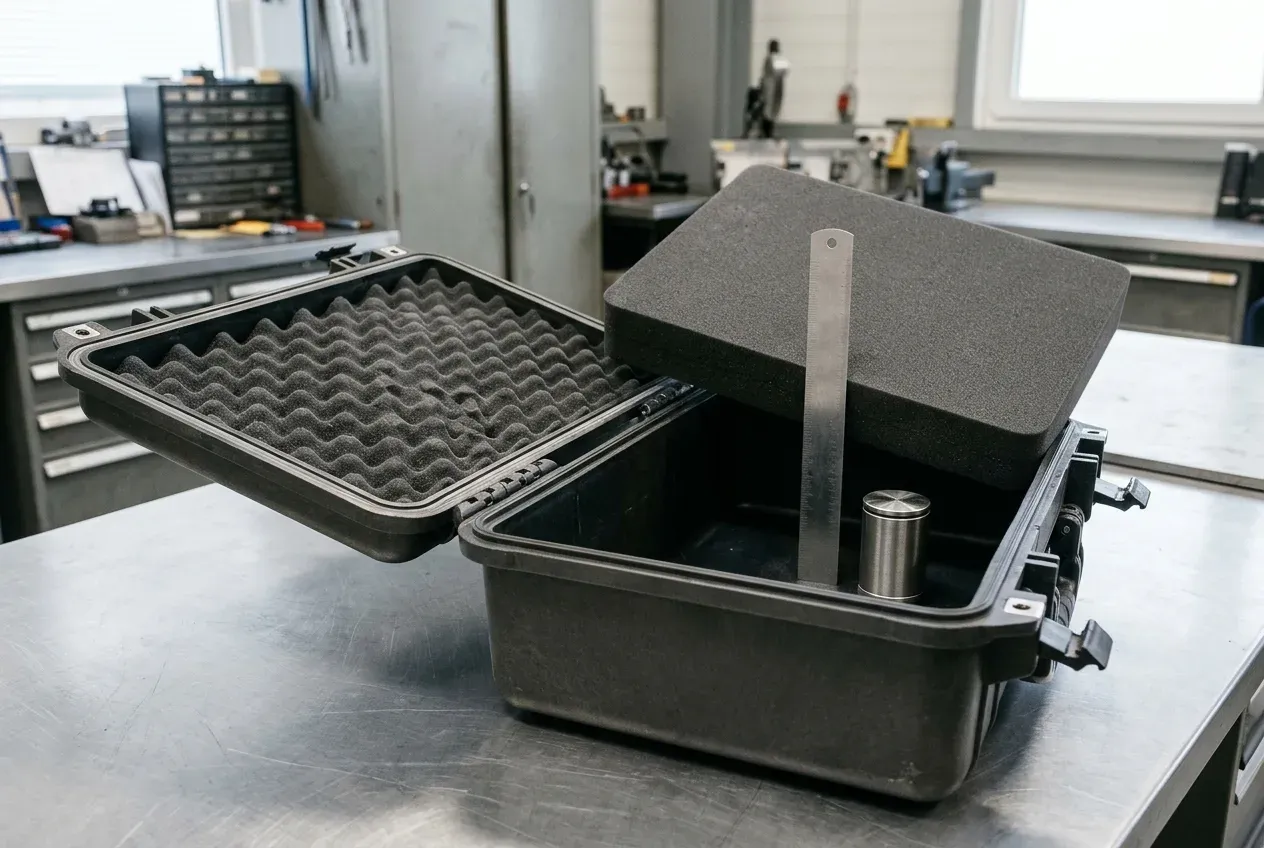
Apply the published foam rules, divider structures, military cushioning thickness tables, and, for Single Lid cases, the published parting-line widths and case-size tolerances when converting bare equipment measurements into required interior case dimensions:
- Pick N Pluck foam layers are pre-scored in 1/2” or 1” cubes, and users must always allow at least 1 in (one inch) of foam between equipment and the wall of the case.
- Pelican cases 1700, 1720, 1740, 1750, 1770, iM3100, iM3200, iM3220, iM3300, and iM3410 ship with solid foam instead of Pick N Pluck Foam.
- The TrekPak Divider System laminates closed-cell foam to corrugated panels and comes complete with perimeter wall sections installed, divider panels, and locking pins.
- Pelican Hybrid interiors combining TrekPak dividers and Pick N Pluck foam are available for the 1510 (Cat No.1510TPF) and 1535 Air (Cat No.1535TPF).
- DoD military packaging standard Table J-VI defines minimum cushioning thickness codes A (1/4 inch), B (1/2 inch), C (3/4 inch), D (1 inch), E (1-1/4 inches), and F (1-1/2 inches).
- DoD military packaging standard Table J-VI defines heavier minimum cushioning thickness codes G (1-3/4 inches), H (2 inches), J (2-1/4 inches), K (2-1/2 inches), L (2-3/4 inches), and M (3 inches).
- In the Single Lid Case Measurement Guide, parting-line width is AL = 1.5” (38mm), BL = 2.0” (51mm), CL = 1.0” (25mm), and DL = 1.75” (44mm).
- Single Lid case size tolerances in inches are ±0.12 (1/8”) for dimension range 1 to 5.99 in, ±0.19 (3/16”) for 6 to 36.99 in, and ±0.25 (1/4”) for 37 to 72.99 in.
- For larger case dimensions, tolerances in inches are ±0.31 (5/16”) for 73 to 90.99, ±0.38 (3/8”) for 91 to 108.99, and ±0.44 (7/16”) for 109 to 134.00.
Check both the required foam wall thickness and the applicable dimensional range before cutting custom inserts or mounting brackets. If you are sizing a pre-cut satellite communications kit rather than building a custom layout from blank foam, see the Starlink Mini transport case fit guide for a component-by-component receiving check.
Action Camera Waterproof Case vs Compact Pelican Storage Case Sizes
Buyers searching for an action camera waterproof case or a compact pelican storage case need to match small electronics, batteries, and field sensors against utility and small Protector enclosures.
Compare the internal and external dimensions across compact Ruck, Go, and Micro utility cases:
- The R20 Pelican Ruck Case has internal dimensions of 7.07” x 3.39” x 1.95” (18 x 8.6 x 5 cm) and external dimensions of 8.96” x 4.83” x 2.88” (22.8 x 12.3 x 7.3 cm).
- The R60 Pelican Ruck Case has internal dimensions of 8.90” x 5.37” x 2.96” (22.6 x 13.6 x 7.5 cm) and external dimensions of 11.14” x 6.86” x 3.88” (28.3 x 17.4 x 9.9 cm).
- The G40 Pelican Go Case has internal dimensions of 7.00” x 3.50” x 1.60” (17.8 x 8.9 x 4.1 cm) and external dimensions of 9.45” x 5.06” x 2.05” (24 x 12.9 x 5.2 cm).
- The Pelican 1010 Micro Case has internal dimensions of 4.37” x 2.87” x 1.68” (11.1 x 7.3 x 4.3 cm) and external dimensions of 5.88” x 4.06” x 2.12” (14.9 x 10.3 x 5.4 cm).
- The Pelican M40 Micro Case (Cat. No. 1040) has internal dimensions of 6.00” x 3.80” x 2.10” (15.2 x 9.7 x 5.3 cm) and external dimensions of 6.80” x 5.00” x 2.60” (17.3 x 12.7 x 6.6 cm).
- The Pelican M60 Micro Case (Cat. No. 1060) has internal dimensions of 8.50” x 4.30” x 2.70” (21.6 x 10.9 x 6.9 cm) and external dimensions of 9.30” x 6.00” x 3.20” (23.6 x 15.2 x 8.1 cm).
When an action camera kit or compact instrument requires Pick N Pluck foam surround and deeper vertical clearance, compare the small Protector case specifications and note how legacy specification sheets compare with updated catalog master tables:
- The 1150 Case specification sheet lists exterior dimensions of 9.12” x 7.56” x 4.37” (23.2 x 19.2 x 11.1 cm) and interior dimensions of 8.18” x 5.68” x 3.62” (20.8 x 14.4 x 9.2 cm).
- The specification sheet lists a lid depth of 0.75” (1.9 cm), bottom depth of 2.87” (7.3 cm), total depth of 3.62” (9.2 cm), weight with foam of 1.98 lbs (0.9 kg), and weight without foam of 1.76 lbs (0.8 kg).
- In the updated catalog master table, the Pelican 1150 lists interior dimensions of 8.29 x 5.79 x 3.75 (21.1 x 14.7 x 9.5) and exterior dimensions of 9.44 x 7.80 x 4.29 (24 x 19.8 x 10.9).
- The 1200 Case specification sheet lists exterior dimensions of 10.62” x 9.68” x 4.87” (27 x 24.6 x 12.4 cm) and interior dimensions of 9.25” x 7.12” x 4.12” (23.5 x 18.1 x 10.5 cm).
- The specification sheet lists a lid depth of 1.18” (3 cm), bottom depth of 2.93” (7.4 cm), and total depth of 4.11” (10.4 cm), with weight with foam of 2.87 lbs (1.3 kg) and weight without foam of 2.65 lbs (1.2 kg).
Check the separate lid depth and bottom depth on these small Protector shells before standing chargers or lenses vertically inside the lower foam tray.
Medium and Carry-On Pelican Case Sizes Chart Across Protector, Air, and Cross-Brand Lines
Medium cases and wheeled carry-on shells represent the core working range for field instruments, camera kits, and diagnostic tools. Comparing medium Air and Protector models alongside cross-brand carry-on shells shows how lid depth, base depth, and foam layer stacks divide usable space.
Medium Air and Protector case specifications
Review the published dimensions, depth splits, weights, and three-layer foam stack-up for medium cases:
- The 1485 Air Case datasheet lists interior dimensions (LxWxD) of 17.75 x 10.18” x 6.15 (45.1 x 25.9 x 15.6 cm) and exterior dimensions (LxWxD) of 19.17 x 12.80” x 6.89 (48.7 x 32.5 x 17.5 cm).
- The lid depth is 1.80” (4.6 cm), bottom depth is 4.35” (11 cm), total depth is 6.15” (15.6 cm), and interior volume is 0.64 ft³ (0.018 m³).
- Weight with foam is 5.39 lbs (2.4 kg) and weight empty is 4.57 lbs (2.1 kg).
- The foam properties stack-up consists of Layer 1 (Lid) 1.80” Convolute, Layer 2 (Base) 3.38” Pick N Pluck, and Layer 3 (Base) 0.70” Pad.
- For the 1485 Air Case with interior dimensions of 17.75 x 10.18” x 6.15, allowing 1 in of Pick N Pluck foam against each wall subtracts 2 in from length and width, leaving 15.75” x 8.18” of horizontal equipment space.
- The 1550 Case has exterior dimensions of 20.62” x 16.87” x 8.12” (52.4 x 42.8 x 20.6 cm) and interior dimensions of 18.43” x 14.00” x 7.62” (46.8 x 35.5 x 19.3 cm).
- Lid depth is 1.75” (4.4 cm), bottom depth is 5.87” (14.9 cm), and total depth is 7.62” (19.3 cm), with weight with foam of 11.9 lbs (5.4 kg) and weight without foam of 10.58 lbs (4.8 kg).
- For the 1550 Case with interior dimensions of 18.43” x 14.00” x 7.62”, allowing 1 in of Pick N Pluck foam against each wall subtracts 2 in from length and width, leaving 16.43” x 12.00” of horizontal equipment space.
Wheeled carry-on hard cases and cubed foam drawing details
Wheeled carry-on shells require checking both the interior dimensions and the wheel-and-handle well warning on the specification sheet:
- The 1510 Carry On Case has exterior dimensions of 22.00” x 13.81” x 9.00” (55.9 x 35.1 x 22.9 cm) and interior dimensions of 19.75” x 11.00” x 7.60” (50.1 x 27.9 x 19.3 cm).
- Lid depth is 1.79” (4.5 cm), bottom depth is 5.79” (14.7 cm), and total depth is 7.58” (19.2 cm), with weight with foam of 13.6 lbs (6.17 kg) and weight without foam of 11.99 lbs (5.44 kg).
- The specification sheet explicitly states that this case has internal wheel and/or handle wells that will reduce usable area and asks users to review for each application.
- For the 1510 Carry On Case with interior dimensions of 19.75” x 11.00” x 7.60”, allowing 1 in of Pick N Pluck foam against each wall subtracts 2 in from length and width, leaving 17.75” x 9.00” of horizontal equipment space.
- The Pelican 1535 Air Case has interior dimensions of 20.39 x 11.20 x 7.20 (51.8 x 28.4 x 18.3) and exterior dimensions of 21.96 x 13.97 x 8.98 (55.8 x 35.5 x 22.8).
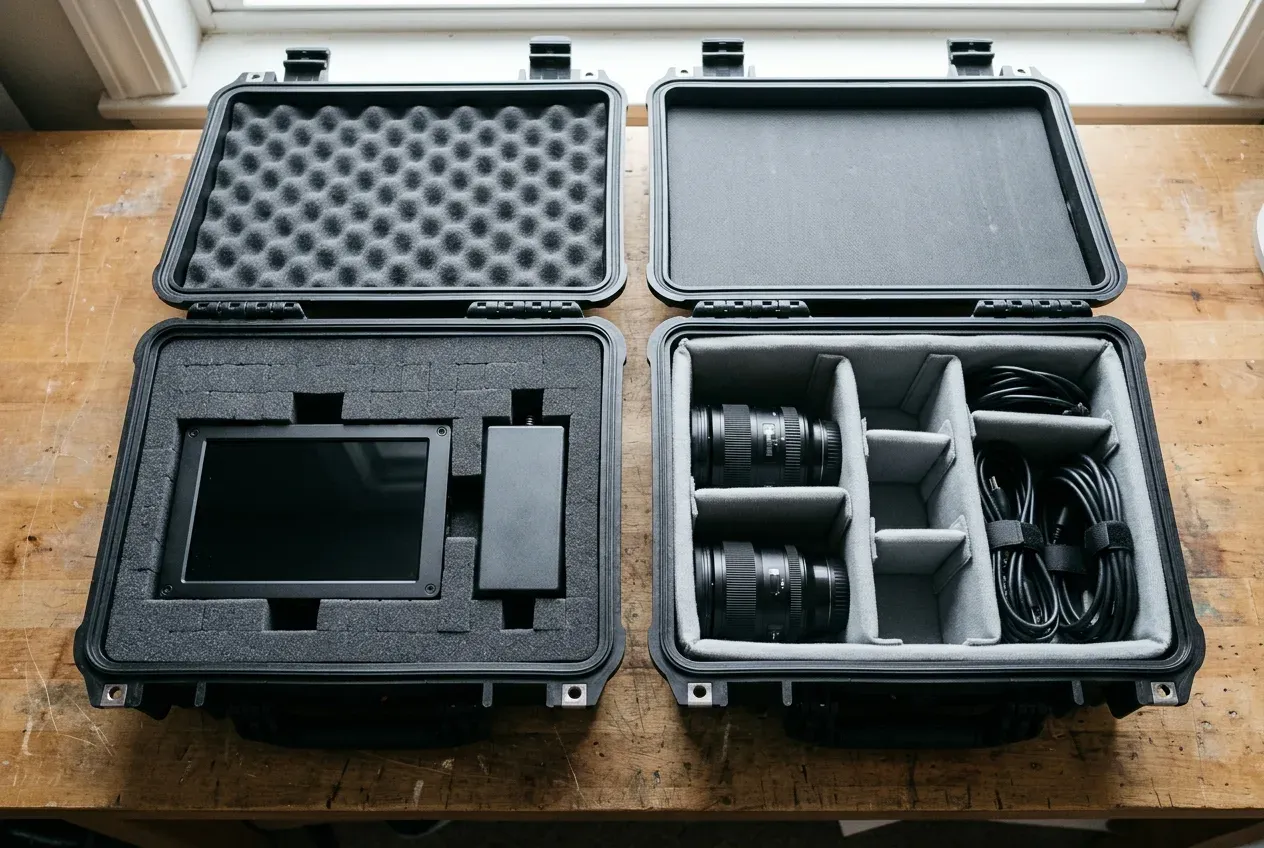
For a cross-brand wheeled carry-on comparison from NANUK (Plasticase Inc.), model 935, review the published case specification sheet and cubed foam technical drawing:
- The NANUK 935 has interior dimensions of 20.5” x 11.3” x 7.5” (521 x 287 x 191 mm) and lid depth is 2.1” (53 mm).
- The NANUK 935 has exterior dimensions of 22.0” x 14.0” x 9.0” (559 x 357 x 229 mm), base depth is 5.4” (137 mm), and empty weight is 11.6 lb (5.3 kg).
- The NANUK 935 cubed foam insert drawing (00935FV_NANUK) specifies tolerances of +/- 1/16 in on cutouts and +/- 1/8 in on overall foam thickness and cavity depths.
- The NANUK 935 cubed foam stack-up (00935FV_NANUK) uses a PUF 1.5 Black 1/2” thick base pad, a 2 1/8” thick layer, a 2 1/2” thick layer, and a CV 2 3/8” thick lid convoluted layer with a 5/8” base.
Notice how the technical drawing separates cutout manufacturing rules from overall foam layer thickness rules and divides the base cavity into two distinct cubed foam layers over a thin bottom pad.
Large Pelican Cases and Wheeled Transport Case Dimensions
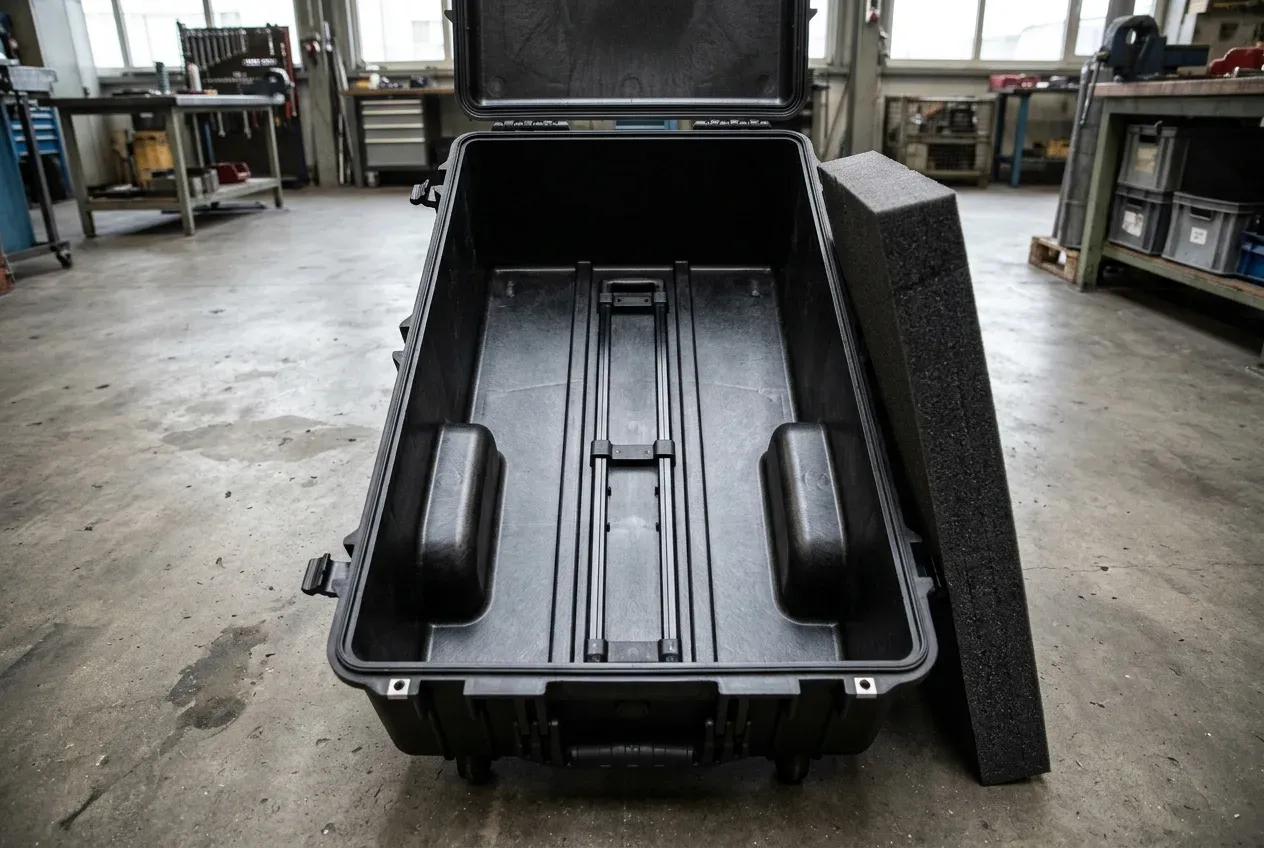
Specifying large pelican cases for multi-instrument field kits requires checking both total interior volume and empty shell mass before loading gear. When selecting a large pelican case with wheels, inspect the interior floor along the wheel end and center channel and verify whether your dimension table comes from a legacy specification sheet or the updated catalog master table.
Large hand-carried and wheeled case specifications
Compare the published dimensions, depth splits, volumes, and weights for large Protector and Air cases:
- The 1600 Case specification sheet lists exterior dimensions of 24.25” x 19.43” x 8.68” (61.6 x 49.3 x 22 cm) and interior dimensions of 21.43” x 16.50” x 7.87” (54.4 x 41.9 x 20 cm).
- Lid depth is 1.75” (4.4 cm), bottom depth is 6.12” (15.5 cm), and total depth is 7.87” (20 cm), with weight with foam of 14.11 lbs (6.4 kg) and weight without foam of 13 lbs (5.9 kg).
- In the updated catalog master table, the Pelican 1600 lists interior dimensions of 21.51 x 16.54 x 7.99 (54.6 x 42 x 20.3) and exterior dimensions of 24.39 x 19.36 x 8.79 (61.9 x 49.2 x 22.3).
- The 1610 Case datasheet lists interior dimensions (LxWxD) of 21.78 x 16.69” x 10.62 (55.3 x 42.4 x 27 cm) and exterior dimensions (LxWxD) of 24.83 x 19.69” x 11.88 (63.1 x 50 x 30.2 cm).
- Lid depth is 2.05” (5.2 cm), bottom depth is 8.57” (21.8 cm), total depth is 10.62” (27 cm), and interior volume is 2.23 ft³ (0.063 m³).
- Weight with foam is 22.30 lbs (10.1 kg) and weight empty is 19.50 lbs (8.8 kg), with 1.3 lb polyurethane foam.
- The 1637 Air Case datasheet lists interior dimensions (LxWxD) of 23.43 x 17.55” x 13.25 (59.5 x 44.6 x 33.7 cm) and exterior dimensions (LxWxD) of 26.61 x 20.65” x 14.87 (67.6 x 52.5 x 37.8 cm).
- Lid depth is 2.00” (5.1 cm), bottom depth is 11.20” (28.4 cm), total depth is 13.2” (33.5 cm), and interior volume is 3.15 ft³ (0.089 m³).
- Weight with foam is 19.40 lbs (8.8 kg) and weight empty is 15.20 lbs (6.9 kg).
Extra-large wheeled transport cases and catalog table comparisons
For extra-large wheeled cases and deep transport trunks, compare the legacy specification sheet figures alongside the updated catalog master table and Protector Mobility table:
- The 1650 Case specification sheet lists exterior dimensions of 30.75” x 20.50” x 11.62” (78.1 x 52 x 29.5 cm) and interior dimensions of 28.50” x 17.37” x 10.50” (72.4 x 44.1 x 26.7 cm).
- Lid depth is 1.87” (4.7 cm), bottom depth is 8.62” (21.9 cm), and total depth is 10.49” (26.6 cm), with weight with foam of 35.49 lbs (16.1 kg) and weight without foam of 29.1 lbs (13.2 kg).
- The specification sheet explicitly states that this case has internal wheel and/or handle wells that will reduce usable area and asks users to review for each application.
- In the updated catalog master table, the Pelican 1650 lists interior dimensions of 28.57 x 17.52 x 10.62 (72.5 x 44.5 x 27) and exterior dimensions of 31.59 x 20.47 x 12.45 (80.2 x 52 x 31.6).
- In the Protector Mobility Cases table of the catalog, the 1650 Protector lists internal dimensions of 28.57” x 17.52” x 10.65” (72.6 x 44.5 x 27.1) and empty weight of 24.03 (10.900).
- The Pelican 1660 Case has interior dimensions of 28.20 x 19.66 x 17.63 (71.6 x 49.9 x 44.8) and exterior dimensions of 31.59 x 22.99 x 19.48 (80.2 x 58.4 x 49.5).
- The Pelican 1690 Case has interior dimensions of 30.13 x 25.13 x 15.36 (76.5 x 63.8 x 39) and exterior dimensions of 33.43 x 28.40 x 17.65 (84.9 x 72.1 x 44.8).
- The Pelican 1780 Case has interior dimensions of 41.12 x 21.54 x 14.88 (104.4 x 54.7 x 37.8) and exterior dimensions of 44.90 x 25.32 x 16.50 (114 x 64.3 x 41.9).
When ordering custom waterjet or CNC foam inserts, record which catalog revision or specification sheet your dimensions came from so the insert fabricator works from the matching cavity numbers.
Case Measurement and Receiving Fit Worksheet
Download the hard case interior clearance, depth split, and foam margin worksheet to structure your dimensional calculations before requesting quotes or plucking foam cubes.
Complete the worksheet in sequence for each item or multi-part kit:
- Measure the bare length, width, and height of every instrument, lens, power brick, mount, and cable bundle in its intended stowage orientation.
- Select the interior insert type and enter the required cushioning wall margin for each side wall, between adjacent items, under the base, and inside the lid.
- Sum the item dimensions and wall margins to establish your required interior length, width, and depth.
- Cross-check your worksheet entries against the pelican case sizes chart above before placing a purchase order, verifying both total depth and the separate lid depth and bottom depth split.
- For wheeled shells, verify that rigid components do not sit directly against the bottom corner wheel housings or center handle channel.
- Measure the vehicle trunk, closet, or rack bay and compare it against the candidate case exterior dimensions and unloaded weight.
- Upon receiving the case, perform a dry trial fit with the equipment resting on the unplucked or unpinned insert before cutting foam or trimming divider panels.
For additional specification records and receiving templates across field gear, visit the equipment checklists and templates page.
Frequently Asked Questions
How much foam margin should I leave around equipment inside a Pelican case?
Pick N Pluck foam layers are pre-scored in 1/2” or 1” cubes, and users must always allow at least 1 in (one inch) of foam between equipment and the wall of the case. DoD military packaging standard Table J-VI defines minimum cushioning thickness codes A (1/4 inch), B (1/2 inch), C (3/4 inch), D (1 inch), E (1-1/4 inches), and F (1-1/2 inches). DoD military packaging standard Table J-VI defines heavier minimum cushioning thickness codes G (1-3/4 inches), H (2 inches), J (2-1/4 inches), K (2-1/2 inches), L (2-3/4 inches), and M (3 inches).
What are the interior and exterior dimensions of carry-on Pelican cases?
The 1510 Carry On Case has exterior dimensions of 22.00” x 13.81” x 9.00” (55.9 x 35.1 x 22.9 cm) and interior dimensions of 19.75” x 11.00” x 7.60” (50.1 x 27.9 x 19.3 cm). Lid depth is 1.79” (4.5 cm), bottom depth is 5.79” (14.7 cm), and total depth is 7.58” (19.2 cm), with weight with foam of 13.6 lbs (6.17 kg) and weight without foam of 11.99 lbs (5.44 kg). The Pelican 1535 Air Case has interior dimensions of 20.39 x 11.20 x 7.20 (51.8 x 28.4 x 18.3) and exterior dimensions of 21.96 x 13.97 x 8.98 (55.8 x 35.5 x 22.8).
Why does the Pelican 1510 Carry On Case have less flat floor space than its catalog interior length suggests?
The specification sheet explicitly states that this case has internal wheel and/or handle wells that will reduce usable area and asks users to review for each application.
Which long Pelican cases ship with solid foam instead of Pick N Pluck foam?
Pelican cases 1700, 1720, 1740, 1750, 1770, iM3100, iM3200, iM3220, iM3300, and iM3410 ship with solid foam instead of Pick N Pluck Foam.
Sources
- Pelican — Full Line Case Catalog
- U.S. Department of Defense — Practice for Military Packaging Cushioning Tables
- Pelican — 1150 Case Specification Sheet
- Pelican — 1200 Case Specification Sheet
- Pelican — 1485 Air Case Datasheet
- Pelican — 1510 Carry On Case Specification Sheet
- Pelican — 1550 Case Specification Sheet
- NANUK — 935 Case Specification Sheet
- NANUK / Plasticase Inc. — 935 Cubed Foam Insert Technical Drawing
- Pelican — 1600 Case Specification Sheet
- Pelican — 1610 Case Specification Sheet
- Pelican — 1637 Air Case Datasheet
- Pelican — 1650 Case Specification Sheet
- Pelican — Single Lid Cases Measurement Guide
Downloads
- Hard case interior clearance, depth split, and foam margin worksheet CSV Record equipment length, width, and height, required perimeter foam or divider margins, separate lid and base depths, wheeled floor clearance, and exterior trunk dimensions.
Next steps
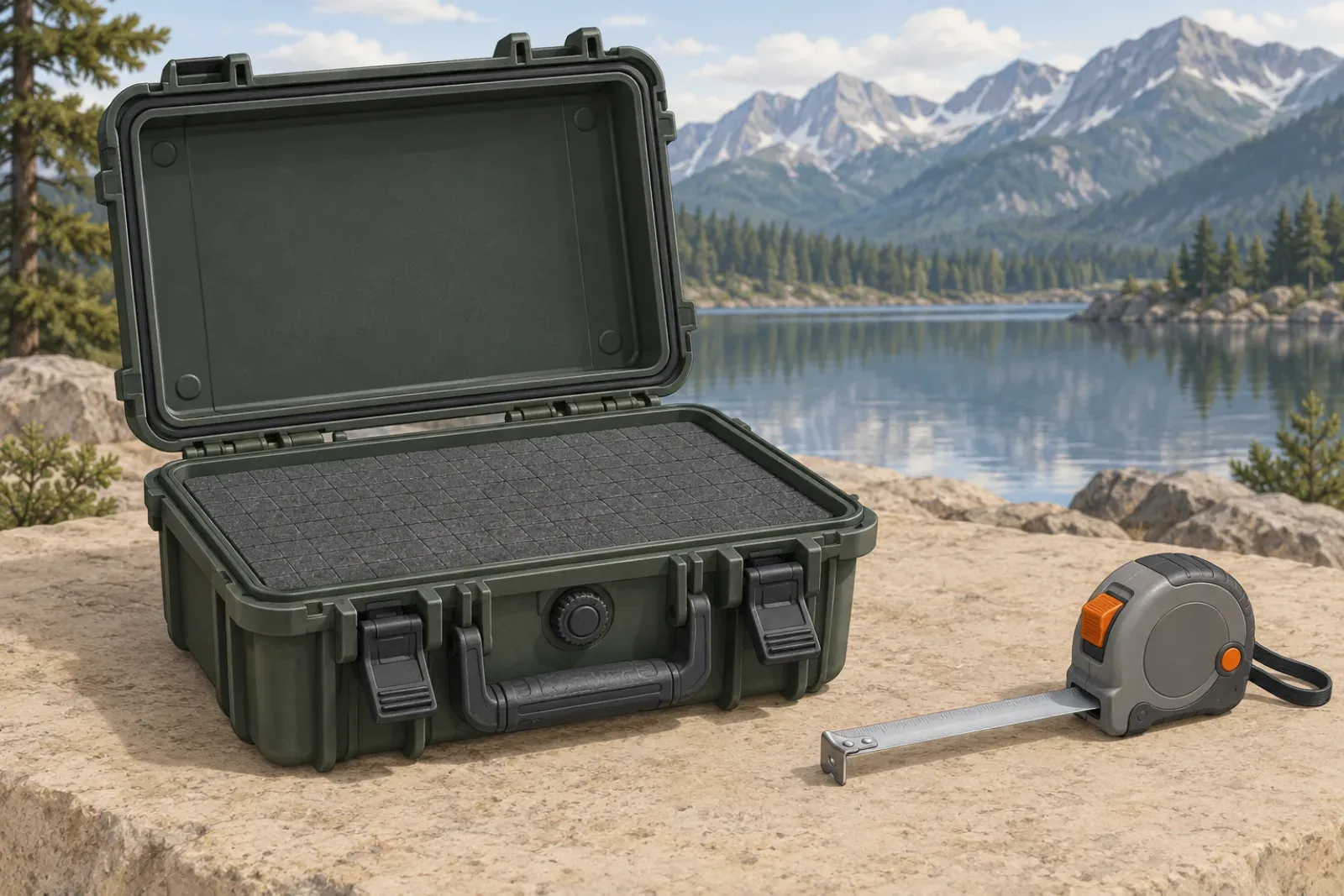
Choosing a Waterproof Equipment Case: A Procurement Checklist
A procurement checklist for waterproof equipment cases: dimensions, seals, latches, valves, rating claims, test report scope, spares and maintenance documents.
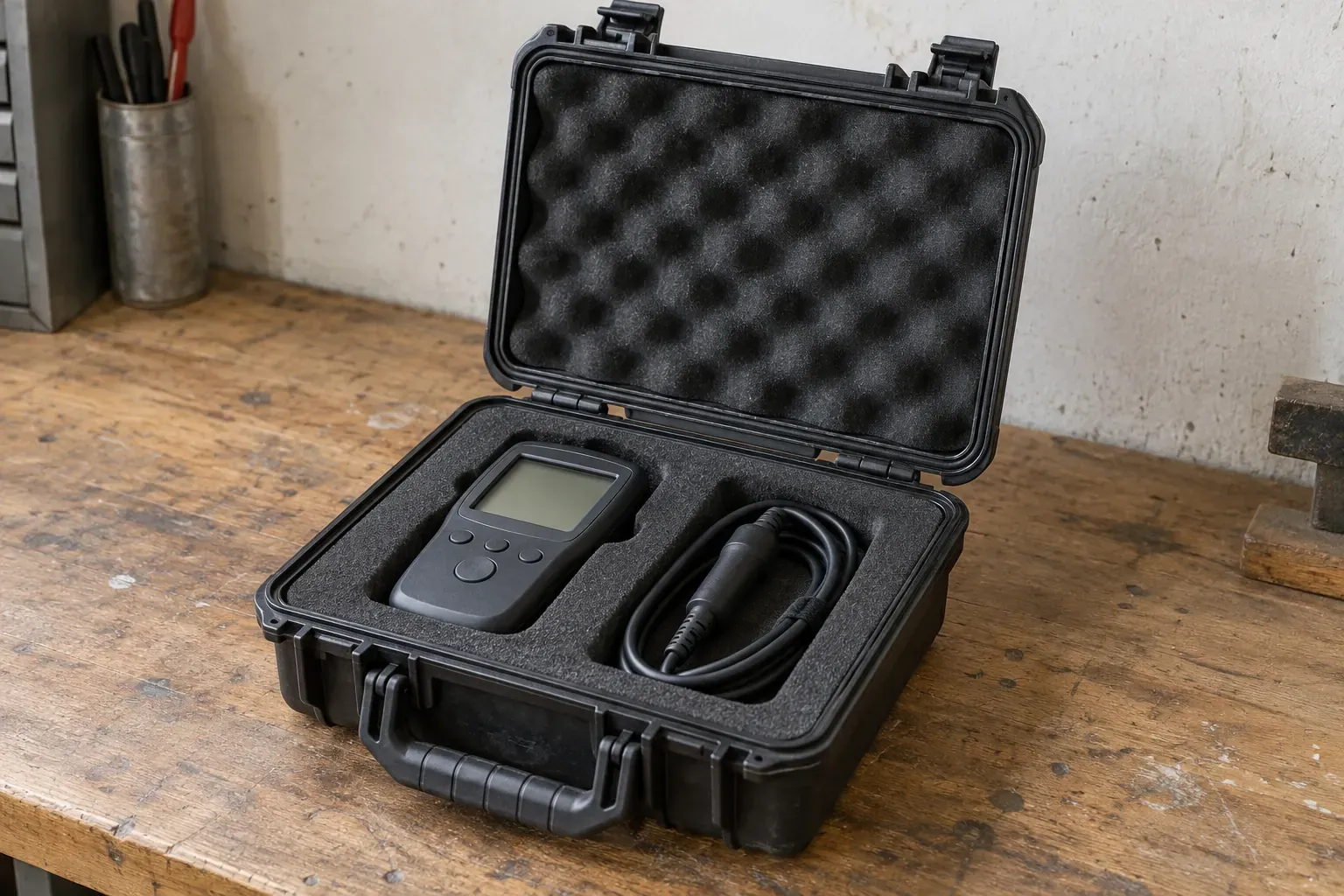
Specifying Hard Equipment Cases: Foam, Wheels and Transport
Specify a hard equipment case by interior fit, foam layout, loaded handling and shipping requirements, with documented dimensions and a receiving checklist.
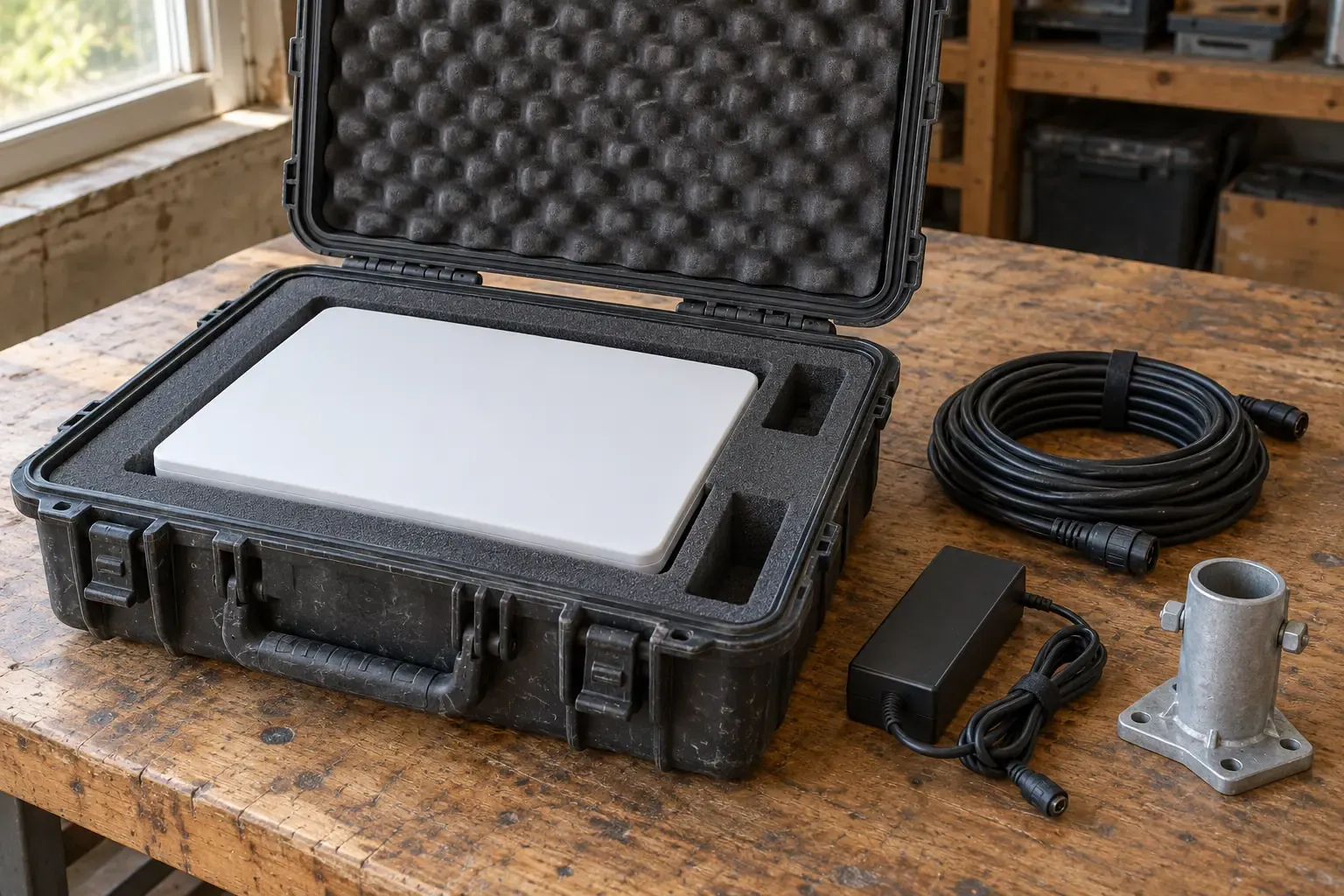
Starlink Mini Case Fit: A Field Kit Packing and Receiving Checklist
Compare Starlink Mini Kit and accessory dimensions against Pelican 1505SSLK transport specs, and run a receiving trial-fit checklist before deployment.
Equipment Cases & Protection
Decide how to protect and transport field equipment by reading protection claims, specifying a case and verifying the evidence behind it.