Portable Power Station vs Generator: Choosing a Power Source for Outdoor Work
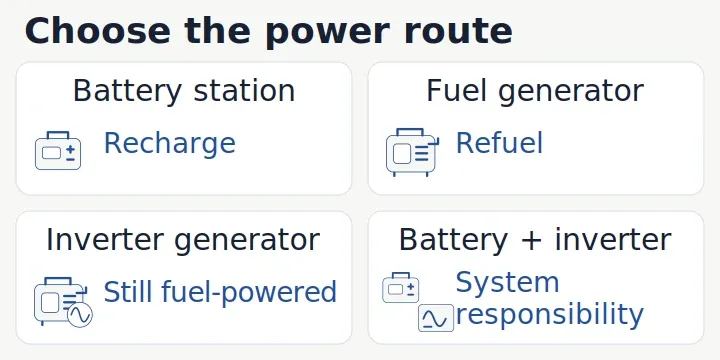
An unplanned replenishment stop wastes working time. Compare power routes against the load, next replenishment opportunity and responsibility for the complete system.
This guide answers portable power station vs generator for outdoor work. It includes conventional fuel generators, inverter generators and separate battery-and-inverter systems. The output is a conditional shortlist, not a brand ranking. The power and lighting hub places this choice alongside load sizing and lighting selection.
Scroll horizontally to see all columns.
| Input or item | Typical value or source | Why it matters |
|---|---|---|
| Loads running together | Equipment nameplates and manuals | Establishes the continuous demand |
| Motor starting demand | Load manufacturer’s documentation | Can rule out a supply that covers running demand |
| Operating period | Shift plan and actual duty cycle | Defines the energy and replenishment task |
| Next charging or refueling opportunity | Site plan, available supply and assigned person | Determines whether the route can be sustained |
| Permitted operating position | Site assessment, official guidance and model manual | May exclude a fuel-powered route |
| Ownership responsibility | Supplier documents and your maintenance plan | Separates an integrated product from a system you must manage |
Compare four power routes
Choose by how energy reaches the load and who supports the complete system. “Inverter” describes power conversion; it does not tell you whether the energy comes from a battery or burning fuel. For this purchasing comparison, conventional fuel generator means the non-inverter route; an inverter generator is another fuel-generator configuration.
Scroll horizontally to see all columns.
| Route | How it is replenished | Useful starting condition | Reason to hold the choice |
|---|---|---|---|
| Integrated portable power station | Compatible charging input refills a built-in battery | Your job fits the usable energy, with a reliable recharge window | Required runtime, startup capability or charging access is unconfirmed |
| Conventional fuel generator | Fuel replenishment, with shutdown and cooling as required | Sustained remote work has permitted fuel logistics and outdoor placement | Exhaust placement, electrical distribution or load compatibility is unresolved |
| Inverter fuel generator | Fuel, just as for other engine generators | You want to investigate a model’s output characteristics for your loads | The word “inverter” is being treated as proof of safety, quietness or compatibility |
| Separate battery and inverter | A charger and battery arrangement specified for the system | A competent designer can document the whole system and its servicing | Nobody owns compatibility, protection, commissioning and support |
The tables here are SavvySkull’s suggested screening tools. They do not assign scores, establish an industry standard or certify a configuration. A “solar generator” label also needs unpacking: identify the storage device, charging equipment and panels actually included in the offer.
Do not select a route solely because one familiar device works with it. A worksite may combine light steady loads with a motor that starts occasionally. The work-light buying guide helps define the lighting task before it becomes an entry in your load list.
Takeaway: Separate the energy source, output conversion and system responsibility before comparing products.
Define the load and the next charging opportunity
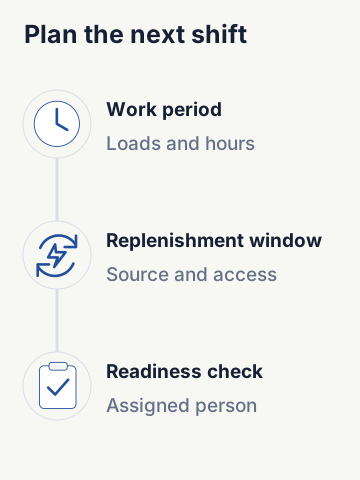
A supply needs both enough output at the demanding moment and enough energy until the next replenishment. The EIA explanation of electricity measurement distinguishes watts, a measure of power, from watt-hours, a measure of energy over time. Neither quantity replaces the other.
Two manufacturer documents illustrate the distinction. These are document examples, not purchase recommendations or our measurements:
- The EcoFlow DELTA 2 US V1.0 manual, printed page 1, states 1,024 Wh capacity, 1,800 W total AC output and 1,200 W maximum AC charging input. Those figures describe separate functions. They do not establish delivered AC energy or an actual charging duration.
- The Honda EU2200i manual 31Z446170, printed page 47, states 1.8 kVA rated power and 2.2 kVA maximum power, and distinguishes continuous operation from the maximum. Retain the manual’s VA units; do not assume a kVA figure is interchangeable with a kW figure for every load.
The EcoFlow manual and Honda manual are the sources for those manufacturer statements. Match the regional version and applicable manual to the unit offered. A maximum charging-input figure is a limit, not a promise that it will be sustained through a complete recharge.
Scroll horizontally to see all columns.
| Planning question | Record before comparing offers |
|---|---|
| What runs together? | Device identity, continuous demand and any starting requirement |
| When is it needed? | Operating periods, interruptions allowed and essential loads |
| Where can replenishment happen? | Available source capability, location and access window |
| Can the window restore readiness? | Required next-shift energy, recharge interval and evidence for the chosen charging mode |
| Who checks the next shift? | Responsible person and a readiness check based on the manual |
Confirm that the proposed recharge interval can meet the next shift’s requirement using model-specific charging documentation or a clearly recorded operating check under your conditions. Do not derive that interval by dividing capacity by a maximum input rating.
Once a battery route looks workable, use the portable power station sizing guide for the capacity calculation. Keep that calculation with the operating plan instead of repeating a manufacturer’s generic runtime claim. For a camp, the campground equipment checklist helps identify site functions that might otherwise be left off the list.
Common mistake: treating a peak output label as continuous capacity, or treating a charging maximum as the average power throughout a recharge.
Takeaway: Choose the replenishment window before accepting an operating-time claim.
Screen fuel options by placement and noise
A fuel-powered option needs an acceptable outdoor operating position before it becomes a candidate. An inverter generator still has an engine and exhaust. Its output electronics do not remove the carbon-monoxide problem.
The CPSC Carbon Monoxide Information Center, checked October 8, 2026, says portable generators are for outdoor use only. Its residential guidance specifies at least 20 feet from homes, with exhaust directed away; open doors or windows do not make garage use acceptable. That residential distance is not a complete worksite placement approval.
For workers, OSHA’s portable-generator fact sheet warns against outdoor positions where exhaust can enter occupied spaces through doors, windows or vents. It also calls for shutting down and cooling before refueling. The linked document is FS-3286, dated 09/2005; OSHA still supplies it as educational guidance. It does not create new compliance requirements.
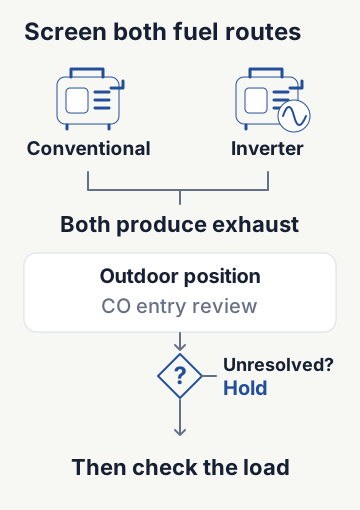
Ask the responsible site person to identify occupied structures, gathering areas, air intakes and the proposed cord route on the site plan. If no suitable position can be established, hold the fuel route and reassess the supply arrangement. Do not shorten the exhaust separation to make an inconvenient cord reach.
Noise needs its own evidence. Ask for the operating mode, load and measurement conditions behind a manufacturer’s sound claim. We have no common-condition noise test across these routes, so this guide cannot declare that every inverter generator is quieter than every conventional generator. A battery supply can also have cooling fans. Keep a noise requirement in the purchasing record and ask for a demonstration appropriate to the actual task.
To narrow conventional versus inverter fuel candidates, apply the same fields to both: continuous and startup capability, the load maker’s output-quality requirements, the candidate’s documented output characteristics, and sound data under stated conditions. Keep both routes on the shortlist when both meet those requirements and there is no documented differentiator. Narrow it only when the evidence shows that one candidate meets a required condition and the other does not, or when a verified difference matters to your task. The category name alone is not that evidence.
For distribution across a construction site, the temporary construction lighting guide addresses a different scope. A power-source comparison does not complete that electrical or lighting assessment.
Takeaway: Reject unresolved exhaust placement first, then assess documented noise and load suitability.
Compare transport, upkeep and system responsibility
Compare the complete delivered arrangement, including replenishment accessories and servicing responsibility. A battery or engine by itself is not the whole supply you will carry and maintain.
Scroll horizontally to see all columns.
| Route | Include in the ownership record | Assign responsibility for |
|---|---|---|
| Integrated station | Charger, permitted accessories, transport arrangement and battery-service support | Readiness, permitted charging and supplier-supported repairs |
| Either fuel-generator route | Fuel arrangements, manual-required servicing and electrical distribution review | Refueling, upkeep, placement and trained operation |
| Separate battery and inverter | Designer’s complete specification, compatible charging arrangement, enclosure and protection documentation | System design, commissioning, alterations and fault support |
This list requests documentation; it is not a construction bill of materials. In a modular system, ask a qualified electrical professional to explain compatibility, isolation, fault protection, environmental suitability and the handover record. This guide supplies no wiring, fuse-sizing or battery-modification instructions.
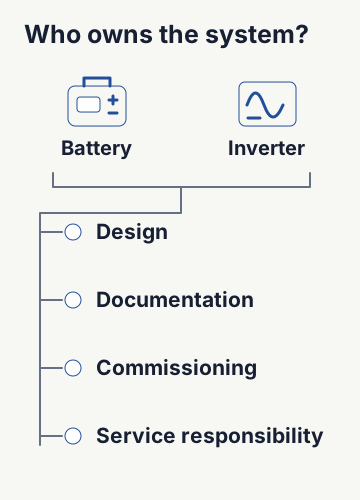
A professional modular system can be a candidate when component replacement and a defined service arrangement matter to your team. A box of individually specified components should remain on hold until someone accepts responsibility for the combination. Ask who supports a fault that crosses the battery, inverter and charger boundary.
For engine upkeep, the Honda document includes a maintenance schedule; for battery storage and permitted charging, the EcoFlow document gives model-specific instructions. Neither establishes a universal service interval. Use the maintenance planning guide to turn the selected manual into assigned tasks. The equipment-case procurement checklist helps record transport protection; a carrying case does not change the supply’s operating restrictions.
Compare costs only after agreeing the scope: purchase, accessories, charging or fuel, servicing, downtime assumptions and replacement support. We have no verified matched quotes or lifecycle records from which to claim that one route always costs less.
Takeaway: Compare the supported complete system, with every ownership task assigned.
Plan a generator-and-battery combination
A mixed arrangement is worth investigating when a fuel-running window and a separate battery-powered working period solve different site needs. Adding a battery does not remove the generator’s operating restrictions.
Draw an information plan first: which period uses battery energy, where replenishment occurs, and which loads must continue during charging. Then ask the suppliers and responsible electrical professional to verify the actual equipment combination.
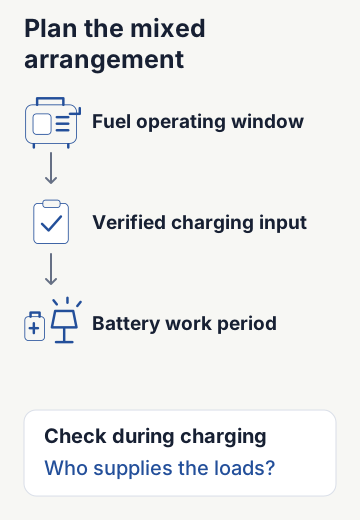
Request confirmation of:
- The charging input and permissible source for the exact battery product.
- The generator’s continuous capability with charging and any other simultaneous loads.
- The recharge interval available after those loads are accounted for, and evidence that the selected charging mode can restore the required next-shift readiness.
- The product’s behavior while charging and its response if the upstream supply stops.
- The proposed placement, operating windows and person responsible for each stage.
The DELTA 2 manual’s bypass discussion illustrates why the third question matters: when AC input supplies connected equipment in bypass, the upstream source supplies those loads. Do not assume charging always creates a separate battery-powered supply to the task. This is a model-specific behavior to check, not a claim about every power station.
Common mistake: adding a generator’s output figure and a station’s output figure to invent a combined available rating. The documented operating mode determines what the connected loads actually receive.
Put the proposed combination and the unresolved questions into the outdoor-equipment RFQ. Request a documented answer before buying additional adapters or assuming operation during charging is permitted.
Takeaway: Confirm charging and load-supply behavior separately before accepting a mixed arrangement.
Make the conditional choice
Start with the route that fits the operating and replenishment conditions, then retain any unresolved condition beside it. The following cases are hypothetical planning situations, not customer experiences.
Scroll horizontally to see all columns.
| If your operating plan looks like this | Start by investigating | Hold the choice until |
|---|---|---|
| Separate devices run between dependable charging opportunities | Integrated station | Output, usable energy and charging access cover the load plan |
| Remote work continues beyond a practicable battery replenishment plan | Fuel generator, conventional or inverter | Suitable outdoor placement, fuel logistics and load compatibility are established |
| Noise-sensitive work occurs between permitted generator-running windows | Documented mixed arrangement | Charging behavior, both operating periods and each location are confirmed |
| You need a serviceable modular arrangement with professional support | Separate battery and inverter | Design, commissioning and ongoing system responsibility are documented |
| No permissible fuel position and no adequate charging plan exist | Reassess the job’s supply plan | The conflict is resolved rather than hidden by a larger nameplate |
Keep a short decision record: required loads, replenishment window, excluded routes and why, candidate route, missing documents and the person who closes each issue. A shortlist is useful even when the result is “hold”; it prevents the next buyer from reopening the same unresolved assumption.
Use the supplier test-report checklist when a quoted compatibility or protection claim depends on a report. The report needs to cover the actual model and claimed condition. A logo or general declaration does not settle that question. The resources page collects existing worksheets that can support your record; no new downloadable form is required for this comparison.
Takeaway: Save a conditional shortlist and its evidence gaps, rather than a universal winner.
When this does not apply
This comparison covers route selection for discrete outdoor-work loads. It does not design building connections, fixed storage, vehicle charging modifications, hazardous-location equipment or a life-critical supply. OSHA’s fact sheet directs structure connections to a qualified electrician using a properly installed transfer switch; this guide does not provide installation instructions.
Nor does “outdoor work” mean permission to expose every supply to weather. The DELTA 2 manual prohibits rain and humid-environment use. Check the chosen model’s operating configuration, including its charging connections; the IP-rating guide explains why a housing claim is not blanket permission for any deployment.
There is no firsthand performance testing here, no comparable noise survey and no calculated cost winner. Missing runtime, waveform compatibility or weather evidence remains a condition to resolve. The same applies to a DIY design without professional review.
Takeaway: Refer installation and special-risk applications to the responsible professionals and applicable model documents.
Frequently asked questions
These questions develop actual search-question and autocomplete topics; they add ownership details to the route comparison.
Is it worth getting a portable power station?
It may be when the unit removes a recurring supply problem and you can keep it ready for that task. Before purchase, ask how battery service and firmware-dependent functions are supported for the offered model. Convenience during one shift does not settle long-term support or replacement availability.
Can an existing deep-cycle battery replace a complete power station?
Owning a battery is a reason to ask a system designer about it, not evidence that it fits. Provide its identity, condition and documentation. Have the professional review it within the proposed complete system before treating an existing asset as usable capacity or a cost saving.
Is an inverter alone an alternative to a portable power station?
An inverter converts power; it does not itself provide the stored energy, charger and complete operating arrangement you are comparing. Ask what the offer actually includes and who supports the complete supply. Avoid comparing an inverter-only price with an integrated product’s price.
Is a DIY battery-and-inverter system automatically cheaper?
No cost conclusion is supported here. Request a complete scope that includes professional review, suitable components, commissioning and ongoing support. Also ask which supplier accepts responsibility for faults in the assembled system; individual component warranties are not a demonstrated whole-system service arrangement.
Are portable power stations completely silent?
Do not assume so. The DELTA 2 overview identifies a ventilation fan. For noise-sensitive work, ask about the offered model’s charging and discharge modes and whether the fan operates during the period that matters. We cannot name the quietest option without comparable measurements.
Does an inverter generator eliminate the need to ask about motor starting?
No. The Honda manual explicitly notes that motors can need more than their rated wattage at startup. Give the supplier the load maker’s starting requirement and ask about the offered generator’s response in its intended operating mode. An inverter label alone does not settle an intermittent tool’s starting behavior.
Takeaway: Resolve the ownership or operating detail behind the label before it enters the shortlist.
Method and sources
SavvySkull prepared this comparison with AI assistance from official public-safety material and manufacturer manuals. The document examples identify the DELTA 2 US V1.0 and EU2200i 31Z446170 editions; confirm the current manual applicable to your supplied unit. Source links were checked on October 8, 2026. Manufacturer statements are documentary evidence, not our tests or endorsements.
The original contribution is the route-screening matrix and suggested replenishment and ownership records. Their conditional recommendations are editorial judgments. The five diagrams show concepts rather than real products, measured results or installation layouts. Our editorial policy explains the publication’s research approach.
FAQ topics come from the October 6, 2026 US-English research snapshot: “Is it worth getting a portable power station?” was a People Also Ask question; battery-and-inverter, deep-cycle battery, inverter, DIY, quietest-station and inverter-generator comparisons were autocomplete topics. We rewrote those topic phrases into the supplementary questions above. The source documents, rather than the search suggestions, support the technical answers.
Takeaway: Use this documented comparison to ask precise questions, then verify the particular system before deployment.
Related reading
- Power station sizing — Turn a battery-route shortlist into a load and energy calculation.
- Outdoor equipment RFQ — Give suppliers the same operating and evidence requirements.
- Maintenance planning — Assign upkeep from the selected product’s manual.
Takeaway: Carry the selected route and its unresolved conditions into sizing, purchasing and maintenance.
Sources and versions
- Carbon Monoxide Information Center , U.S. Consumer Product Safety Commission Supports: Outdoor-only generator use; residential separation guidance and exhaust direction.
- Using Portable Generators Safely, FS-3286 (09/2005) , OSHA Supports: Worker safety guidance on CO entry, refueling, electrical hazards and structure connections; an educational fact sheet, not a new regulation.
- DELTA 2 US User Manual V1.0 , EcoFlow Supports: Manufacturer statements on capacity, AC output and charging input; ventilation fan, water restrictions and bypass behavior.
- EU2200i Owner's Manual, 31Z446170 , Honda Supports: Manufacturer statements distinguishing maximum and rated output, motor starting and engine upkeep. Match the manual to the supplied unit.
- Measuring electricity , U.S. Energy Information Administration Supports: Power in watts and energy over time in watt-hours are different quantities.
Next steps
How to Size a Portable Power Station for Outdoor Work
Size a portable power station for outdoor work: list loads, check continuous and surge watts, estimate watt-hours with stated assumptions, and verify charging.

How to Write an RFQ for Outdoor Equipment
How to write a request for quotation for outdoor equipment: measurable requirements, documents, commercial terms and a response table that makes quotes comparable.

Outdoor Equipment Maintenance: Building a Practical Schedule
Build an outdoor equipment maintenance schedule from model manuals: equipment register, trigger types, task types, roles, records, and a downloadable template.