Temporary Construction Lighting: OSHA Requirements and Worksite Power
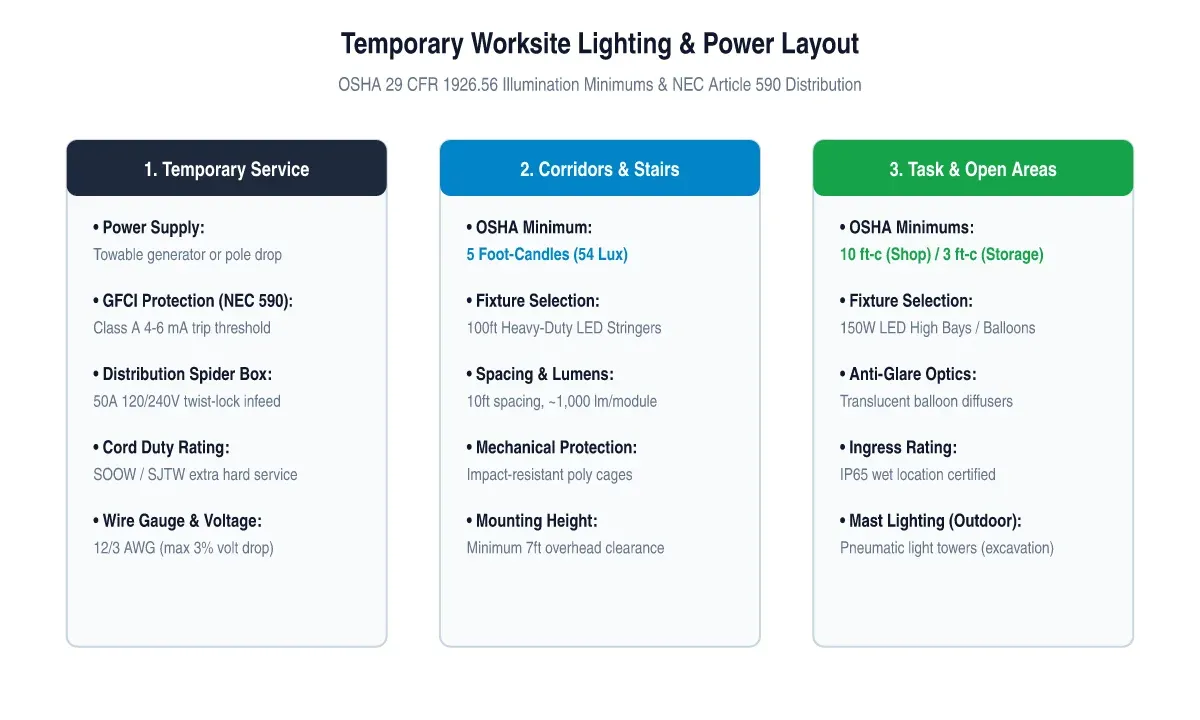
Inadequate worksite illumination is a primary contributor to construction tripping hazards, equipment collisions, and precision workmanship defects. During dark winter mornings, night shifts, and interior framing phases prior to utility energization, contractors must install and maintain temporary construction lighting that satisfies mandatory safety regulations.
Under federal safety law, jobsite lighting is not left to guesswork. The Occupational Safety and Health Administration (OSHA) enforces specific minimum illuminance thresholds measured at the working plane.
This guide details OSHA compliance requirements, temporary fixture selection, electrical code safeguards, and power sizing calculations.
1. OSHA 29 CFR 1926.56 Illumination Requirements
OSHA Table D-3 specifies the legal minimum light levels required across active construction areas:
| Area of Operation | Minimum Foot-Candles (ft-c) | Approximate Lux (lx) | Typical Worksites |
|---|---|---|---|
| Active Storage Areas & Yards | 3 ft-c | 32 lx | Outdoor equipment staging, refuse disposal, spoil piles |
| General Construction Area | 5 ft-c | 54 lx | Hallways, stairways, corridors, interior framing, access ramps |
| General Indoor Work | 5 ft-c | 54 lx | Drywall hanging, mechanical rough-in, conduit pulling |
| First Aid & Field Offices | 30 ft-c | 320 lx | On-site medical stations, site plan review desks |
| Shops & Precision Task Areas | 10 ft-c | 108 lx | Pipe threading, electrical panel assembly, rebar fabrication |
Measurement Rule: Illuminance must be verified using a calibrated photometer (lux meter) held at the task height (typically 30 inches above the floor or directly at the walking surface).
For hand-held and battery task fixtures, consult our portable work light buying guide.
2. Fixture Families: String Lights vs. High Bays vs. Balloon Lights
Modern temporary jobsite lighting has transitioned almost entirely to commercial LED fixtures:
A. Heavy-Duty LED String Lights
- Best For: Corridors, stairwells, and linear passageways.
- Specification Check: Look for 100-foot stringers featuring molded polycarbonate drop cages spaced every 10 feet. Modern LED stringers draw roughly 100W to 150W per 100 feet (outputting 10,000 to 15,000 lumens) and allow daisy-chaining up to 10 strings on a single 15A branch circuit.
B. Suspended High-Bay LED Fixtures (Corn Cobs & UFOs)
- Best For: Open interior deck framing and warehouse bays with ceiling heights above 12 feet.
- Specification Check: 100W to 150W high-bay fixtures with eye-hooks and heavy-gauge wire guards. Placing high-bay units on a 20-foot by 20-foot grid provides uniform 10 to 15 ft-c illumination without creating harsh shadow pockets.
C. Translucent Balloon Diffuser Lights
- Best For: Road paving, concrete finishing, and active excavation.
- Specification Check: Glare from bare halogen or open LED floodlights blinds heavy equipment operators and passing motorists. Balloon lights utilize an inflatable translucent envelope that diffuses light 360 degrees with zero glare and minimal harsh shadows.
3. Electrical Code Safety: NEC Article 590 & GFCI Protection
Temporary electrical setups are exposed to mud, vehicle traffic, and abrasive debris. The National Electrical Code (NEC Article 590) mandates specific precautions:
- Mandatory GFCI Protection: All 125-volt, single-phase, 15-, 20-, and 30-ampere temporary receptacle outlets must have Class A Ground-Fault Circuit-Interrupter (GFCI) protection for personnel. Portable distribution boxes (“spider boxes”) must be equipped with dedicated GFCI modules.
- Cord Duty Ratings: Flexible cords must be marked for hard service or extra-hard service (types S, SO, SOOW, ST, STO, or SJTW). Never use lightweight residential extension cords.
- Elevated Suspension: All temporary lighting strings must be suspended overhead using insulated hangers or non-conductive cable ties. Cords must never be fastened with metallic staples or uninsulated wire.
- Voltage Drop Mitigation: Long runs of 12-gauge cord combined with high lighting loads cause significant voltage drops. Keep voltage drops under 3% by upsizing extension trunk lines to 10 AWG for distances exceeding 100 feet.
If operating off-grid with inverter battery systems, review our guide on how to size a portable power station.
4. Worksite Power Sizing & Generator Sizing
Calculating total power requirements prevents nuisance breaker trips:
Total Wattage = Sum(Fixture Watts x Quantity) x 1.25 (Continuous Load Margin)Worked Example:
- 400 ft of LED string lights (4 × 150W = 600W)
- 8 × 150W High-Bay Area Fixtures (1,200W)
- 2 × 300W Task Floodlights (600W)
- Total Connected Load: 2,400 Watts.
- Continuous Load Safety Sizing (125%): 2,400 × 1.25 = 3,000 Watts.
A single 3,500W to 5,000W commercial jobsite generator or a 30A 120V spider box comfortably sustains this setup with ample headroom for intermittent cordless tool charging.
Sources and versions
- OSHA Standard 29 CFR 1926.56: Illumination , Occupational Safety and Health Administration Supports: Minimum illumination standards in foot-candles for construction areas
- NFPA 70: National Electrical Code (NEC) Article 590: Temporary Installations , National Fire Protection Association Supports: Requirements for temporary electrical services, GFCI protection, and cord protection on construction sites
Next steps
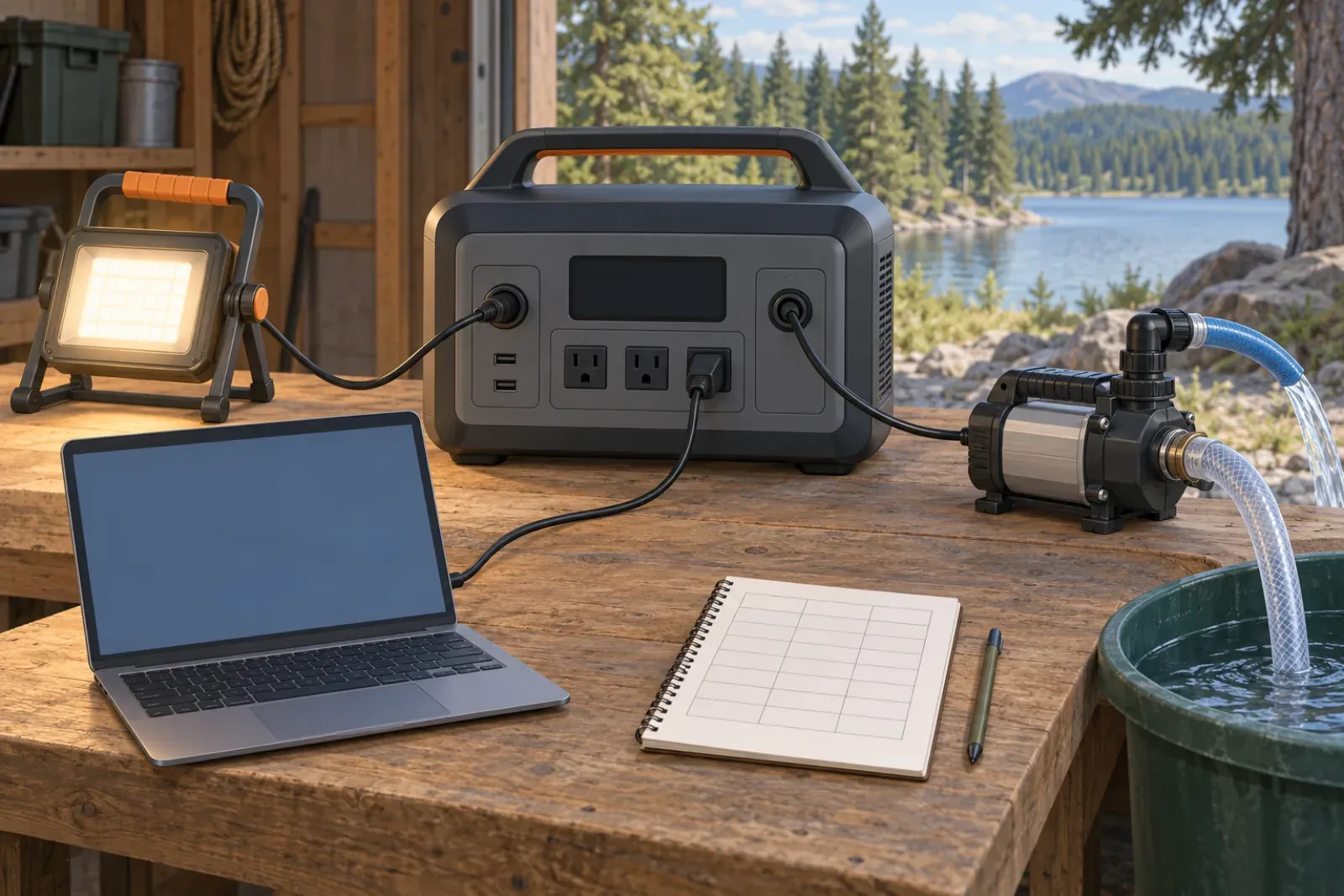
How to Size a Portable Power Station for Outdoor Work
Size a portable power station for outdoor work: list loads, check continuous and surge watts, estimate watt-hours with stated assumptions, and verify charging.
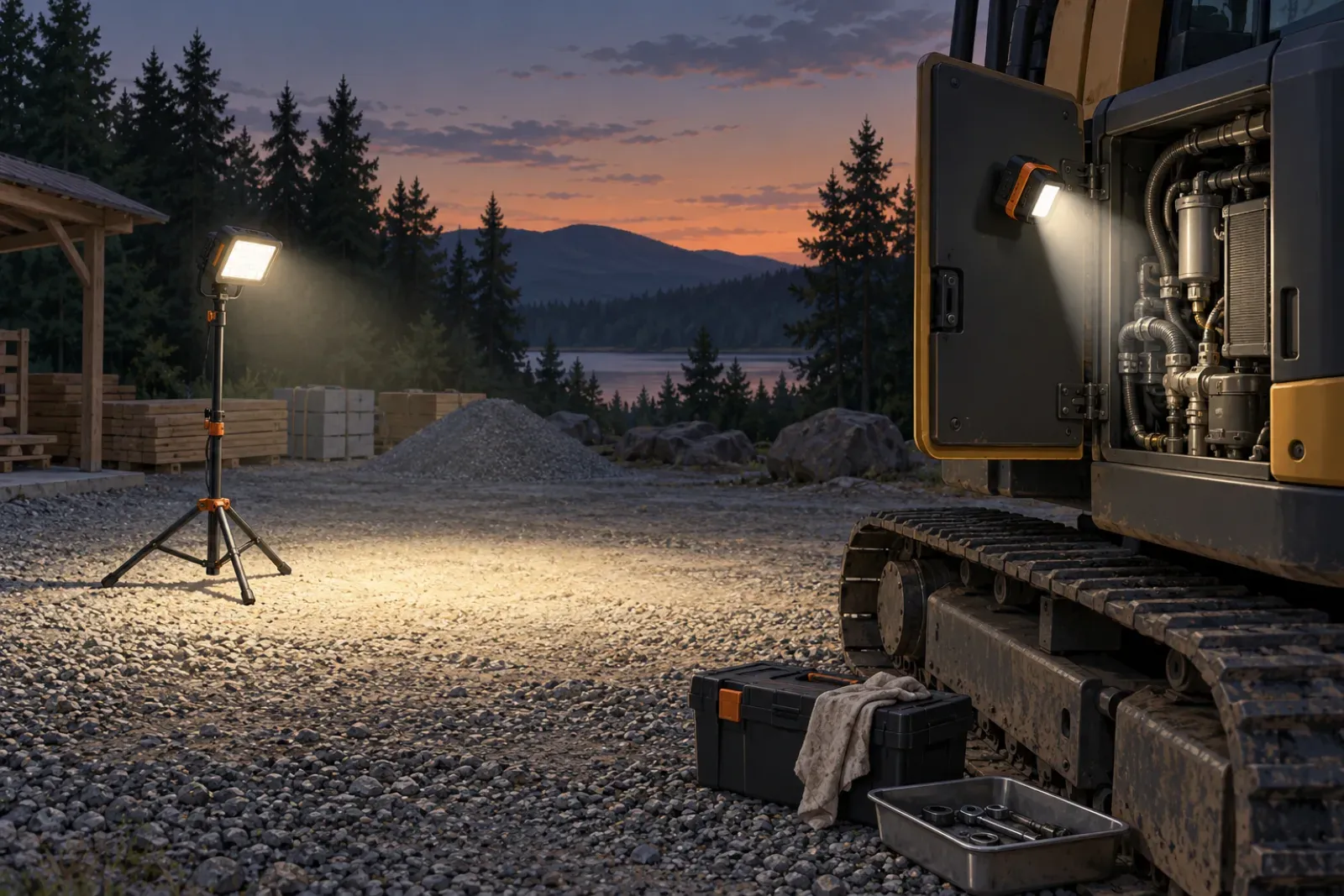
Portable Work Lights: A Buying Guide for Outdoor Teams
How outdoor teams can compare portable work lights: lumens vs lux, beam pattern, runtime claims, mounting, protection ratings, plus a supplier comparison sheet.