Whole-House Battery Backup vs. Portable Power Station: Split-Phase Loads and Transfer Switch Limits
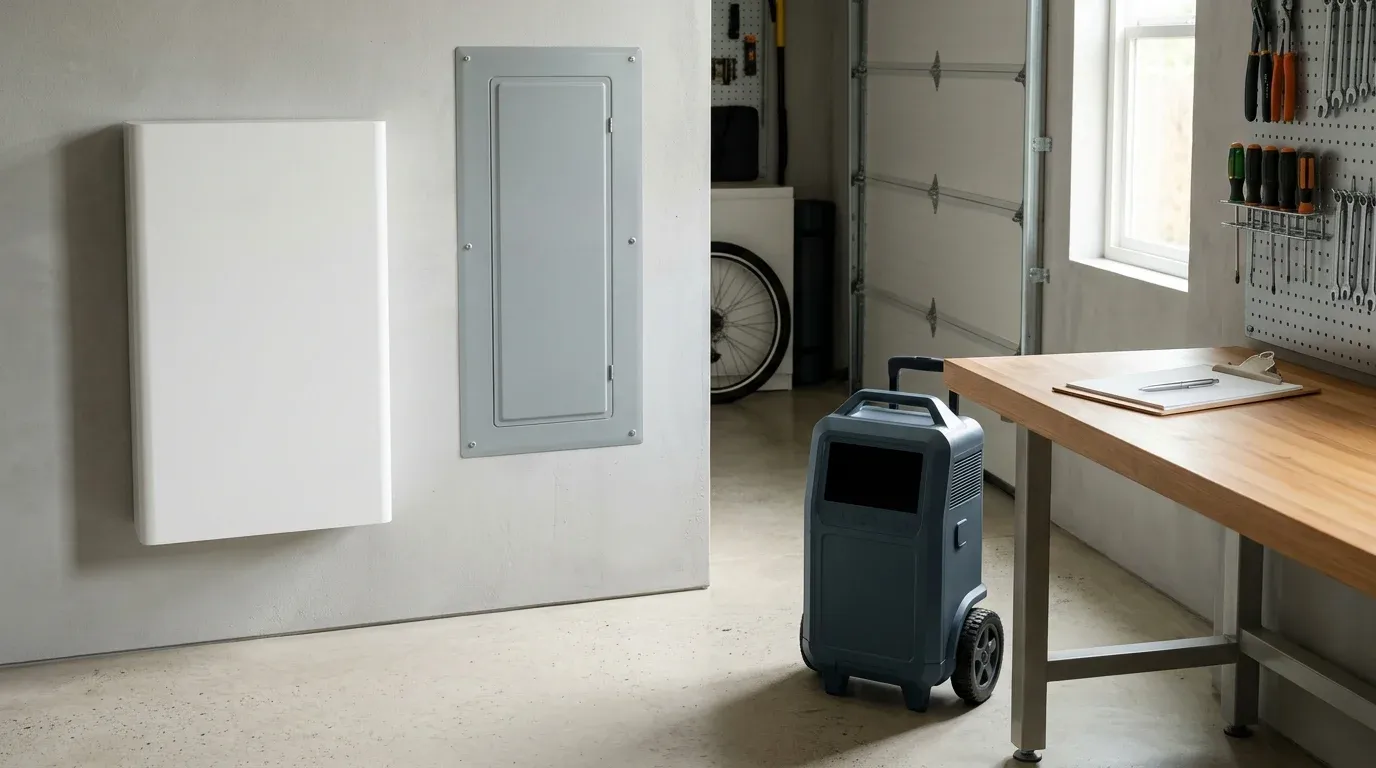
Selecting battery backup for whole house coverage versus a portable power station is an electrical architecture decision before it is a capacity calculation. Compare how each candidate power source connects to your building wiring, starts motor loads, and coordinates with your transfer switch before comparing storage sizes.
Screen your installation across four technical boundaries:
- Branch circuit voltage and phase configuration across single-phase and split-phase loads.
- Motor locked-rotor startup current alongside daily energy consumption.
- Transfer switch pole count, neutral-to-ground bonding, and branch breaker behavior.
- Residential fire-testing listings, physical enclosure weight, and qualified electrician installation scope.
Browse the Power & Lighting guides to connect this architecture review with your wider site equipment plan.
Screen your electrical architecture before comparing batteries
Start your screening record by separating branch-circuit requirements from marketing labels. Buyers searching for a home battery backup without solar or comparing the best solar generator for home backup should verify branch circuit voltage, motor startup current, and transfer switch compatibility on a single worksheet before selecting hardware.
Scroll horizontally to see all columns.
| Screening boundary | Document to inspect | What to record on your worksheet |
|---|---|---|
| Voltage and phase | Battery or station datasheet and branch panel schedule | Whether the load requires single-phase or split-phase supply and whether an external hub is required |
| Motor starting demand | Submersible pump or compressor motor nameplate and manual | Running wattage, full-load current, and locked-rotor current alongside the battery startup specification |
| Transfer switch and neutral path | Transfer switch manual and power source manual | Whether the switch uses a solid neutral or a sequentially switched neutral pole |
| Branch circuit grouping | Panel schedule and transfer switch wiring guide | Shared-neutral multi-wire branch circuits and double-pole circuits that require handle ties |
| Physical installation and listing | Equipment datasheet and local building rules | Unit weight, mounting method, enclosure type, and energy storage safety listing |
When your outage plan only covers individual corded household appliances such as a kitchen refrigerator, a freestanding lamp, or a communication router without panel wiring, use the direct-appliance home outage guide instead of installing a transfer switch.
Compare stationary split-phase systems and portable power stations
Stationary home battery systems and portable power stations differ in how they deliver alternating current, isolate from the utility grid, and expand capacity. Use the published datasheet and user manual for each candidate model to compare nominal grid voltage, continuous power, motor-starting current, and expansion options.
Stationary split-phase battery specifications
Review the published specifications for stationary systems by recording each model on its own worksheet line:
- In the Tesla Powerwall 3 datasheet, power scalability supports up to 4 Powerwall 3 units.
- For Tesla Powerwall 3, supported islanding devices are Gateway 3, Backup Switch, and Backup Gateway 2.
- On the Tesla North America datasheet, the nominal grid voltage for input and output is 120/240 VAC.
- On the Tesla North America datasheet, the grid type is split phase.
- On the Tesla North America datasheet, the overcurrent protection device rating is 60 A.
- On the Tesla North America datasheet, the nominal battery energy is 13.5 kWh AC.
- On the Tesla North America datasheet, the maximum continuous discharge power is 11.5 kW AC.
- On the Tesla North America datasheet, the maximum continuous charge power is 5 kW AC.
- On the Tesla North America datasheet, the maximum continuous current is 48 A.
- On the Tesla North America datasheet, the 1-second load start capability is 185 A LRA.
- On the Tesla North America datasheet, the maximum solar STC input is 20 kW.
- On the Tesla North America datasheet, the warranty period is 10 years.
For a modular AC-coupled stationary battery comparison, record the published Enphase specifications separately:
- For the Enphase IQ Battery 5P (model IQBATTERY-5P-1P-NA), the rated continuous AC output power is 3.84 kVA at 240 VAC.
- For the Enphase IQ Battery 5P, the peak AC output power is 7.68 kVA for three seconds and 6.14 kVA for ten seconds.
- For the Enphase IQ Battery 5P, the rated output current at 240 VAC is 16 A.
- For the Enphase IQ Battery 5P, the peak output current at 240 VAC is 32 A for three seconds and 25.6 A for ten seconds.
- For the Enphase IQ Battery 5P, the Power Start capability is up to 48 A LRA.
- For the Enphase IQ Battery 5P, the usable battery capacity is 5.0 kWh.
Portable power station specifications
Compare those stationary split-phase figures against published portable power station manuals:
- In the EcoFlow DELTA Pro user manual, the battery capacity is 3,600Wh, 48V.
- In the EcoFlow DELTA Pro user manual for US/CA, the AC output is pure sine wave, 3,600W total (surge 7,200W), at 120V (60Hz).
- In the EcoFlow DELTA Pro user manual for US/CA, AC charge input is 120V 1,800W Max and 240V 3,000W Max.
- In the EcoFlow DELTA Pro user manual, the solar charger input is 11-150V, 15A Max, 1,600W Max.
- In the EcoFlow DELTA Pro user manual, the battery cell chemistry is LFP with a cycle life of 3,500 cycles to 80%+ capacity.
- A single DELTA Pro can link with up to two Smart Extra Batteries at once for added capacity.
- With EcoFlow X-Boost technology, the product can power a 4,500W max. device while rated output power remains 3,600W, and X-Boost is incompatible with appliances that have strict voltage requirements.
- In the EcoFlow DELTA Pro EPS section, in a sudden blackout, the product can automatically switch to battery-powered supply mode within 30ms and does not support 0ms switching.
- In the EcoFlow DELTA Pro user manual, the Double Voltage Hub (US/CA) is listed as an add-on sold separately.
- In the EcoFlow user manual, Model EFD350 weighs approximately 23 kg and has a capacity of 2,048Wh.
- For this EcoFlow model in US/CA, the AC output is pure sine wave, 2,400W total (surge 4,800W), at 120V~50Hz/60Hz.
Keep each model specification attached to its exact manual edition. Record the exact voltage requirement of each appliance on your worksheet before relying on voltage-reduction modes or external hub accessories.
Match well pumps and compressor startups to motor-starting limits
Submersible well pumps, air conditioners, and refrigeration equipment require checking both startup demand and continuous running draw on your screening sheet.
Refrigerators, freezers, and air conditioners place a high demand on the power source when the compressor cycles on, commonly known as surge power.
When screening a deep-well water system or compressor load, copy the full-load running figures and the locked-rotor startup current directly from the motor manual or rating plate. Compare the following published submersible pump motor rows:
- In Table 13, Franklin single-phase motor model 244505 (1/2 HP, 0.37 KW, 230 VOLTS, 60 HZ) has 5.0 full-load AMPS, 670 full-load WATTS, and 32.2 locked-rotor AMPS.
- In Table 13, Franklin single-phase motor model 244507 (3/4 HP, 0.55 KW, 230 VOLTS, 60 HZ) has 6.8 full-load AMPS, 940 full-load WATTS, and 40.7 locked-rotor AMPS.
- In Table 13, Franklin single-phase motor model 244508 (1 HP, 0.75 KW, 230 VOLTS, 60 HZ) has 8.2 full-load AMPS, 1210 full-load WATTS, and 48.7 locked-rotor AMPS.
Check the motor voltage and locked-rotor current against your candidate battery datasheet before estimating runtime. Compare the motor nameplate voltage and locked-rotor current against the candidate battery output voltage and load-start specification on your worksheet.

Once you confirm that the battery architecture matches the motor voltage and startup current, calculate daily energy demand from the running power and operating schedule.
Daily kilowatt-hour (kWh) consumption equals Wattage multiplied by Hours Used per Day divided by 1000, where 1 kilowatt (kW) equals 1,000 Watts.
Enter the running watts and daily operating hours for each circuit into the portable power station sizing guide to organize your multi-load energy worksheet and reserve margin. If a multi-day outage schedule exceeds practical battery storage and requires outdoor fuel replenishment, compare your options in the portable power station versus generator guide.
Check transfer switch poles, neutral bonding, and branch protection
Connecting a portable power station or generator to building branch circuits requires proper isolation between the backup source and the utility grid.
Attaching a generator directly to a building electrical system without a properly installed transfer switch can energize wiring systems for great distances. Transfer switches are required for use with portable generators by Article 702 of the 2017 National Electrical Code. In the Reliance Controls manual transfer switch instructions, improper installation of the transfer switch could cause damage or personal injury by electrocution or fire, and installation must be performed by a qualified electrician.
Before selecting a transfer switch for generator or portable battery input, verify how the switch handles utility isolation, double-pole circuits, and shared-neutral wiring:
- The double-throw action of the switches prevents feeding generator power to the utility and prevents feeding utility power to the generator.
- The Reliance Pro/Tran2 series is UL Listed to Standard 1008.
- In the Reliance Controls manual transfer switch instructions, any two adjacent circuit selector switches may be used for a double-pole 240-volt circuit with a handle tie, and only circuits A and B may be used for 30-amp circuits.
- For a multi-wire branch circuit, the two circuits sharing the neutral must be connected to opposing legs (phases) of the generator power with a handle tie installed so that both legs are transferred at the same time.
- Failure to properly install a multi-wire branch circuit could result in overloading the neutral wire.
- In the Reliance Controls manual transfer switch instructions, when the transfer switch is connected to branch circuits with AFCI or GFCI breakers, AFCI or GFCI protection will be lost when the toggle switch in the transfer switch is in the GEN position.
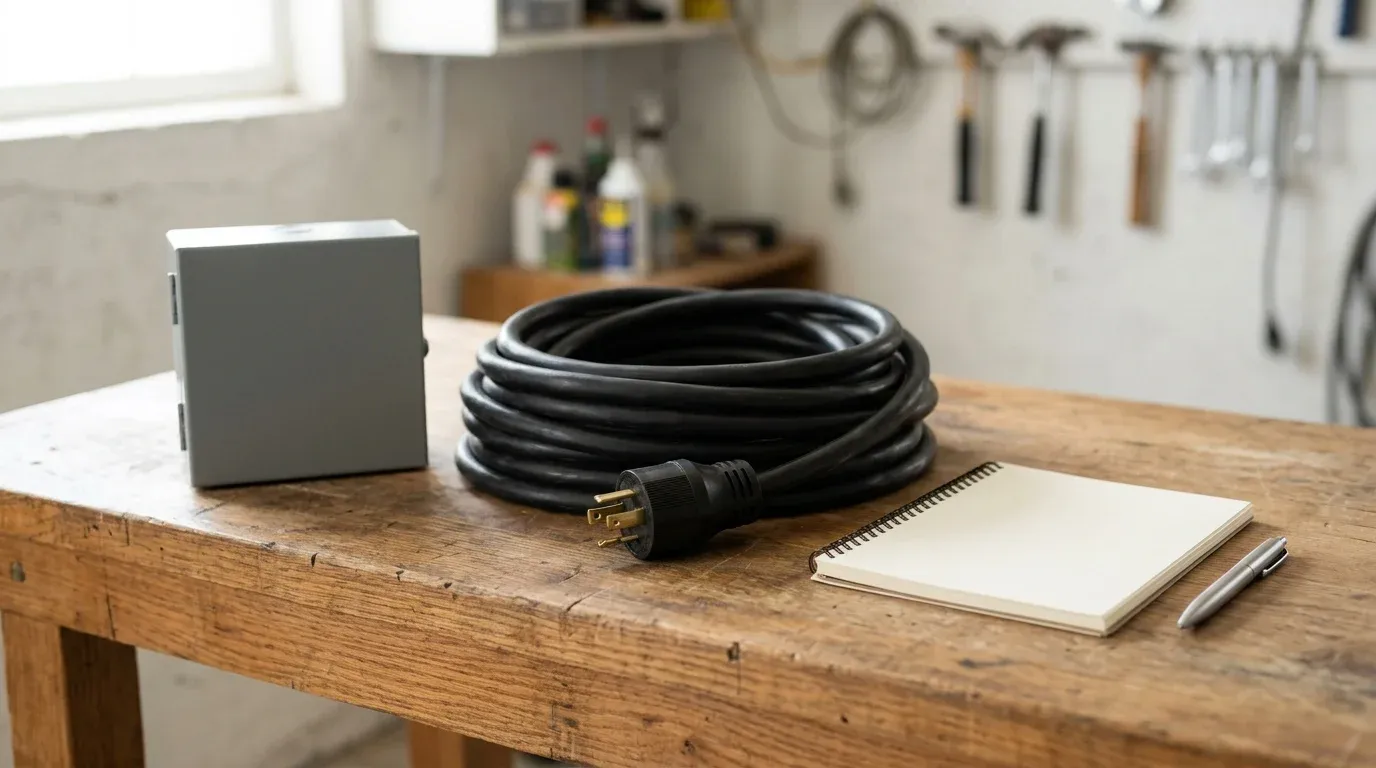
Solid-neutral versus sequentially switched-neutral transfer switches
Check whether the neutral-to-ground configuration of the power source matches the neutral path inside the transfer switch.
Bonding is the intentional connection between the grounded circuit conductor (neutral) and the grounding means for the generator.
Review the transfer switch documentation alongside the power source manual to match floating-neutral and bonded-neutral arrangements:
- The Reliance Protran2 Transfer Switch is a two-pole transfer switch that does not switch the neutral wire and is intended to be used with a generator that has a floating neutral configuration.
- Contractor-grade portable generators have their neutral wire bonded to the ground wire to pass OSHA inspection, which may cause nuisance tripping of the generator GFCI breaker when connected to a transfer switch.
- The Reliance Panel/Link X Series is a double-pole manual transfer switch with an exclusive third-pole for the neutral that switches sequentially.
- On GFCI protected generators, the Panel/Link X Series prevents a ground fault and prevents circuit breakers on the generator from nuisance tripping.
- If the neutral bond cannot be removed or voids the warranty, a Switched Neutral Kit (SNK, Generac model 6297) 30 Amp accessory must be installed with transfer switch 6382, and is not available for transfer switch 6335.
Never guess whether a portable power station or generator has a floating neutral or a bonded neutral. Record the neutral configuration from the manufacturer manual and hand that specification to your electrician before ordering the transfer switch.
Review residential fire-testing scope, unit weight, and mounting
Stationary whole-house battery systems and portable power stations also involve different residential installation rules and physical handling checks. Check the residential code references, fire-testing evaluations, enclosure ratings, and installed weights in each manufacturer datasheet before selecting an installation location.
Compare the published safety listings, fire-testing evaluations, enclosure types, and physical weights across your candidates:
- The intent of the 2018 IRC Section R327.2 is that energy storage systems (ESS) be Listed (Certified) to UL 9540, and markings noting “Suitable For Use in Residential Dwelling Units Where Permitted” or similar indicate that the energy storage system has successfully completed the cell-level fire testing as required in UL 9540A.
- On the Tesla North America datasheet, listed certifications include UL 1741, UL 1973, and UL 9540.
- On the Tesla North America datasheet, for fire testing, the unit meets the unit level performance criteria of UL 9540A.
- On the Tesla North America datasheet, the enclosure rating is NEMA 3R.
- On the Tesla North America datasheet, the weight is 130 kg (287 lb).
- The Enphase IQ Battery 5P is evaluated to UL 9540A for thermal runaway fire propagation.
- For the Enphase IQ Battery 5P, the total installed weight is 78.9 kg (174 lb).
- In the EcoFlow DELTA Pro user manual, the net weight is approximately 45kg (99 lbs).
Record the installed weight and mounting requirements on your site sheet before choosing an installation wall or utility corner. Share the enclosure dimensions, installed weight, and electrical single-line diagram with your electrician to plan wall framing, conduit routing, or indoor portable staging space.
Complete the backup architecture and transfer switch worksheet
Download the whole-house battery versus portable station and transfer switch screening worksheet to structure your inspection record before requesting quotes or purchasing hardware.

For each circuit and candidate backup system, fill in:
- Circuit name, panel breaker poles, and required nominal voltage.
- Connected motor or appliance model, full-load running watts, full-load current, and locked-rotor startup current.
- Daily operating hours and calculated daily energy consumption.
- Multi-wire branch circuit shared-neutral status and handle-tie requirement.
- Existing branch breaker fault-protection type and transfer switch position behavior.
- Candidate battery or portable station model, manual edition, continuous output, startup capability, and usable energy capacity.
- Transfer switch model, pole count, neutral switching behavior, and power source neutral-to-ground configuration.
- Enclosure weight, mounting location, safety listing documentation, and electrician verification notes.
Review the completed worksheet with your electrician to confirm panel compatibility and local permitting requirements. For additional procurement and planning sheets, visit the equipment checklists and templates page.
Frequently asked questions
Can a stationary home battery operate as a home battery backup without solar?
On the Tesla North America datasheet, the maximum continuous charge power is 5 kW AC. On the Tesla North America datasheet, the maximum continuous discharge power is 11.5 kW AC. For Tesla Powerwall 3, supported islanding devices are Gateway 3, Backup Switch, and Backup Gateway 2. Record the AC charge power, AC discharge power, and supported islanding device from your candidate battery datasheet on the screening worksheet.
Why does a generator or power station trip its breaker when plugged into a manual transfer switch?
Contractor-grade portable generators have their neutral wire bonded to the ground wire to pass OSHA inspection, which may cause nuisance tripping of the generator GFCI breaker when connected to a transfer switch. On GFCI protected generators, the Panel/Link X Series prevents a ground fault and prevents circuit breakers on the generator from nuisance tripping. Check the neutral configuration in your power source manual and transfer switch documentation before ordering hardware.
What happens to multi-wire branch circuits on a manual transfer switch?
For a multi-wire branch circuit, the two circuits sharing the neutral must be connected to opposing legs (phases) of the generator power with a handle tie installed so that both legs are transferred at the same time. Failure to properly install a multi-wire branch circuit could result in overloading the neutral wire.
Can a single portable power station run a submersible well pump?
In the EcoFlow DELTA Pro user manual for US/CA, the AC output is pure sine wave, 3,600W total (surge 7,200W), at 120V (60Hz). In the EcoFlow DELTA Pro user manual, the Double Voltage Hub (US/CA) is listed as an add-on sold separately. Check the submersible pump motor voltage and locked-rotor current on your worksheet before selecting a power source.
Sources
- Tesla — Powerwall Datasheet
- Enphase Energy — IQ Battery Data Sheet
- EcoFlow — DELTA Pro User Manual
- EcoFlow — DELTA 2 Max User Manual
- Reliance Controls — Manual Transfer Switch Installation and Operating Instructions
- Reliance Controls — Full Line Transfer Switch Catalog
- Reliance Controls — Transfer Switch Technical Bulletin
- Generac Power Systems — Manual Transfer Switch Owner’s Manual
- OSHA — Fact Sheet on Using Portable Generators Safely
- OSHA — Fact Sheet on Grounding Requirements for Portable Generators
- Franklin Electric — Submersible Motors Application, Installation, Maintenance Manual
- UL Code Authorities — Energy Storage Systems
- Virginia Cooperative Extension — Estimating Appliance Energy Use
- GE Appliances — Running an Appliance on a Generator
Downloads
- Whole-house battery versus portable station and transfer switch screening worksheet CSV Record branch circuit voltage, motor locked-rotor amps, transfer switch pole count, neutral configuration, and enclosure mounting details.
Next steps
Portable Power Station for Home Backup: Appliance Startup Checks, Duty Cycles, and Corded Load Limits
Plan a portable power station for home backup: check appliance surge demand, refrigerator duty cycles, cord limits, and your outage load worksheet.
How to Size a Portable Power Station for Outdoor Work
Size a portable power station for outdoor work: list loads, check continuous and surge watts, estimate watt-hours from the hours and the loss and reserve you write down, and verify charging.
Portable Power Station vs Generator: Choosing a Power Source for Outdoor Work
Compare portable power stations, fuel and inverter generators, and battery-inverter systems for outdoor work by load, replenishment, safety and upkeep.

Portable Power & Lighting
Work out how much portable power and light an outdoor site needs, then compare options and put the requirement into a purchase request.