IP65 vs IP67: Water Jets vs Temporary Submersion
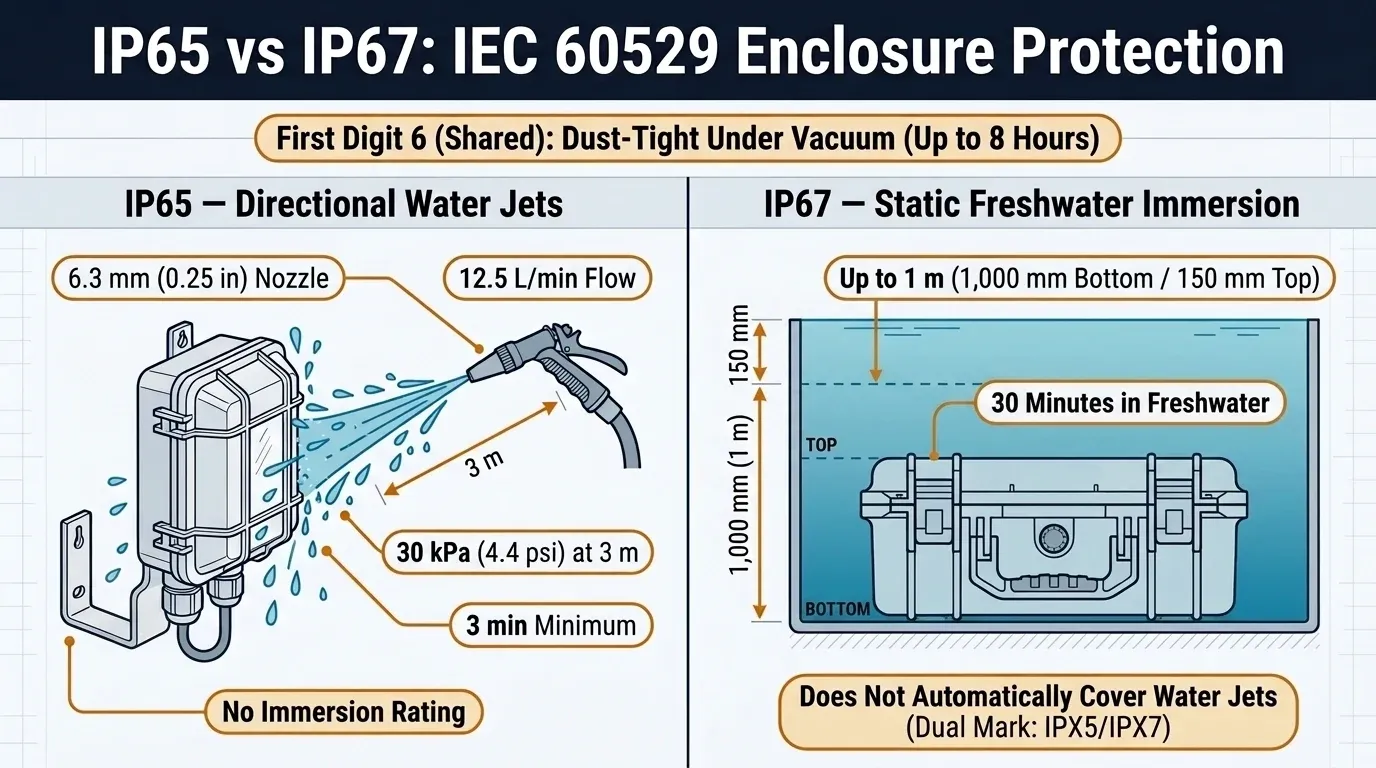
Both IP65 and IP67 provide level 6 dust-tight sealing under IEC 60529, yet their water digits test separate hazards: IP65 resists directional 6.3 mm nozzle water jets at 12.5 litres per minute and 30 kPa, whereas IP67 covers 30-minute freshwater immersion up to 1 meter without automatically covering water jets.
When comparing ip65 vs ip67 for work lights, junction housings, or transport trunks, read the two digits independently and match the second digit to how water strikes the seal. Within the Cases & Protection hub, pair this comparison with IP ratings for outdoor equipment for whole-product versus component claim boundaries and the waterproof equipment case procurement checklist for interior sizing, latches, and spare seals.
Scroll horizontally to see all columns.
| IEC 60529 Rating | First Digit (Solids & Dust) | Second Digit Test Mode | Nozzle Size or Depth Datum | Flow Rate & Pressure | Minimum Duration & Cumulative Rule |
|---|---|---|---|---|---|
| IP65 | Level 6 dust-tight (no dust ingress under vacuum up to 8 hours) | Directional water jets from any direction | 6.3 mm (0.25 in) nozzle at 3 m (9.8 ft) distance | 12.5 litres/min at 30 kPa (4.4 psi) | 1 min per square meter, at least 3 min; cumulative through IPX5, zero immersion rating |
| IP66 | Level 6 dust-tight (complete contact protection, zero dust ingress) | Powerful water jets from any direction | 12.5 mm (0.49 in) nozzle at 3 m (9.8 ft) distance | 100 liters/min at 100 kPa (15 psi) | 1 min per square meter, at least 3 min; cumulative through IPX6, zero immersion rating |
| IP67 | Level 6 dust-tight (vacuum-tested solid-particle seal) | Temporary static freshwater immersion | Up to 1 m (3 ft 3 in): lowest point 1,000 mm (39 in) or highest point 150 mm (5.9 in) below surface | Static freshwater head at test depth (no nozzle flow) | 30 minutes; non-cumulative above IPX6 (does not cover IPX5 or IPX6 jets alone) |
| IP68 | Level 6 dust-tight (same level 6 solid-particle tier) | Continuous freshwater immersion | 1 m (3 ft 3 in) or more, specified by manufacturer (generally up to 3 m / 9.8 ft) | Static head at manufacturer-specified depth (no nozzle flow) | Specified by manufacturer (greater than IPx7); non-cumulative for water jets unless dual-marked |
| IP65/IP67 or IP66/IP67 | Level 6 dust-tight (shared across both paired ratings) | Both directional water jets and temporary immersion | 6.3 mm or 12.5 mm nozzle at 3 m plus 1 m immersion datum | 12.5 L/min at 30 kPa (IPX5) or 100 L/min at 100 kPa (IPX6) plus 1 m static head | At least 3 min jet test plus 30 min immersion on the same sample and closed configuration |
| IPx9 / IP69K | IPx9 leaves dust unstated (X); IP69K pairs dust-tight level 6 under ISO 20653 | Close-range high-pressure, high-temperature spray downs | IEC 60529 / ISO 20653 nozzle at 0.10–0.15 m (0.15–0.2 m freehand on larger specimens) | 14–16 liters/min at 8–10 MPa (80–100 bar) and 80 °C (176 °F) | 30 sec in each of 4 turntable angles (2 min total) or 1 min/m2 freehand (3 min minimum) |
What Is the Real Difference Between IP65 and IP67 Enclosures?
IP65 and IP67 share identical level 6 dust-tight protection under IEC 60529 Consolidated edition 2.2 (2013), yet IP65 tests 6.3 mm nozzle water jets from 3 meters while IP67 tests 30-minute static freshwater submersion up to 1 meter—and passing IPX7 immersion does not prove compliance with IPX5 or IPX6 jets.
The International Electrotechnical Commission defines the Ingress Protection code under IEC 60529, published in the European Union by CENELEC as EN 60529, to classify how mechanical casings and electrical enclosures guard against intrusion, dust, accidental contact, and water. Instead of relying on undefined marketing labels such as waterproof, the code assigns separate digits to solid-particle and liquid laboratory tests.
How First Digit 6 and IP Code Notation Work
Both IP65 and IP67 carry dust-tight level 6 as their first numeral under IEC 60529. Level 5 (dust protected) does not completely stop dust from entering, requiring only that dust not enter in sufficient quantity to interfere with safe equipment operation. Level 6 (dust-tight) permits no ingress of dust and requires complete protection against contact while a vacuum is applied for a test duration of up to 8 hours based on airflow.
Read placeholder letters and punctuation literally when screening supplier datasheets:
- Digit 0 means no protection is provided against that hazard.
- The letter X replaces a digit when insufficient data has been gathered to assign a protection level, so the X in IPX7 says nothing about dust protection.
- Standard IP codes never contain hyphens, which makes hyphenated strings such as IPX-8 invalid IP codes.
Why IP67 Immersion Does Not Cover IP65 Water Jets
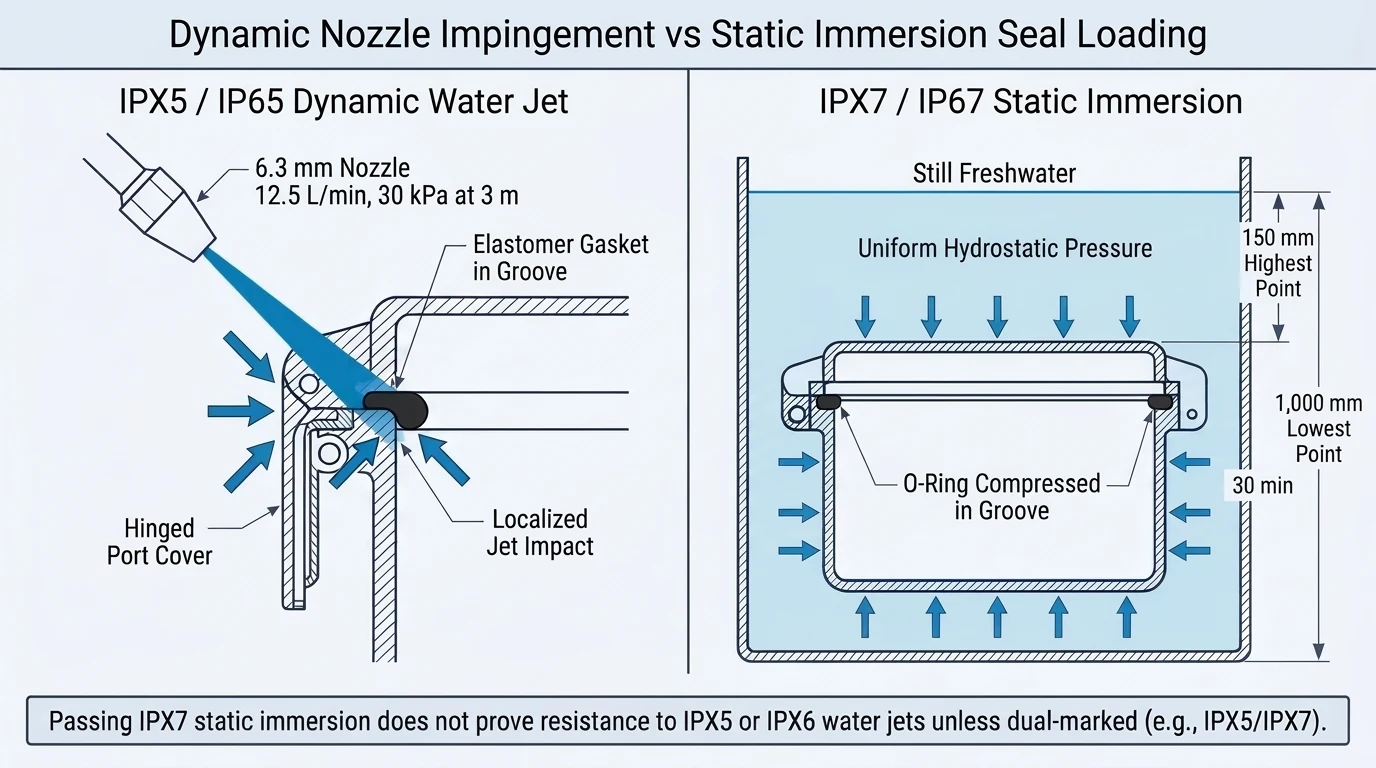
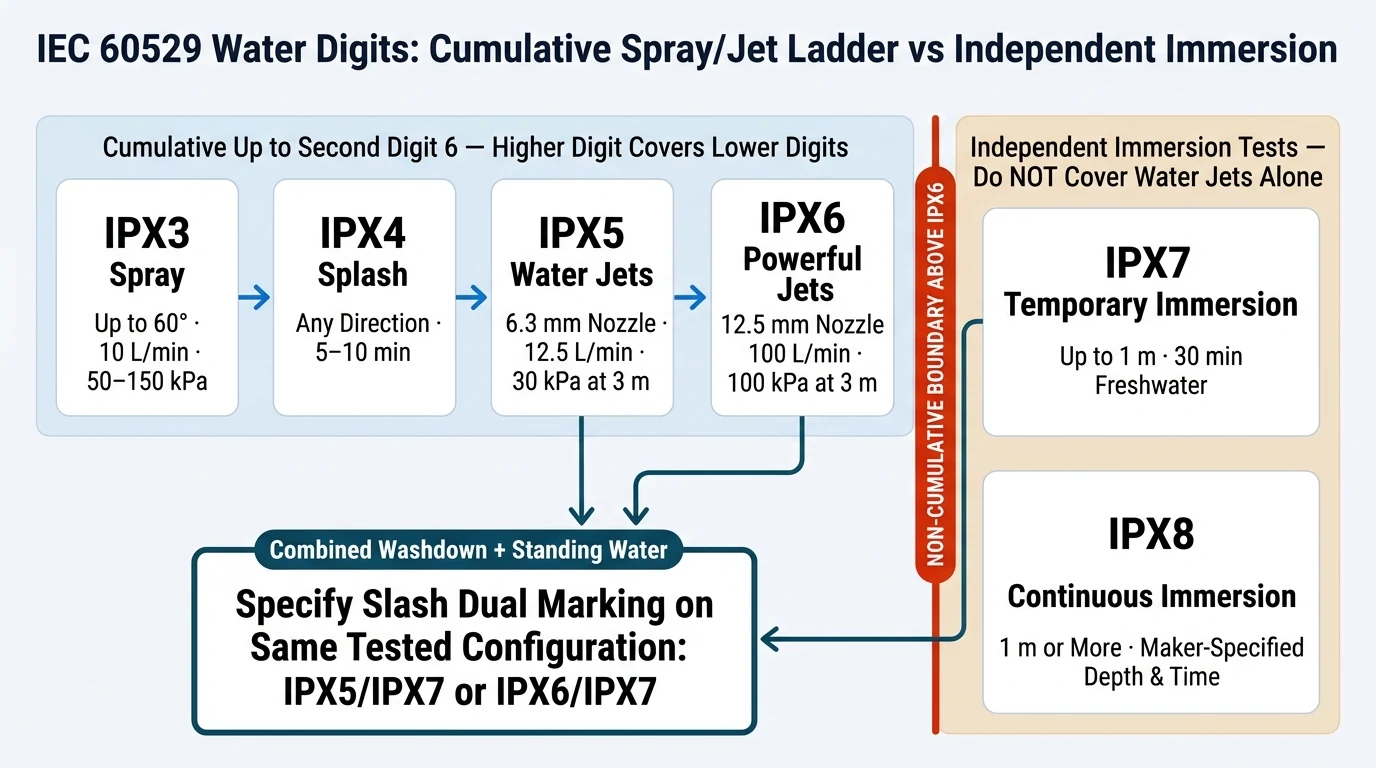
Up to second digit 6, a higher water numeral covers the lower water tests beneath it, whereas digits 7 and 8 do not. Under IEC 60529, water ingress ratings are not cumulative beyond IPX6: an enclosure compliant with IPX7 water immersion is not necessarily compliant with IPX5 or IPX6 water jets.
The two test setups load perimeter gaskets and port covers in different ways. During the level 5 jet test, a 6.3 mm (0.25 in) nozzle projects 12.5 litres per minute at 30 kPa (4.4 psi) from a 3-meter (9.8 ft) standoff against the housing from any direction for 1 minute per square meter and at least 3 minutes. During the level 7 immersion test, the enclosure sits in still freshwater for 30 minutes with its lowest point 1,000 mm (39 in) below the surface, or its highest point 150 mm (5.9 in) below the surface, whichever is deeper. When a device passes both tests, IEC 60529 indicates dual compliance by separating the two ratings with a slash, such as IPX5/IPX7 or IPX6/IPX7.
Is IP65 Enough for Outdoor Rain Exposure and Hose Spray?
IP65 handles general outdoor rain, wind-blown splash, and low-pressure rinse hoses within its 6.3 mm nozzle, 12.5 litres per minute, and 30 kPa test envelope at 3 meters, whereas heavy washdown rigs exceed IP65 and long-term outdoor UV, ice, corrosion, and condensation sit outside IEC 60529 testing.
Because water numerals are cumulative up to level 6, an IP65 housing covers the lower spray and splash tests below it. Level 3 protects against spraying water at any angle up to 60 degrees from the vertical—running 1 minute per square meter for at least 5 minutes at 10 liters per minute and 50–150 kPa (7.3–21.8 psi) on the spray-nozzle test—and level 4 protects against water splashing from any direction for 10 minutes with an oscillating fixture or at least 5 minutes with an unshielded spray nozzle. Level 5 adds omnidirectional 6.3 mm (0.25 in) water jets at 12.5 litres per minute and 30 kPa (4.4 psi) from 3 meters (9.8 ft) for at least 3 minutes.
Passing a short freshwater spray test on a benchtop does not establish multi-season outdoor durability. Under OSHA electrical enclosure definitions, watertight means constructed so moisture will not enter the enclosure, whereas weatherproof means constructed or protected so exposure to weather will not interfere with successful operation—a requirement that rainproof, raintight, or watertight equipment fulfills only where snow, ice, dust, or temperature extremes are not a factor. An IP rating applies to a new sample in its tested size and closed-cover configuration and says nothing about UV, corrosion, temperature cycling, condensation, seal aging, impact, or cleaning chemicals. When hose crews step up above 12.5 litres per minute or 30 kPa, move up to IP66 (100 liters per minute at 100 kPa), NEMA Type 4 or 4X (at least 65 GPM from a 1-inch nozzle at 10 feet for 5 minutes), or IPx9 / IP69K for close-range 80 °C high-pressure washdowns.
Is IP67 Really Waterproof for Temporary Immersion?
IP67 is a bounded laboratory claim—not an unlimited waterproof guarantee—covering dust-tight protection plus immersion in freshwater up to 1 meter (1,000 mm bottom or 150 mm top depth) for up to 30 minutes on a new sample with every cover, plug, cable gland, and valve in its tested state.
Rather than relying on vague labels, IEC 60529 defines IP67 around two strict immersion reference points: for 30 minutes, harmful water ingress is not permitted with the lowest point of the enclosure 1,000 mm (39 in) below the water surface, or the highest point 150 mm (5.9 in) below the surface, whichever is deeper. That dual datum ensures taller enclosures still keep at least 150 mm (5.9 in) of water above their highest point when 1,000 mm (39 in) measured to the bottom would not immerse the top.
Four field conditions separate a valid IP67 laboratory pass from actual jobsite protection:
- Fluid chemistry: Standard IP testing uses fresh water, so protection against salt water, oils, or solvents is not guaranteed by an IP67 mark and requires specific chemical resistance testing.
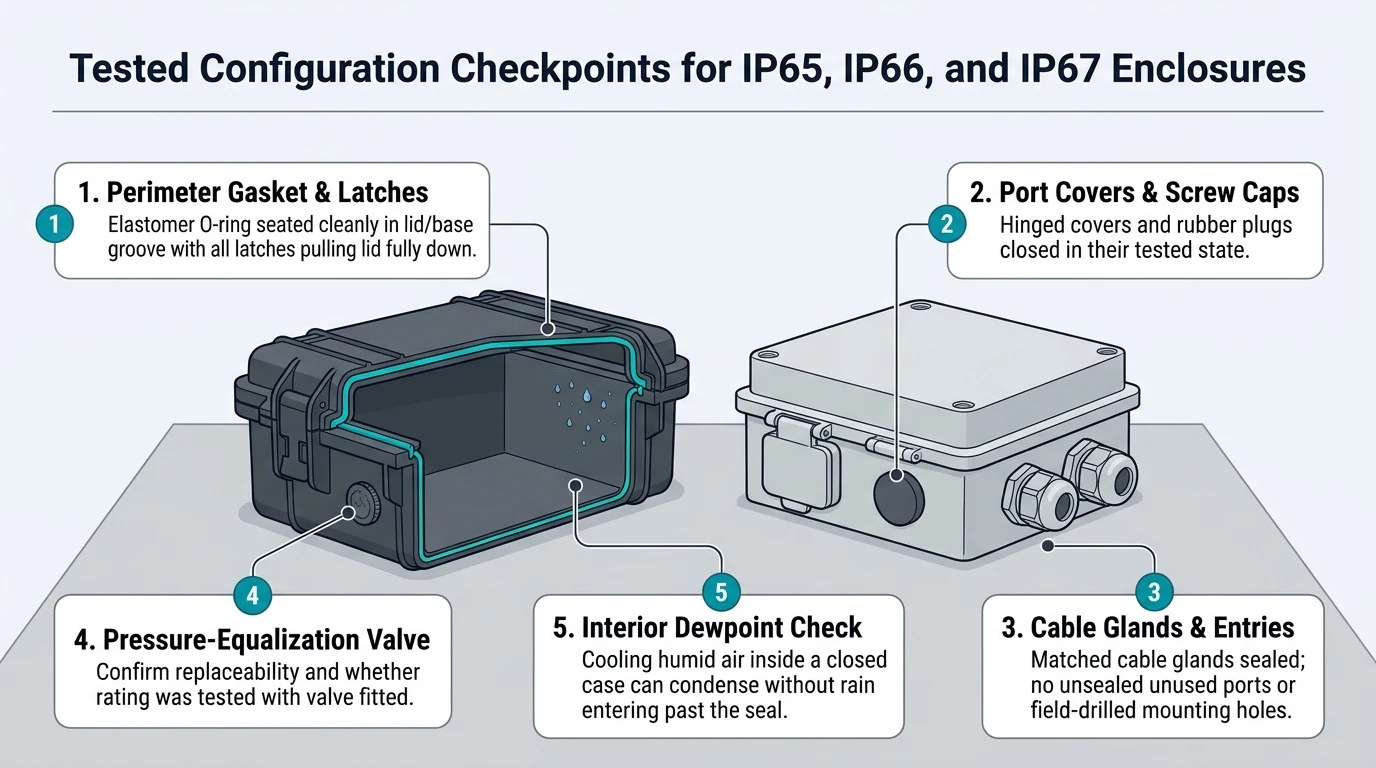
- Closed covers and cable entries: Hinged port covers, rubber plugs, screw caps, and matched cable glands are part of the tested enclosure configuration; drilling a mounting hole, adding an unmatched cable gland, leaving an unused gland unsealed, or operating with an open cover voids that state.
- Case-versus-device separation and seal hardware: A rated case protects its contents only while closed and in good condition, and most waterproof cases compress a gasket or O-ring in a groove when latched while many include a pressure-equalization valve for altitude or temperature changes—verify whether the seal and valve are user-replaceable and whether the published rating was tested with the valve fitted.
- Dewpoint condensation versus seal failure: Pressure valves can permit airflow while repelling water, and humid air already inside a closed case reaches saturation at its dewpoint as it cools, so droplets on an inner lid do not by themselves prove rain entered past the gasket; log moisture observations with the equipment-case condensation record.
Between IP65 and IP67, Which Is Better When Washdown Spray Is Present?
When washdown hoses spray equipment directly, IP65—or IP66 for heavier jets—is the relevant IEC 60529 choice because bare IP67 proves static immersion only and has not claimed jet resistance; sites facing both hose spray and standing-water flooding require a dual-rated IPX5/IPX7 or IPX6/IPX7 enclosure.
Under OSHA electrical location definitions, partially protected outdoor areas under canopies, marquees, or roofed open porches are classified as damp locations, whereas underground installations, concrete slabs or masonry in earth contact, vehicle-washing areas subject to water saturation, and unprotected weather-exposed sites are wet locations. OSHA general electrical requirements prohibit locating conductors or electrical equipment in damp or wet locations or exposing them to deteriorating liquids, fumes, vapors, or excessive temperatures unless identified for use in that operating environment, and require outdoor electric equipment to sit in suitable enclosures protected from unauthorized contact, vehicular traffic, and piping spillage or leakage.
Match the rating directly to the hydraulic exposure on your pad or transport route:
- Rain and low-pressure rinse spray with zero pooling: Choose IP65 (6.3 mm nozzle, 12.5 litres per minute, 30 kPa at 3 m) on portable fixtures or sealed housings mounted clear of standing water.
- Puddle drops, flooded vaults, or boat-deck splash-over without hose washdown: Choose IP67 (1 m freshwater immersion for 30 minutes) when temporary submersion is the primary hazard and crews do not wash the housing with pressurized nozzles.
- Combined hose washdown and standing-water immersion: Require a slash dual rating, such as IP65/IP67 or IP66/IP67, confirming the exact model passed both the nozzle-jet test and the 30-minute immersion test on the same sample.
How Does an IP66 Enclosure Sit Between IP65 and IP67 for Powerful Water Jets?
An ip66 enclosure shares level 6 dust-tight sealing with IP65 and IP67 while stepping water-jet testing up from a 6.3 mm nozzle at 12.5 litres per minute (30 kPa) to a 12.5 mm nozzle at 100 liters per minute and 100 kPa, without adding submersion coverage.
Under IEC 60529 level 6 (powerful water jets), water projected through a 12.5 mm (0.49 in) nozzle against the enclosure from any direction for 1 minute per square meter and at least 3 minutes—delivering 100 liters per minute at 100 kPa (15 psi) from 3 meters (9.8 ft)—shall have no harmful effects. Because second digit 6 sits at the top of the cumulative spray-and-jet ladder, an IP66 enclosure covers lower liquid levels through IPX5 automatically, yet still carries zero immersion claim unless paired in a dual mark such as IP66/IP67. Where sanitation crews use close-range hot high-pressure lances, level 9—identified as IPx9 in IEC 60529 and matching the IP69K water test in ISO 20653—tests spray downs at 80 °C (176 °F), 8–10 MPa (80–100 bar), and 14–16 liters per minute from 0.10–0.15 meters.
For fixed North American electrical installations, buyers also encounter ANSI/NEMA EN 10250-2026 (revising the 2024 edition, formerly NEMA 250). NEMA enclosure types and IEC 60529 IP codes are not directly equivalent because NEMA ratings require additional features and tests—including icing functionality, hazardous-area construction, and cable knock-outs—not addressed by IP ratings. Under NEMA 250, higher enclosure numbers do not include lower-numbered tests (Types 3, 4, and 6 are intended for outdoor use whereas Type 5 is not), and a NEMA enclosure rating does not mean it meets the same UL enclosure rating. Compare fixed junction boxes in detail with the outdoor electrical junction-box NEMA and IP gasket guide.
Scroll horizontally to see all columns.
| NEMA 250 Outdoor Type | Published Protection Scope & Test Condition | Key Distinction From Single IP65 or IP67 Codes |
|---|---|---|
| NEMA Type 3 and Type 3R | Weather-resistant outdoor enclosures protecting against falling dirt, rain, sleet, and snow and undamaged by ice formation; Type 3 protects against windblown dust, whereas Type 3R omits windblown-dust protection | Tests external ice formation, which IEC 60529 IP65 and IP67 do not evaluate |
| NEMA Type 4 and Type 4X | Watertight enclosures excluding at least 65 GPM of water from a 1-inch nozzle from a distance not less than 10 feet for 5 minutes; 4X adds corrosion resistance | Heavier 1-inch nozzle hose-down test plus icing and construction checks; does not substitute for submersible Type 6 |
| NEMA Type 6 and Type 6P | Submersible enclosures designed for specified conditions of pressure and time in water or oil in quarries, mines, and manholes | Addresses water or oil submersion plus NEMA construction criteria rather than fresh-water-only IPX7 immersion |
How Do IP65, IP67, and IP68 Differ for Prolonged Immersion?
Comparing ip67 vs ip68 alongside IP65 separates zero-immersion jet housings from bounded and continuous submersion enclosures: IP65 is not rated for immersion, IP67 caps freshwater submersion at 1 meter for 30 minutes, and IP68 covers continuous immersion at 1 meter or deeper under manufacturer-specified depth and duration.
Under IEC 60529 liquid level 8, the equipment is suitable for continuous immersion in water at 1 meter (3 ft 3 in) or deeper than IPx7 under conditions specified by the manufacturer—generally up to 3 meters (9.8 ft)—where both test depth and duration exceed the requirements for IPx7. With certain types of equipment under level 8, water can enter only if it produces no harmful effects. Because IEC 60529 leaves the exact level 8 parameters to agreement with the manufacturer, an IPX8 or IP68 label printed without a stated depth and duration is an incomplete claim.
Like IP67, an IP68 continuous-immersion mark sits above the IPX6 cumulative cutoff and does not establish resistance to IPX5 or IPX6 hose-directed water jets unless dual-marked. For handheld smartphones and field tablets carried in sealed two-piece shells or floating pouches, use our sibling waterproof phone and field-tablet IP68 depth and touch acceptance guide. For fixed electrical housings installed in flooded vaults, manholes, or quarries where oil exposure or corrosion resistance also applies, specify NEMA Type 6 or Type 6P rather than converting from a bare IP67 or IP68 code.
How Do You Verify Dual Washdown and Submersion Protection Before Deployment?
Before deploying equipment on sites combining hose washdowns with standing water, verify that the supplier test report names the IEC 60529 edition, testing laboratory, report date, nozzle flow and distance, and immersion depth and duration—confirming both tests ran on the exact variant and closed configuration you purchase.
Use the field verification table below alongside our supplier test report verification checklist before signing off on a quotation or dispatching gear to a wet work zone.
Scroll horizontally to see all columns.
| Verification Checkpoint | Where to Inspect | Required Pass Condition | Disqualifying Gap |
|---|---|---|---|
| Exact rating syntax and dual mark | Datasheet, housing nameplate, and test report | Valid non-hyphenated code: IP65 or IP66 for jets, IP67 or stated-depth IP68 for immersion, or slash dual mark (IP65/IP67, IP66/IP67) when both hazards exist | Bare waterproof marketing copy, invalid hyphenated strings such as IPX-8, X placeholder treated as dust-tight, or IP68 with no depth and time |
| Single-sample dual-test scope | Accredited or named lab test report | Report lists IEC 60529 edition (such as Consolidated edition 2.2, 2013), testing lab, report number/date, jet nozzle flow and distance, immersion depth and duration, and confirms both tests ran on the same model variant and configuration | Jet test run on a blank housing while immersion was run on a different size, port layout, or accessory variant |
| Covers, plugs, and cable glands | Physical housing and installation drawing | All hinged port covers, rubber plugs, and screw caps closed; cable glands matched to cable diameter; zero field-drilled holes or unsealed unused entries | Equipment operated with port flap open, unmatched aftermarket gland added, or mounting hole drilled through enclosure wall |
| Gasket groove, latches, and purge valve | Case rim, latch set, and parts manual | Gasket or O-ring seated cleanly in groove without cuts or flattening; all latches pull lid fully down; manual confirms whether seal and pressure-equalization valve are replaceable and tested in place | Bent latch failing to compress seal, non-replaceable worn gasket, or aftermarket valve not included in the rated test |
| Operating environment and fluid match | Site hazard log and OSHA / NEMA specification | Fresh-water assumption checked against salt water, oils, solvents, UV, ice, and cleaning chemicals; OSHA wet-location electrical gear identified for the operating environment (such as NEMA Type 4/4X or Type 6/6P) | Bare IP65 or IP67 fresh-water rating used alone for chemical washdowns, saltwater immersion, icing outdoor switchgear, or oil-exposed manholes |
Frequently Asked Questions
Does IP67 automatically include IP65 water-jet protection?
No. Under IEC 60529, water ingress ratings are cumulative only up to IPX6; digits 7 and 8 are independent immersion tests, so an IP67 enclosure is not necessarily compliant with IPX5 or IPX6 water jets unless dual-marked with a slash such as IP65/IP67 or IPX5/IPX7.
Is IP65 enough for heavy outdoor rain and water jets?
IP65 covers general rain, omnidirectional splash, and 6.3 mm nozzle water jets at 12.5 litres per minute and 30 kPa from 3 meters on a new, closed housing, while UV exposure, ice formation, corrosion, temperature cycling, and seal aging must be verified separately outside the IP code.
Can you wash down an IP65 or IP67 enclosure with a high-pressure hose?
IP65 stops at a 6.3 mm nozzle delivering 12.5 litres per minute at 30 kPa (4.4 psi), and bare IP67 does not cover nozzle jets at all. Higher-output washdowns require IP66 (100 liters per minute at 100 kPa), NEMA Type 4 or 4X (65 GPM from a 1-inch nozzle), or IPx9 / IP69K (8–10 MPa at 80 °C).
What does the slash mean in IP65/IP67 or IP66/IP67?
A slash-separated code indicates that the enclosure passed both the directional water-jet test (level 5 or level 6) and the 30-minute, 1-meter temporary immersion test (level 7). Buyers should check the test report to confirm both tests ran on the exact same model variant and closed-port configuration.
Why is there moisture inside a closed IP67 equipment case?
Droplets inside a closed IP67 case do not automatically mean water leaked past the O-ring. Pressure-equalization valves can pass air while repelling water, and humid air trapped inside a closed case reaches saturation at its dewpoint as it cools, forming interior condensation without external seal failure.
Sources and versions
- IP code (IEC 60529 / EN 60529) , Wikipedia Supports: IEC 60529 and EN 60529 scope, digit 0 and letter X rules, invalid hyphen syntax, solid particle levels 5 and 6, liquid ingress levels 3 through 9 (including IP69K under ISO 20653), non-cumulative water rule beyond IPX6, slash dual-marking such as IPX5/IPX7, fresh-water test limit, and NEMA 250 non-equivalence.
- NEMA enclosure types (NEMA 250) , Wikipedia Supports: Non-cumulative numbering under NEMA 250, distinction from UL enclosure ratings, Type 3 and Type 3R outdoor weather protection, Type 4 and 4X 65 GPM 1-inch nozzle hose test at 10 feet for 5 minutes, and Type 6 and 6P submersible enclosures.
- OSHA Subpart S Electrical Definitions (Damp, Wet, Watertight, Weatherproof) , U.S. Occupational Safety and Health Administration (OSHA) Supports: Classification of damp locations versus wet locations including vehicle-washing areas and unprotected outdoor sites, and definitions of watertight and weatherproof enclosures.
- OSHA General Electrical Requirements (Operating Environments and Outdoor Enclosures) , U.S. Occupational Safety and Health Administration (OSHA) Supports: Identification requirement for electrical equipment in damp, wet, or deteriorating operating environments and outdoor enclosure protection against unauthorized contact, vehicular traffic, and piping spillage or leakage.
Next steps
Equipment Cases & Protection
Decide how to protect and transport field equipment by reading protection claims, specifying a case and verifying the evidence behind it.
IP Ratings for Outdoor Equipment: How to Read Protection Claims
How to read an IP rating on outdoor equipment: the code structure, the cited standard, the tested configuration, and the questions to ask before deployment.
Choosing a Waterproof Equipment Case: A Procurement Checklist
A procurement checklist for waterproof equipment cases: dimensions, seals, latches, valves, rating claims, test report scope, spares and maintenance documents.
How to Check an Equipment Supplier’s Test Report
How to check a supplier's equipment test report: document type, issuer, model and sample match, scope, conclusions, accreditation, plus a downloadable record.