Waterproof Phone and Field-Tablet Cases: IP68 Depth Limits, Submersion Acceptance Test, and Gloved Capacitive Touch
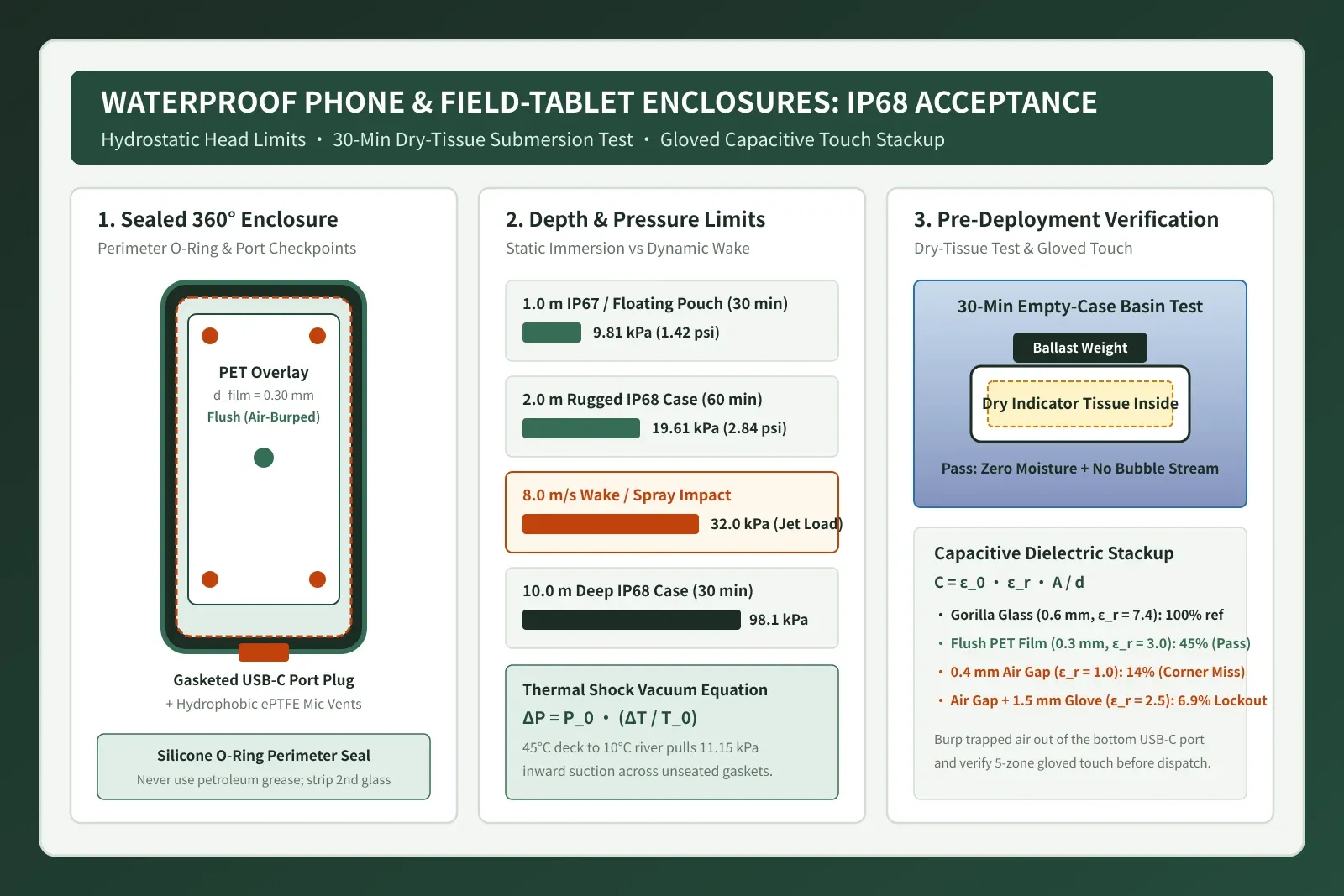
Selecting a waterproof case phone enclosure by its headline IP68 badge without checking the manufacturer’s depth-duration boundary or burping trapped internal air causes flooded logic boards, dead corner touch zones, and costly field downtime. Hydrographic survey crews, utility storm-restoration technicians, and dusty jobsite inspectors who deploy a waterproof case for iphone 17 or a field tablet waterproof enclosure need a pre-deployment acceptance protocol that verifies perimeter O-ring compression, charge-port plug fatigue, acoustic vent integrity, and gloved capacitive touch sensitivity before electronics enter wet or abrasive work zones.
Scroll horizontally to see all columns.
| Hardware Tier / Enclosure Family | Representative Models & Stated Scope | IEC 60529 Rating & Depth / Duration Limit | Static Freshwater Head (P_static) | Seal Architecture & Screen Interface | Drop / Mounting & Serviceability Notes |
|---|---|---|---|---|---|
| Bare Flagship Smartphone | Apple iPhone 12 through iPhone 16 & iPhone 17 / 17 Pro / 17 Pro Max (HT207043 / 108039) | IP68 · 6.0 m (19.7 ft) up to 30 min (lab static water) | 58.84 kPa (8.53 psi) | FactoryPSA adhesive perimeter + internal ePTFE mic/speaker meshes; bare Gorilla Glass / Ceramic Shield | Resistance degrades with drops/wear; warranty excludes liquid damage; seals not field-serviceable |
| Two-Piece Rugged Phone Enclosure (2 m Tier) | OtterBox Frē Series for iPhone 17 (2 m / 60 min); Armor-X IP68 iPhone 17 Case (2 m / 60 min); Pelican Marine Hard Case (2 m / 30 min) | IP68 · 2.0 m (6.6 ft) for 30–60 min | 19.61 kPa (2.84 psi) | 360° snap-clasp PC/TPU housing, perimeter elastomer gasket, hinged USB-C plug, integrated ~0.3 mm PET film | OtterBox Frē rated 5X MIL-STD-810G 516.6; Armor-X includes X-Mount rail; inspect port-plug hinge before shift |
| Deep-Immersion Two-Piece Phone Case (10 m Tier) | Catalyst Total Protection Case for iPhone 16 / 15 series | IP68 · 10.0 m (33.0 ft) for 30 min | 98.07 kPa (14.22 psi) | Removable silicone rear O-ring in precision channel, rotary mute/action switch, removable USB-C plug, recessed PET screen | Requires 30-min empty-case water test before install and after drops; lubricate O-ring with silicone grease only |
| Field Tablet Waterproof Enclosure (2 m Tier) | Armor-X IP68 iPad Pro 11/13 (M4/M5) & Galaxy Tab Active Case (2 m / 60 min); Catalyst Waterproof iPad Case (2 m) | IP68 · 2.0 m (6.6 ft) for 30–60 min | 19.61 kPa (2.84 psi) | Long-perimeter multi-clasp frame (> 700 mm seal path), integrated hand strap / VESA or X-Mount bracket, large-span PET overlay | Long straight bezel rails require full clasp engagement check and bottom-port air-burp to prevent center film pillowing |
| Universal Floating Waterproof Pouch | Pelican Marine Waterproof Floating Pouch (MWFP) & PP054790 Universal Case | IP68 · 1.0–1.5 m (3.3–4.9 ft) for 30 min | 9.81–14.71 kPa (1.42–2.13 psi) | Flexible TPU window bag with twist-lock cam clip and sealed buoyant air cushion | Adds positive buoyancy over open water; loose TPU window creates variable air gap (1–3 mm) that degrades gloved corner touch |
For the underlying IEC 60529 code structure and how laboratory ingress digits differ from NEMA enclosure Types, pair this guide with IP ratings for outdoor equipment. For rigid transport trunks that carry tablets, radios, and chargers between sites, see the waterproof equipment case procurement checklist, the Cases & Protection hub, and the Camp & Site Equipment hub.
Catalog IP68 depth and duration boundaries across phone and tablet cases
Under Consolidated Edition 2.2 of IEC 60529, an IP68 marking combines two independent laboratory results:
- First characteristic numeral
6(Dust-tight): No ingress of dust is permitted when the enclosure is tested in a talcum-powder suspension chamber, including under an internal vacuum of up to2.0 kPa(20 mbar) where the standard requires negative-pressure testing. On grading, concrete-cutting, and arid construction sites, numeral6prevents abrasive silica and cement fines from entering the USB-C receptacle, camera optics, or speaker cavities. - Second characteristic numeral
8(Continuous immersion): Unlike numeral7—which fixes temporary immersion at1.0 m(3.3 ft) depth for30 minutes—numeral8has no single universal depth or time in IEC 60529. Instead, the standard specifies that conditions forIPX8are set by agreement between the manufacturer and user, provided they are more severe than numeral7.
Because each manufacturer defines its own IP68 test envelope, two products carrying the same four characters on a box can differ by a factor of ten in hydrostatic pressure capacity. Hydrostatic gauge pressure (P_static, in pascals above atmospheric pressure) increases linearly with water depth (h), fluid density (ρ), and gravitational acceleration (g = 9.80665 m/s²):
P_static = ρ × g × h
In standard freshwater (ρ ≈ 1,000 kg/m³; seawater is denser at ρ ≈ 1,025 kg/m³, increasing pressure by 2.5% at any given depth):
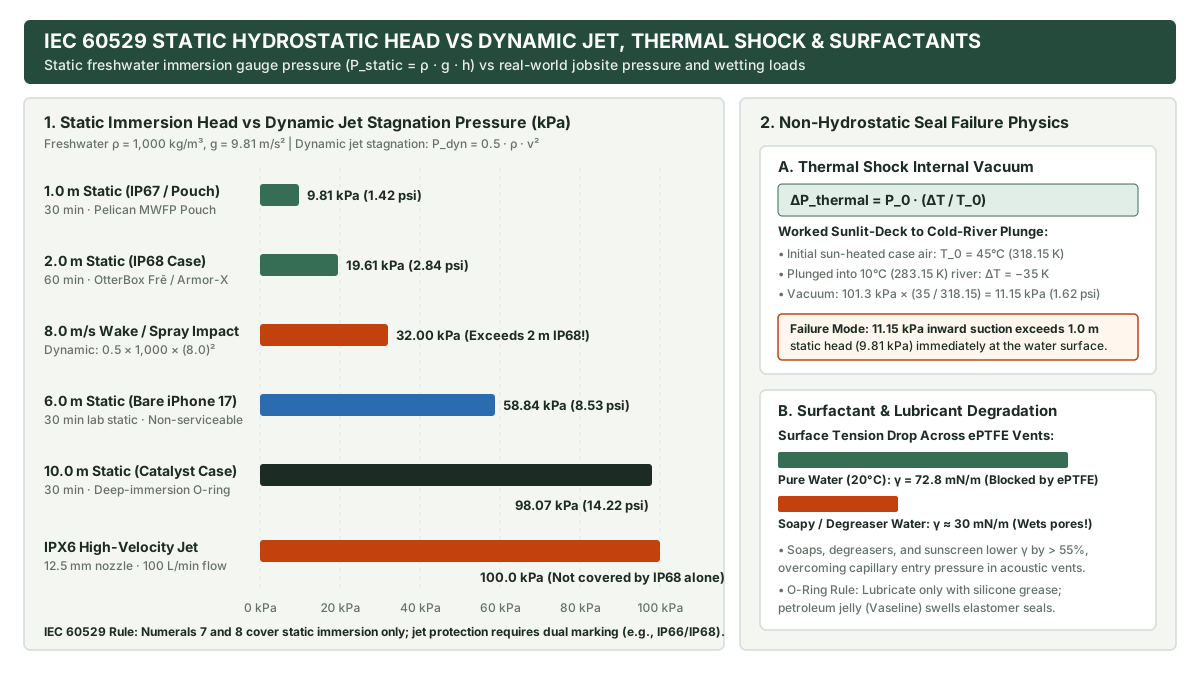
1.0 m(3.3 ft) for30 min(IP67baseline and floating pouches): Produces1,000 × 9.80665 × 1.0 = 9,807 Pa = 9.81 kPa(1.42 psi) of static gauge pressure. Universal floating pouches such as the Pelican MarineMWFPoperate in the1.0 m to 1.5 m(9.81 to 14.71 kPa) band because their flexible TPU seams and twist-lock closures are designed to float a dropped phone near the surface rather than withstand deep hydrostatic heads.2.0 m(6.6 ft) for30 to 60 min(Two-piece rugged work cases and tablet enclosures): Produces1,000 × 9.80665 × 2.0 = 19,613 Pa = 19.61 kPa(2.84 psi). Both the OtterBox Frē Series for iPhone 17 (2.0 mfor60 minutes) and Armor-X IP68 enclosures for iPhone 17 and iPad Pro/Air (2.0 mfor60 minutes) sit at this tier, balancing submersion margin against thin capacitive screen films and MIL-STD-810G drop absorption.6.0 m(19.7 ft) for30 min(Bare flagship smartphone laboratory rating): Produces1,000 × 9.80665 × 6.0 = 58,840 Pa = 58.84 kPa(8.53 psi). Apple rates the bare iPhone 12 through iPhone 16 and iPhone 17 series to6.0 mfor30 minutesunder static laboratory freshwater conditions (HT207043 / 108039). However, that seal relies on microscopic factory pressure-sensitive adhesive (PSA) tapes around the display and back glass that cannot be visually inspected, cleaned, or re-compressed after a jobsite drop.10.0 m(33.0 ft) for30 min(Deep-immersion O-ring cases): Produces1,000 × 9.80665 × 10.0 = 98,067 Pa = 98.07 kPa(14.22 psi—nearly one additional atmosphere of pressure). Enclosures rated to this depth, such as the Catalyst Total Protection Case for iPhone, use a thicker, removable circular-cross-section silicone O-ring seated in a rigid perimeter groove and a stiffer housing frame.
Takeaway: Never record "IP68" on a procurement or receiving sheet without copying the exact depth in meters and duration in minutes (2 m / 60 min vs 10 m / 30 min) printed in the manufacturer’s specification.
Why static IP68 immersion ratings fail under dynamic water jets, thermal shock, and surfactants
Field technicians frequently ask why an IP68 phone or case rated to 2.0 m (19.61 kPa) or 6.0 m (58.84 kPa) can leak when hit by boat wake spray, washed under a utility hose, or dropped into a cold creek on a hot afternoon. As documented in NEMA’s enclosure comparison and IEC 60529 Clause 14.2, numerals 7 and 8 evaluate static immersion in still water only; they do not test resistance to high-velocity water jets (numerals 5 and 6) unless the product carries a dual marking such as IP66/IP68. Three physical mechanisms drive water past an IP68 seal in real field operations:
1. Dynamic stagnation pressure from water jets and boat wakes
When a moving jet of water or a workboat wake strikes a perimeter seal, a USB-C port plug, or an acoustic microphone vent at velocity v (in m/s), the fluid’s kinetic energy converts into dynamic stagnation pressure (P_dynamic):
P_dynamic = 0.5 × ρ × v²
- Worked example — workboat wake or deck-hose spray at
v = 8.0 m/s(17.9 mph):P_dynamic = 0.5 × 1,000 kg/m³ × (8.0 m/s)² = 32,000 Pa = 32.0 kPa (4.64 psi)A localized water impact at8.0 m/sexerts32.0 kPaagainst the flexible lip of a USB-C charge-port plug or PET screen border—63%higher than the19.61 kPastatic head of a2.0 mIP68 test. - High-pressure washdown jets: An IEC 60529
IPX6test nozzle (12.5 mmdiameter at100 L/minflow) delivers roughly100 kPa(14.5 psi) of nozzle pressure, exceeding even a10.0 m(98.07 kPa) deep-immersion rating. Both Apple’s handling disclosures (108039) and rugged case manuals forbid exposingIP68devices to pressurized hose washdowns, water skiing, or wakeboarding impacts. For fixed electrical enclosures exposed to hose washdown, compare these limits with the outdoor electrical junction box NEMA and IP gasket guide.
2. Thermal shock internal vacuum (ΔP_thermal)
In IEC 60529 Clause 14.2.8, standard immersion tests maintain the water temperature within 5 K (5°C) of the equipment temperature specifically to isolate hydrostatic pressure from thermal contraction. In the field, a black smartphone case resting on a truck dashboard, survey tripod, or aluminum boat console in direct sun routinely reaches 45°C (318.15 K / 113°F). If that case falls into 10°C (283.15 K / 50°F) river or coastal water, the trapped internal air cools rapidly by ΔT = -35 K. By the ideal gas law at constant internal volume (V), the internal air pressure drops by ΔP_thermal:
ΔP_thermal = P_0 × (ΔT / T_0)
- Worked calculation —
45°Csunlit case plunged into10°Cwater:ΔP_thermal = 101.3 kPa × (35 K / 318.15 K) = 11.15 kPa (1.62 psi) inward vacuumBefore the phone even sinks below the surface, thermal contraction pulls11.15 kPaof inward suction across the perimeter O-ring and bottom charge-port stopper—more than the entire hydrostatic pressure of a1.0 mIP67submersion test (9.81 kPa). If the device sinks to2.0 m(19.61 kPaexternal head) while cooling, total inward differential pressure across the seal reaches19.61 + 11.15 = 30.76 kPa(4.46 psi). When moist air is trapped inside a sealed case before cooling, temperature drops also trigger internal droplet formation, which is covered in the equipment-case condensation guide.
3. Surfactants, degreasers, and petroleum lubricants
Pure freshwater at 20°C has a high liquid surface tension (γ ≈ 72.8 mN/m), which prevents capillary penetration through microscopic elastomer surface roughness and hydrophobic expanded polytetrafluoroethylene (ePTFE) acoustic vents. Under the Washburn capillary entry relationship (P_entry = -2 · γ · cos(θ) / r_pore), entry pressure is directly proportional to surface tension γ.
- Soap, detergent, and degreaser wetting: Hand soaps, industrial degreasers, bilge cleaners, and insect repellents act as surfactants that cut water surface tension from
72.8 mN/mdown to25–35 mN/m. At less than half the normal surface tension, soapy water wets across hydrophobicePTFEmicrophone meshes and wicks past low-compression TPE flaps at shallow depths. - Silicone O-ring swelling from petroleum grease: Catalyst’s maintenance instructions explicitly warn crews never to apply petroleum jelly (Vaseline) or mineral-oil lubricants to case O-rings. Hydrocarbon greases diffuse into silicone elastomers, causing volumetric swelling, softening, and permanent extrusion out of the seal groove. Use only 100% pure silicone grease when conditioning a removable silicone O-ring.
Takeaway: Rule of thumb: treat any IP68 phone or tablet case as a static freshwater barrier; keep it away from high-velocity hose jets (v > 5 m/s), shade dark enclosures on hot decks to prevent > 10 kPa thermal-shock vacuum, and never clean or lubricate seals with soaps, solvents, or petroleum grease.
Running the 30-minute dry-tissue submersion acceptance test before deployment
Manufacturer support documentation for two-piece sealed phone and tablet enclosures—including Catalyst’s pre-installation water test instructions—requires performing a 30-minute empty-case submersion test before installing a phone or tablet for the first time, whenever the rear housing is opened for cleaning, and immediately after any hard drop or impact that could warp a clasp or unseat a perimeter gasket.
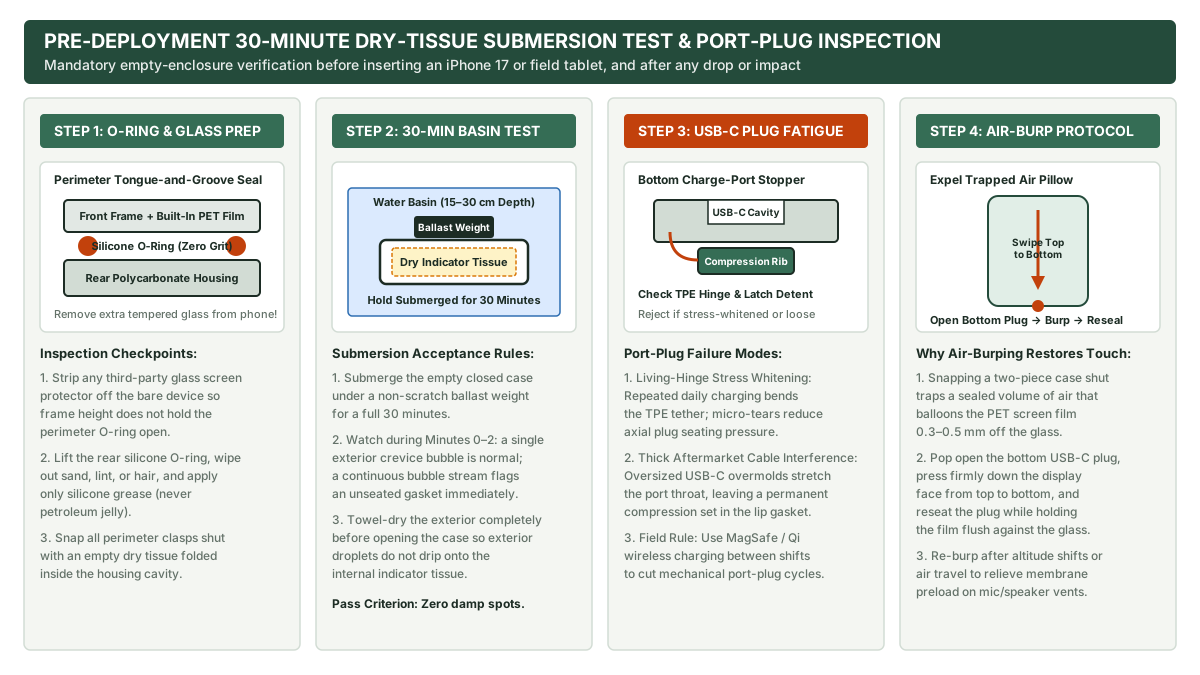
Execute the five-step acceptance test in a clean sink or bucket before signing off a case for field issue:
- Strip secondary screen protectors off the target phone or tablet: Before testing or installing the device, confirm that the phone or iPad carries zero aftermarket tempered-glass or film screen protectors. Two-piece
IP68cases (OtterBox Frē,Catalyst Total Protection,Armor-X) are machined to clamp directly against the bare factory glass height. Leaving a0.33 mm to 0.50 mmtempered-glass sheet on an iPhone 17 prevents the front bezel from bottoming out on the rear O-ring land, reducing gasket squeeze on one side while creating a double-overlay air pocket that deadens capacitive touch. (For the gasket-squeeze equationS = ((h_free − h_closed) / h_free) × 100%, see the Apache vs Pelican latch and seal comparison.) - Inspect and seat the perimeter O-ring and port plug: Open the empty case shells. On removable-gasket models, lift the silicone O-ring out of its rear channel, wipe the groove with a lint-free microfiber cloth, inspect the elastomer under bright light for nicks, twists, or sand grains, and press it evenly back into the track without stretching it (stretching thins the cross-section and creates a bunching loop at the final corner). Fold a crisp, bone-dry white paper tissue and place it flat inside the empty cavity. Snap the front and rear shells together around all four edges until every perimeter clasp clicks flush, then press the bottom USB-C charge-port plug firmly into its seat.
- Submerge under ballast for 30 minutes: Fill a basin or bucket with room-temperature freshwater (
15 cm to 30 cmdeep). Place the empty, tissue-loaded case flat on the bottom and set a smooth, non-scratch ballast weight (such as a rubber-coated dive weight or water-filled bottle) on the back plate so internal buoyancy cannot float the case to the surface. Start a 30-minute timer. - Observe the 2-minute bubble gate: Watch the perimeter seam, mute switch, camera ring, and USB-C plug during the first 120 seconds. One or two isolated air bubbles escaping from external plastic latch crevices are normal; a continuous stream of small bubbles rising from the perimeter seam or charge-port plug indicates an unseated gasket or cracked housing. Pull the unit immediately and re-seat the seal if a bubble stream appears.
- Dry the exterior completely before opening and inspecting the tissue: At the 30-minute mark, lift the case out of the basin and towel-dry the entire exterior shell, clasp recesses, and port plug hinge thoroughly before unclipping the housing. Opening a wet shell allows exterior droplets to wick across the parting line onto the tissue, causing a false failure. Unclip the dry case and press the white indicator tissue against a dark surface: any damp spot, translucent ring, or water droplet fails the enclosure and removes it from service until the O-ring or housing is replaced.
Takeaway: Never skip the 30-minute empty-case dry-tissue test on a new or dropped enclosure, and always towel-dry the exterior shell completely before popping the clasps open to inspect the tissue.
Inspecting O-ring perimeters, charge-port plugs, and ePTFE acoustic vents
Once an enclosure passes initial receiving, ongoing water resistance depends on three wear components that degrade over weeks of field charging, dust exposure, and altitude shifts:
1. Perimeter O-ring compression and long-rail tablet deflection
A smartphone case has a relatively short perimeter (~450 mm), whereas an 11-inch or 13-inch field tablet waterproof enclosure (such as an Armor-X or Catalyst iPad Pro case) has a perimeter seal path exceeding 750 mm to 900 mm. Along the long straight edges of a tablet frame, bending stiffness between snap clasps drops inversely with the cube of the unsupported span (k_beam ∝ 1 / L³). If a single side clasp is left unhooked—or if sand grit bridges the groove—the midpoint of the long tablet rail lifts enough to lose O-ring contact pressure. Always run a thumb and forefinger pinch sweep around the entire perimeter after snapping a case shut, verifying zero visible gap consistency along the parting line.
2. USB-C port-plug living hinges and aftermarket cable stretch
On two-piece cases, the bottom USB-C access door is opened and closed far more frequently than the main housing shell. Two mechanical failure modes occur at the charge port:
- Living-hinge stress whitening and tear: The flexible thermoplastic elastomer (
TPE) or silicone tether that anchors the USB-C stopper bends through90° to 180°at every corded charge cycle. Inspect the hinge crease for chalky white stress marks or partial edge tears; a fatigued tether pulls the plug at an angle rather than seating its compression rib squarely into the port throat. - Oversized USB-C overmold distortion: Waterproof cases mold a tight recessed collar around the USB-C opening sized for standard OEM cable housings. Forcing a thick, ruggedized aftermarket USB-C connector into that throat stretches the elastomer collar and gouges the sealing land. Where supported by the case (
OtterBox Frēfor iPhone 17 andCatalyst Total Protection), use MagSafe or Qi wireless charging pads for routine overnight charging (paired with the DC supplies in the portable power station vs power bank guide) so the physical USB-C port plug stays sealed day to day.
3. Hydrophobic ePTFE acoustic and barometric vents
For a sealed case or bare smartphone to transmit voice calls, ringtones, and siren alerts while keeping water out, manufacturers bond microporous expanded polytetrafluoroethylene (ePTFE) acoustic membranes (such as GORE Acoustic Vents) across the microphone, earpiece, and speaker apertures. As W. L. Gore’s portable electronic vent specifications detail, the microporous node-and-fibril ePTFE structure blocks liquid water droplets and dust (IP67 / IP68) while vibrating freely with sound waves (introducing < 1 to 2 dB of acoustic insertion loss in properly sized cavities) and allowing air molecules to pass slowly to equalize barometric pressure.
Three field rules protect ePTFE membranes from acoustic deadening or rupture:
- Never clean vent grilles with compressed air or sharp picks: Blowing shop air or poking a toothpick into a muffled microphone or speaker slot punctures the microscopic
ePTFEfilm immediately behind the protective mesh, destroying theIP68barrier with zero external warning. - Rinse salt crystals and mud slurry gently in freshwater: When saltwater evaporates on an acoustic vent, crystalline salt crust stiffens the membrane (
mass loading), making voice calls sound distant or underwater. Soak or gently rinse the closed case in low-pressure tap water for 2 minutes after marine or muddy shifts, then let the vent air-dry before making calls. - Equalize trapped cabin or elevation pressure: While bare phones vent small internal volumes rapidly, a two-piece waterproof case traps a much larger air pocket around the exterior of the device. After flying in an aircraft or driving down a mountain pass, Catalyst’s troubleshooting guide instructs users to momentarily open and close the bottom charge-port plug in a dry environment. Equalizing the internal case cavity stops differential air pressure from pre-loading the acoustic membranes or bowing the screen film.
Takeaway: Protect the USB-C port seal by using wireless MagSafe/Qi charging whenever possible, never blow compressed air into ePTFE microphone/speaker vents, and log port-plug hinge checks in your outdoor equipment maintenance schedule.
Capacitive touch physics across PET screen membranes, air gaps, and work gloves
A waterproof enclosure that keeps a phone dry is still unusable if the crew cannot tap survey waypoints, swipe camera controls, or acknowledge dispatch alerts while wearing work gloves or standing in rain. Modern smartphone and tablet displays use mutual-capacitance (C_m) touch arrays, which measure the change in electric field coupling (ΔC) when a conductive finger approaches the intersection of drive (Tx) and sense (Rx) electrodes beneath the cover glass.
Series dielectric stackup equation and effective air thickness (d_eff)
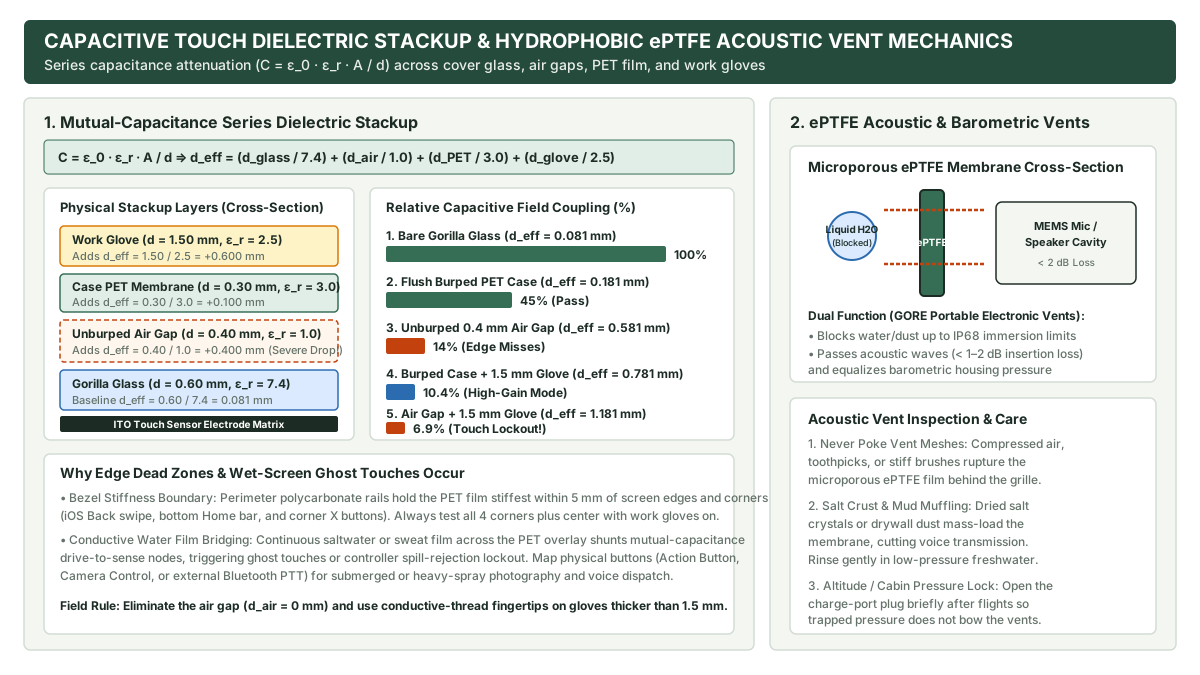
As documented in the Texas Instruments CapTIvate Technology Guide and the Azoteq Capacitive Sensing Design Guide (AZD125), layering a case’s built-in polymer screen protector, any trapped air pocket, and a work glove over the phone’s cover glass places multiple dielectrics in series between the sensor electrodes and the operator’s finger. For parallel-plate capacitors in series over contact area A, total capacitance C_total is governed by the sum of each layer’s physical thickness d_i divided by its relative dielectric permittivity ε_r,i:
C_total / A = ε_0 / d_eff
where the effective dielectric thickness (d_eff, in millimeters of equivalent air) is:
d_eff = (d_glass / ε_glass) + (d_air / ε_air) + (d_film / ε_film) + (d_glove / ε_glove)
Look at the published relative permittivities (ε_r) from the TI CapTIvate reference table:
- Gorilla Glass / Ceramic Shield (
ε_glass ≈ 7.4): High dielectric constant passes electric fields efficiently. - Polycarbonate / PET built-in case membrane (
ε_film ≈ 3.0): Moderate permittivity (2.9–3.0). - Leather / nitrile / fabric work glove (
ε_glove ≈ 2.0 to 3.0, nominal2.5): Low permittivity and large physical thickness (1.0 to 2.0 mm). - Trapped air gap (
ε_air = 1.0): Lowest possible dielectric constant (1.0). Every0.1 mmof air gap attenuates the capacitive electric field7.4 timesmore severely than0.1 mmof cover glass!
Worked comparison: why air-burping the case decides gloved touch pass/fail
Compare five real stackup states on an iPhone 17 or field tablet with a 0.60 mm cover glass (ε_glass = 7.4) inside a waterproof case with a 0.30 mm built-in PET screen membrane (ε_film = 3.0):
Scroll horizontally to see all columns.
| Stackup Configuration | Layer Terms (d_i / ε_r,i) | Effective Air Thickness (d_eff) | Relative Field Coupling (0.081 / d_eff) | Field Touch Behavior |
|---|---|---|---|---|
| 1. Bare Smartphone Glass | 0.60 / 7.4 | 0.081 mm | 100.0% (Baseline) | Instant multi-touch response across center and edges |
| 2. Case PET Film Seated Flush (Air-Burped, Bare Finger) | 0.081 + (0.30 / 3.0) + (0.00 / 1.0) | 0.181 mm | 44.8% | Clean single-tap and swipe registration across all 5 screen zones |
3. Case with 0.40 mm Unburped Air Pillow (Bare Finger) | 0.081 + 0.100 + (0.40 / 1.0) | 0.581 mm | 13.9% | Center responds to heavy presses; bezel corners and bottom Home-bar swipes drop out |
4. Flush Burped Case + 1.50 mm Work Glove (ε_r = 2.5) | 0.081 + 0.100 + 0.000 + (1.50 / 2.5) | 0.781 mm | 10.4% | Usable with conductive-thread fingertips or high-sensitivity touch accommodations |
5. Unburped 0.40 mm Air Gap + 1.50 mm Work Glove | 0.081 + 0.100 + 0.400 + 0.600 | 1.181 mm | 6.9% | Complete touch lockout; finger ΔC falls below controller noise floor |
Three operational rules for touch screens in wet and gloved work
- Execute the bottom charge-port air-burp after every installation: When you snap a two-piece waterproof case shut, the displaced internal air has nowhere to escape and balloons the flexible
0.30 mmPET screen protector outward by0.3 to 0.5 mm. As the calculation above shows, that0.40 mmair pillow (ε_r = 1.0) slashes capacitive coupling from44.8%down to13.9%. Immediately after snapping the case shut, pop open the bottom USB-C charge-port plug, lay the case flat, press a thumb or microfiber cloth firmly from the top earpiece down to the bottom bezel to push the trapped air pocket out of the charge port, and snap the USB-C plug shut while holding the screen film flush against the glass. - Test the 4 bezel corners plus center (5-zone acceptance check): Because the rigid polycarbonate bezel frame supports the perimeter of the PET film, mechanical deflection stiffness is highest within
5 mmof the screen edges and corners—exactly where iOS/Android back-navigation swipes, bottom Home-bar gestures, and corner close (X) buttons sit. Always verify touch registration at all four corners plus the center while wearing the exact nitrile-dipped or leather gloves assigned to the crew. - Mitigate wet-screen conductive bridging with hardware button mapping: Water has a very high relative permittivity (
ε_r ≈ 80), and rainwater mixed with sweat or sea salt contains dissolved ions that form a conductive sheet across the PET screen overlay. In mutual-capacitance controllers, a continuous conductive water film shunts drive-to-sense field lines across multiple nodes simultaneously, triggering phantom (“ghost”) touches or causing the firmware’s spill-rejection algorithm to lock out finger input until the surface is wiped. When operating in heavy spray or underwater, map critical actions—such as camera shutter, voice memo, or push-to-talk (PTT)—to physical mechanical buttons (the iPhone Action Button, Camera Control button, or volume keys) rather than relying on wet capacitive swipes.
Takeaway: Always burp trapped air out of the bottom charge-port plug so d_air ≈ 0 mm, verify gloved taps across all four bezel corners before leaving the trailer, and bind camera or PTT actions to physical side buttons for heavy rain or submerged use.
Comparing bare IP68 smartphones, two-piece rugged enclosures, and floating pouches
Equipment managers deciding how to outfit a field crew generally weigh three options: running bare IP68 smartphones, fitting two-piece sealed polycarbonate/TPU enclosures (OtterBox Frē, Catalyst Total Protection, Armor-X), or issuing universal floating pouches (Pelican Marine MWFP).
Scroll horizontally to see all columns.
| Decision Factor | Bare IP68 Smartphone (iPhone 17, 6 m / 30 min) | Two-Piece Rugged IP68 Case (OtterBox Frē, Catalyst, Armor-X) | Universal Floating IP68 Pouch (Pelican Marine MWFP, 1–1.5 m) |
|---|---|---|---|
| Seal Inspectability & Pre-Shift Verification | None: internal PSA adhesive tapes cannot be visually checked or tissue-tested by the crew | High: removable or visible perimeter O-ring + mandatory 30-min empty-case dry-tissue test | Moderate: visual check of top twist-lock cams and heat-welded TPU seam; supports dry-tissue test |
| Drop & Impact Survival on Concrete / Rock | Vulnerable: a single corner drop can micro-fracture glass or shear internal PSA water seals | High: MIL-STD-810G 516.6 drop buffering (5X on OtterBox Frē) isolates the phone chassis from impact | Low: thin TPU bag + air bladder cushions light bumps but lacks rigid corner crush framing |
| Capacitive Touch & Gloved Usability | 100% baseline (d_eff = 0.081 mm): best bare and gloved sensitivity | 45% coupling (d_eff = 0.181 mm when air-burped): reliable 5-zone touch when secondary glass is removed | 10–25% variable coupling: loose TPU window traps 1–3 mm air pockets that hinder corner swipes |
| Camera Optical Clarity & Thermal Dissipation | Unobstructed: zero secondary lens window; direct chassis heat dissipation | Dedicated optical window: recessed hard-coated lens cover; enclosed air pocket slows solar heat shedding | Flexible TPU film over lens: prone to condensation fogging, water-droplet distortion, and glare |
| Buoyancy in Open-Water Drops | Sinks immediately: high density drops straight to river or harbor bottom | Sinks unless tethered: requires wrist lanyard, floating tether, or Armor-X mechanical mount | Floats (Positive Buoyancy): built-in air cushion keeps most smartphones at the water surface |
Use three conditional rules to assign the right hardware tier to each task:
- Assign two-piece rugged IP68 cases (
OtterBox Frē,Catalyst,Armor-X) for daily construction, utility restoration, forestry, and hydrographic survey work where devices face repeated drops onto rock or concrete, abrasive silica dust (IP6X), and rain or shallow immersion—and where technicians need flush, air-burped screen response and rigid mechanical mounts (Armor-X X-Mount) or MagSafe charging. When packing tablet kits alongside satellite terminals or radios inside larger hard cases, pair this setup with the Starlink Mini case fit and receiving checklist and verify supplier test documentation with the equipment test report checklist. - Assign universal floating pouches (
Pelican Marine MWFP) as temporary over-water secondary protection for kayak/workboat transfers or shoreline inspections where positive buoyancy (floating on drop) is the primary requirement and high-speed gloved data entry is minimal. - Never rely on a bare smartphone’s factory IP68 rating as primary field protection once the handset has experienced jobsite drops, battery/screen repairs, or exposure to concrete dust, salt spray, or degreasers, because factory adhesive seals degrade silently and carry zero liquid-damage warranty coverage.
Takeaway: Match the enclosure to the dominant hazard—two-piece air-burped hard cases for drop-heavy, dusty, and gloved technical work; buoyant twist-lock pouches for open-water transfers where sinking is the primary loss risk.
Pre-deployment waterproof phone and tablet case acceptance checklist
Before issuing a waterproof phone case or field tablet enclosure to a crew—or returning a dropped unit to active service—complete the 8-point acceptance record below. Download the waterproof phone and field-tablet case acceptance checklist (CSV), which is also listed on the checklists and templates page.
Scroll horizontally to see all columns.
| Inspection Step | Acceptance Criterion | Failure Mode Prevented | Example Field Log Entry |
|---|---|---|---|
| 1. Rating & Model Match | Exact device variant matches case SKU; depth (m) and duration (min) recorded from manual | Using an iPhone 16 case on an iPhone 17 or assuming 10 m depth on a 2 m case | Survey Phone #04 · iPhone 17 Pro in OtterBox Frē (IP68, 2.0 m / 60 min) |
| 2. Secondary Glass Removal | Bare phone/tablet carries zero tempered-glass or film screen protectors | Perimeter O-ring held open by +0.4 mm extra glass height; double-layer touch lockout | Confirmed bare Ceramic Shield; stripped 0.33 mm tempered glass |
| 3. Perimeter O-Ring & Groove Prep | O-ring free of cuts/sand/hair; seated flat in groove without stretching; silicone lube only | Capillary leak paths across grit; petroleum grease swelling silicone elastomer | Rear O-ring wiped clean; lightly dressed with pure silicone grease |
| 4. USB-C Port Plug & Hinge Check | TPE tether free of stress-whitening or tears; plug rib clicks tightly into port throat | Dynamic spray or thermal vacuum pulling water past a loose charge-port flap | USB-C stopper latch tight; crew assigned MagSafe pad for daily charging |
| 5. ePTFE Acoustic Vent Inspection | Mic/speaker meshes intact, unpunctured, and free of dried salt or mud crust | Ruptured ePTFE membrane from compressed air or muffled voice calls from salt loading | Top/bottom acoustic vents clean; zero mesh deformation |
| 6. 30-Min Empty Dry-Tissue Test | Weighted 30-min basin immersion (15–30 cm); zero bubble stream; exterior dried before opening; tissue 100% dry | Discovering a warped clasp or pinched O-ring with a $1,200 device inside | 30-min basin test passed 2026-10-26; indicator tissue bone-dry |
| 7. Bottom-Port Air-Burp | Bottom USB-C plug opened after install, screen swept top-to-bottom to expel air pillow, plug resealed flush | 0.4 mm trapped air gap (ε_r = 1.0) cutting capacitive coupling from 45% to 14% | Air-burped via USB-C port; PET membrane seated flush against glass |
| 8. 5-Zone Gloved Touch & Audio Check | Center + all 4 bezel corners register taps/swipes with assigned work gloves; test voice call clear | Field lockout on corner Back / X buttons or inaudible dispatch audio | 5-zone touch passed with 1.2 mm nitrile work gloves; mic/speaker clear |
Takeaway: Keep the signed acceptance row in your equipment register and repeat Step 6 (the 30-minute empty-case dry-tissue test) after any drop onto hard ground or before any submerged hydrographic deployment.
Frequently asked questions
Does an IP68 waterproof phone case protect against high-pressure hose washdowns or boat wake impacts?
No. Under IEC 60529 (and NEMA’s enclosure comparison), second characteristic numerals 7 and 8 test static immersion in still water only (19.61 kPa at 2.0 m depth) and do not establish resistance to high-velocity water jets (numerals 5 and 6) unless the enclosure carries a dual rating such as IP66/IP68. A water jet or boat wake striking a case at 8.0 m/s (18 mph) generates 32.0 kPa of dynamic stagnation pressure (P_dynamic = 0.5 · ρ · v²), while an IPX6 washdown hose generates 100 kPa, either of which can force water past a static-immersion port plug or perimeter O-ring.
Why do waterproof phone case manufacturers require removing a tempered-glass screen protector before installation?
Two-piece IP68 enclosures (OtterBox Frē, Catalyst Total Protection, Armor-X) are dimensioned to clamp directly onto the bare factory display glass and include their own integrated ~0.30 mm PET or polycarbonate screen membrane. Leaving an aftermarket 0.33 mm to 0.50 mm tempered-glass protector on the phone adds stack height that prevents the front bezel clasps from compressing the perimeter O-ring evenly and traps an air layer (ε_r = 1.0) between the two protectors that severely degrades capacitive touch sensitivity.
How do you fix dead touch zones and unresponsive corners on a waterproof phone or tablet case?
First, verify that any secondary glass protector was removed from the bare device. Second, perform the bottom charge-port air-burp: pop open the bottom USB-C port plug, lay the device flat, press firmly down the screen from top to bottom with a microfiber cloth to push the trapped air pillow out of the bottom port, and snap the USB-C plug shut while holding the built-in PET film flush against the display glass. Removing a 0.40 mm trapped air gap increases series capacitive field coupling from 13.9% back to 44.8% of bare-glass strength. Finally, enable Touch Accommodations or increased touch sensitivity in the device settings when working with gloves.
If the iPhone 17 is already rated IP68 to 6 meters, why do field crews still use a waterproof case?
Apple’s IP68 rating (6.0 m for 30 minutes under IEC 60529) is tested on new devices in static laboratory freshwater, and Apple’s support disclosures (HT207043 / 108039) explicitly state that water and dust resistance are not permanent conditions, decrease with normal wear or jobsite drops, and are excluded from warranty coverage. Because a bare smartphone’s internal adhesive seals cannot be inspected or dry-tissue tested before a shift, a two-piece IP68 rugged enclosure adds an inspectable, replaceable perimeter O-ring, MIL-STD-810G drop protection, and a sacrificial barrier against concrete dust, salt spray, and mud.
Can you apply Vaseline or petroleum jelly to a waterproof phone case O-ring?
Never apply Vaseline, petroleum jelly, mineral oil, or aerosol solvent sprays to a waterproof case O-ring or charge-port plug. Petroleum hydrocarbons absorb into silicone and thermoplastic elastomers, causing the seal to swell, soften, lose its durometer stiffness, and extrude out of the sealing channel. Clean removable O-rings with mild freshwater and a lint-free cloth, and condition them only with 100% pure silicone grease as specified by the enclosure manufacturer.
Downloads
- Waterproof phone and field-tablet case acceptance checklist (CSV) CSV Blank pre-deployment inspection record covering IP68 depth/duration, O-ring prep, 30-minute dry-tissue submersion test, bottom-port air-burp, and 5-zone gloved touch verification.
Sources and versions
- IEC 60529:1989+AMD1:1999+AMD2:2013 CSV — Degrees of protection provided by enclosures (IP Code) , International Electrotechnical Commission (IEC) Supports: Consolidated Edition 2.2 of IEC 60529 defining first characteristic numeral 6 (dust-tight under vacuum) and second characteristic numerals 5/6 (water jets from 6.3 mm and 12.5 mm nozzles), 7 (temporary immersion at 1 m depth for 30 minutes), and 8 (continuous immersion under depth and duration conditions specified by the manufacturer that are more severe than numeral 7).
- About splash, water, and dust resistance of iPhone 7 and later (HT207043 / 108039) & iPhone Important Handling Information , Apple Inc. Supports: Recent iPhone models (iPhone 12 through iPhone 16 and iPhone 17 series) carry an IP68 rating under IEC standard 60529 (maximum depth of 6 meters up to 30 minutes under controlled laboratory static water conditions). Apple states that splash, water, and dust resistance are not permanent conditions, decrease with normal wear, drops, or impacts, are excluded from warranty coverage, and require avoiding pressurized or high-velocity water, steam, soap, detergent, pool water, and saltwater.
- OtterBox Launches Frē Series Waterproof Phone Case for iPhone 17 Devices , OtterBox / PR Newswire Supports: OtterBox Frē Series (designed by LifeProof) for iPhone 17, iPhone 17 Pro, and iPhone 17 Pro Max is rated IP68 for submersion up to 2 meters (6.6 ft) for 1 hour, engineered to withstand 5X the drops of MIL-STD-810G 516.6, and built as a 360-degree two-piece sealed enclosure with an integrated screen protector, gasketed USB-C port cover, MagSafe magnets, and Camera Control button integration.
- Catalyst iPhone Waterproof Case Support: Installation, Pre-Installation Water Test, O-Ring Care & Troubleshooting , Catalyst Lifestyle Supports: Catalyst Total Protection Case is rated IP68 up to 10 meters (33 feet) for 30 minutes on iPhone models (and 2 meters / 6.6 feet on waterproof iPad enclosures). Manufacturer instructions require a 30-minute empty-case basin submersion water test before first use and after any drop, removing pre-installed glass/film screen protectors on the phone, cleaning the silicone O-ring and charge-port plug using only silicone lubricant (never petroleum/Vaseline), and burping trapped air out of the bottom charge-port plug.
- Armor-X IP68 Waterproof & Shockproof Cases for iPhone 17 Series and iPad Field Tablets , Armor-X Supports: Armor-X rugged IP68 waterproof enclosures for iPhone 17 / 17 Pro / 17 Pro Max and field tablets (iPad Pro 11/13 M4/M5, iPad Air, iPad mini, Samsung Galaxy Tab Active) provide IP68 submersion protection up to 2 meters (6.6 feet) for 1 hour, built-in screen protection, hinged charging-port seals, hand straps, and integrated X-Mount mechanical locking interfaces.
- Pelican Marine Universal Waterproof Case (PP054790) and Marine Waterproof Floating Pouch (MWFP) , Pelican Products Supports: Pelican Marine series waterproof phone cases and pouches carry IP68 ingress ratings under distinct depth/duration envelopes (2 meters / 6.6 ft for 30 minutes on fitted Marine hard cases vs 1 meter / 3.3 ft to 1.5 meters / 4.9 ft for 30 minutes on universal floating pouches with buoyant air cushions and twist-lock closures).
- GORE Acoustic Vents and Portable Electronic Vents for Mobile Devices , W. L. Gore & Associates Supports: Microporous expanded polytetrafluoroethylene (ePTFE) acoustic and pressure vents provide IP67 and IP68 immersion protection while allowing air molecules and sound waves to pass through with low acoustic insertion loss (< 1–2 dB in typical mobile transducer cavities) and equalizing differential housing pressure.
- CapTIvate Technology Guide — Mechanicals, Typical Stackup, Overlays, Air Gaps, Gloves, and Moisture Physics , Texas Instruments Supports: Capacitive touch sensitivity follows parallel-plate capacitance (C ~ ε_r / d). Documented relative permittivities (ε_r): Air = 1.0, Glass = 7.6–8.0, Gorilla Glass = 7.2–7.6, Polycarbonate = 2.9–3.0, Acrylic = 2.8, ABS = 2.4–4.1, and leather/plastic/fabric work gloves = < 2.0 to 4.0. Air gaps (ε_r = 1.0) severely attenuate electric field coupling, while conductive water films cause false detections or spill-rejection lockout.
- Capacitive Sensing Design Guide (AZD125 v1.2) , Azoteq Supports: In mutual-capacitance touch screens, an air gap in series with a polymer cover sheet acts as a low-permittivity series capacitor (1/C_total = Σ d_i / (ε_0 · ε_r,i · A)) whose effective dielectric thickness is dominated by the air gap and glove thickness, reducing finger-induced ΔC below the controller detection threshold particularly along rigid bezel edges and corners.
- NEMA Enclosure Types Summary & OSHA 29 CFR 1910.399 Definitions , National Electrical Manufacturers Association (NEMA) / U.S. OSHA Supports: Under IEC 60529 (summarized in NEMA's enclosure comparison), water numerals 7 and 8 test static immersion only and do not automatically establish resistance to water jets (numerals 5 and 6) unless the enclosure is dual-rated. OSHA 29 CFR 1910.399 defines weatherproof and watertight for electrical enclosures without defining the marketing word waterproof.
Next steps
IP Ratings for Outdoor Equipment: How to Read Protection Claims
How to read an IP rating on outdoor equipment: the code structure, the cited standard, the tested configuration, and the questions to ask before deployment.
Choosing a Waterproof Equipment Case: A Procurement Checklist
A procurement checklist for waterproof equipment cases: dimensions, seals, latches, valves, rating claims, test report scope, spares and maintenance documents.
Do Pelican Cases Keep Moisture Out? A Condensation and Return-to-Storage Guide
A watertight case can still contain damp gear and humid air. Use this return-to-storage record to investigate condensation, inserts and desiccant instructions.
Outdoor Equipment Maintenance: Building a Practical Schedule
Build an outdoor equipment maintenance schedule from model manuals: equipment register, trigger types, task types, roles, records, and a downloadable template.