Pick-and-Pluck Foam vs. Closed-Cell PE/EVA Density: Load Creep, Wall Tearing, and Cushioning Selection
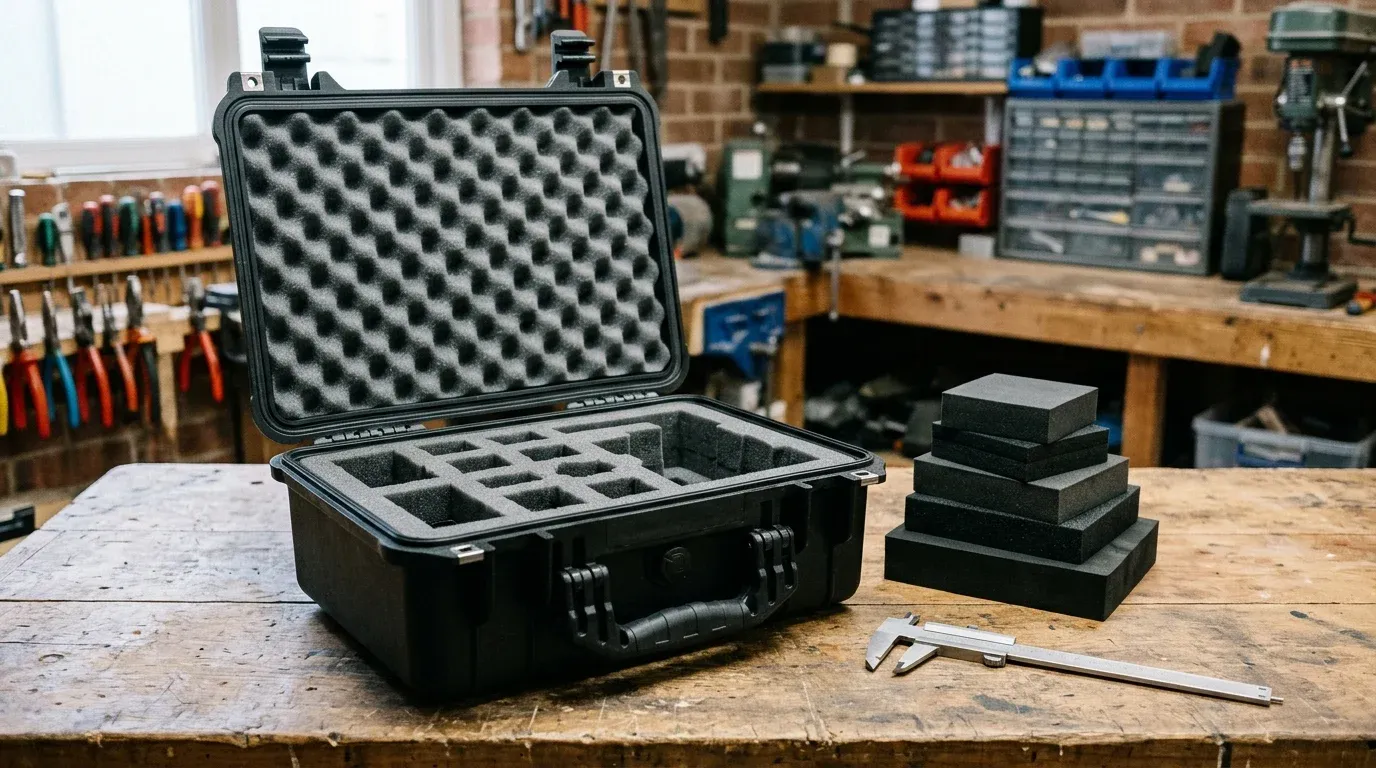
Evaluating pick and pluck foam against closed-cell polyethylene, cross-linked polyethylene, and copolymer inserts requires matching polymer cell structure and polyurethane foam density to the weight, fragility, and operating environment of the packed kit.
Screen these engineering variables before plucking a stock insert or ordering a custom hard case foam insert:
- Cellular pore structure and air permeability across open-cell urethane versus closed-cell olefin planks.
- Sustained static bearing pressure where heavy payloads compress soft foam and cause long-term thickness loss.
- Inter-cavity wall tear resistance when pre-scored vertical columns sit beside dense cylindrical lenses or tools.
- Liquid, oil, and humidity retention inside gasketed shells during wet outdoor deployment.
- Particulate shedding in cleanrooms and electrostatic charge dissipation around circuit assemblies.
Explore the Cases & Protection guides to connect insert material selection with shell sizing, wheeled transport planning, and seal maintenance.
Scroll horizontally to see all columns.
| Selection dimension | Pre-scored open-cell urethane insert | Laminated or extruded closed-cell polyethylene | Cross-linked polyethylene or copolymer insert |
|---|---|---|---|
| Typical payloads (catalog examples) | Pelican Polyurethane: lighter weight sensitive equipment such as cameras, smartphones, and laptops | Pelican Polyethylene: often used for communications equipment and power supplies | Pelican Cross-Link: often used in clean room applications (reduces FOD) |
| Water and oil interaction | Charcoal packaging foam: complete open-pore structure gives high air flow | FastCap Kaizen Foam: liquids and oils stay on the surface | Pelican Cross-Link: non-porous closed cell foam resists grease, dirt, and water |
When converting your required foam border thickness into shell cavity dimensions, pair this material comparison with the hard case size chart and measurement guide. For loaded wheel selection, stair handling, and carrier shipping preparation, see the hard case foam, wheels, and transport guide.
Open-Cell Polyurethane vs Closed-Cell Polyolefin Material Architecture
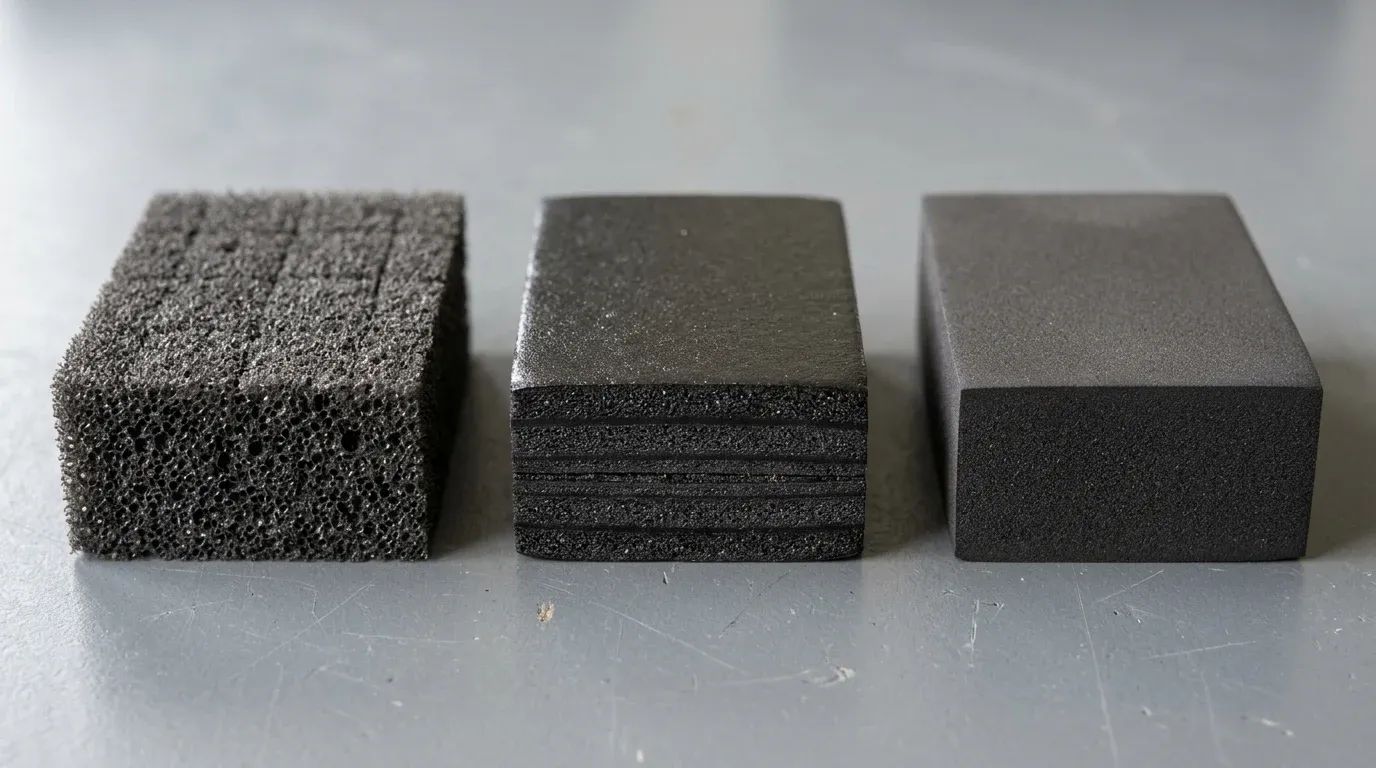
Comparing kaizen foam vs pick and pluck begins with the underlying cellular polymer and the laboratory methods used to measure density, stiffness, tear propagation, and recovery. Open-cell flexible urethanes and closed-cell olefin foams belong to separate material families and use distinct mechanical definitions.
Open-cell polyurethane evaluation and commercial density grades
Review the published urethane test framework and commercial polyurethane foam density specifications across case and packaging grades:
- The ASTM D3574 standard for flexible cellular urethane foams includes 19 different tests, including Test A for Apparent Density (ISO 845), Test B 1 for Indentation Force Deflection (IFD, ISO 2439), Test C for Compression Force Deflection (ISO 3386), Test D for Constant Deflection Compression Set, Test E for Tensile Strength (ISO 1798), Test F for Tear Resistance (ISO 8067), Test G for Air Flow, and Test H for Resilience Ball Rebound (ISO 8307, DIN 13014).
- Under the ASTM D 3574 test method, the 7 critical properties measured for flexible cellular materials are Density (mass per unit volume), Compression Deflection (CD), Tensile Strength & Elongation, Tear Strength (resistance to tear propagation), Resilience, Load-Deflection Properties, and Compression Set (ability to recover its original shape after being compressed for a specified amount of time at a specific temperature).
- In Pelican custom foam cushioning, standard Polyurethane is a softer open cell foam best for lighter weight sensitive equipment such as cameras, smartphones, and laptops, and is available in a variety of densities.
- Index Packaging’s commercial packaging foam selector classifies polyurethane grades from 1.0 to 2.0 pcf (including 1.0 PF 12 0148 3215, 1.2 pcf PU 1240, 1.5 pcf PU 1544, 1.8 pcf PU 1835, 2.0 pcf PU 200 Ester, and pink antistatic 1.2 pcf ASPU 3212 / 1.5 pcf ASPU 8415) and polyethylene grades from .9 to 9.0 pcf (including .9 pcf Senflex Polylam, 1.2 pcf PE 120, 1.7 pcf PE 170, 2.2 pcf PE 220, 4.0 pcf PE 400, 9.0 pcf PE 900, and composite PE Foam MDL 1.7 pcf with laminated 6.0 pcf liner).
- Index Packaging Foam Grade 1240 open-cell polyurethane foam tested to ASTM D-3574-91 has a density of 1.2 PCF (+/- .05), IFD on 4” at 25% deflection of 32-40, minimum resilience of 45%, minimum tensile strength of 15 PSI (lbs/in2), minimum elongation of 150%, minimum tear strength of 1.5 lb/in, and maximum 90% compression set of 10.0%.
- The Foam Factory Charcoal Regular open-cell polyurethane foam (ASTM D 3574) has a typical life of 8 to 10 years, density of 1.3 LB/cubic ft, 25% ILD of 36 LB, support factor (65%/25% Min.) of 1.90, minimum air flow of 3.00 CFM, minimum tensile strength of 14.0 PSI, minimum elongation of 200%, minimum tear resistance of 1.50 PPI, and minimum resiliency of 40%.
- The Foam Factory Pink Anti-Static open-cell polyurethane foam (ASTM D 3574) has a typical life of 5 to 8 years, density of 1.4 LB/cubic ft, 25% ILD of 35 LB, support factor (65%/25% Min.) of 1.90, minimum tensile strength of 13.0 PSI, minimum elongation of 200%, minimum tear resistance of 1.30 PPI, and minimum resiliency of 35%.
- Index Packaging Grade 1544 open-cell polyurethane foam tested to ASTM D-3574-91 has a density of 1.50 +/- 0.10 PCF, IFD on 4” at 25% deflection of 44-52, minimum resilience of 40%, minimum tensile strength of 15 PSI, minimum elongation of 125%, minimum tear strength of 2.0 lb/in, and maximum 90% compression set of 10.0%.
- The Foam Factory Charcoal Firm open-cell polyurethane foam (ASTM D 3574) has a typical life of 8 to 10 years, density of 1.7 LB/cubic ft, 25% ILD of 70 LB, support factor (65%/25% Min.) of 1.90, minimum air flow of 3.00 CFM, minimum tensile strength of 10.0 PSI, minimum elongation of 150%, minimum tear resistance of 1.50 PPI, and minimum resiliency of 25%.
- Index Packaging Grade S82C open-cell polyester polyurethane foam (ASTM D357491) has a density of 1.7 +/ 0.05 PCF, IFD on 4” at 25% deflection of 85, minimum resilience of 70%, average tensile strength of 25 PSI, average elongation of 120%, average tear strength of 1.9 lb/in, and maximum 90% compression set of 10.0%.
Closed-cell polyolefin architecture and laminated Kaizen sheets
Compare how closed-cell olefin foams and peelable laminated sheets are structured and evaluated:
- Charcoal polyurethane packaging foam has a complete open-pore structure that gives it high air flow, whereas polyethylene packaging foam is a strong and resilient closed-cell foam suited for shock absorbing products, vibration dampening, and buoyancy.
- ASTM D3575 (Standard Test Methods for Flexible Cellular Materials Made from Olefin Polymers) evaluates closed-cell polyolefin foams including crosslinked polyethylene (XLPE), polypropylene, and EVA across Density (Method A), Tensile Strength and Elongation (Method B), Tear Resistance (Method C), Compression Force Deflection (Method D, typically 25% and 50% compression), Compression Set (Method E), Water Absorption (Method F), and Thermal Stability (Method G).
- In Pelican custom foam cushioning, Anti-Static Polyurethane is an open cell foam that inhibits static electricity buildup for lightweight sensitive electronic equipment (circuit boards, computer chips), Polyethylene is a strong, non-abrasive, water-resistant, resilient closed cell foam often used for packaging fragile goods such as communications equipment and power supplies, Anti-Static Polyethylene is a strong, non-abrasive, water-resistant, resilient closed cell foam commonly used for shipping electronic parts, circuit boards, and computer chips, and Cross-Link is a non-porous, non-particulate closed cell foam that reduces foreign object debris (FOD) and resists grease, dirt, and water.
- FastCap Kaizen Foam is a closed-cell polyethylene foam laminated in 1/8” layers, sold in 2’ x 4’ (24”x48” plus/minus 1”) sheets in 3 thicknesses (with +3mm / -1mm tolerance); because it is a closed-cell foam, liquids and oils do not absorb into it, while glues that create a heat reaction when curing could melt the foam.
When building stepped tool trays by hand, laminated closed-cell polyethylene lets technicians slice an outline with a utility knife and peel horizontal layers to the exact recess depth without leaving vertical cube perforations through the surrounding walls.
Static Load Creep, Compression Set, and Dynamic Cushioning Selection
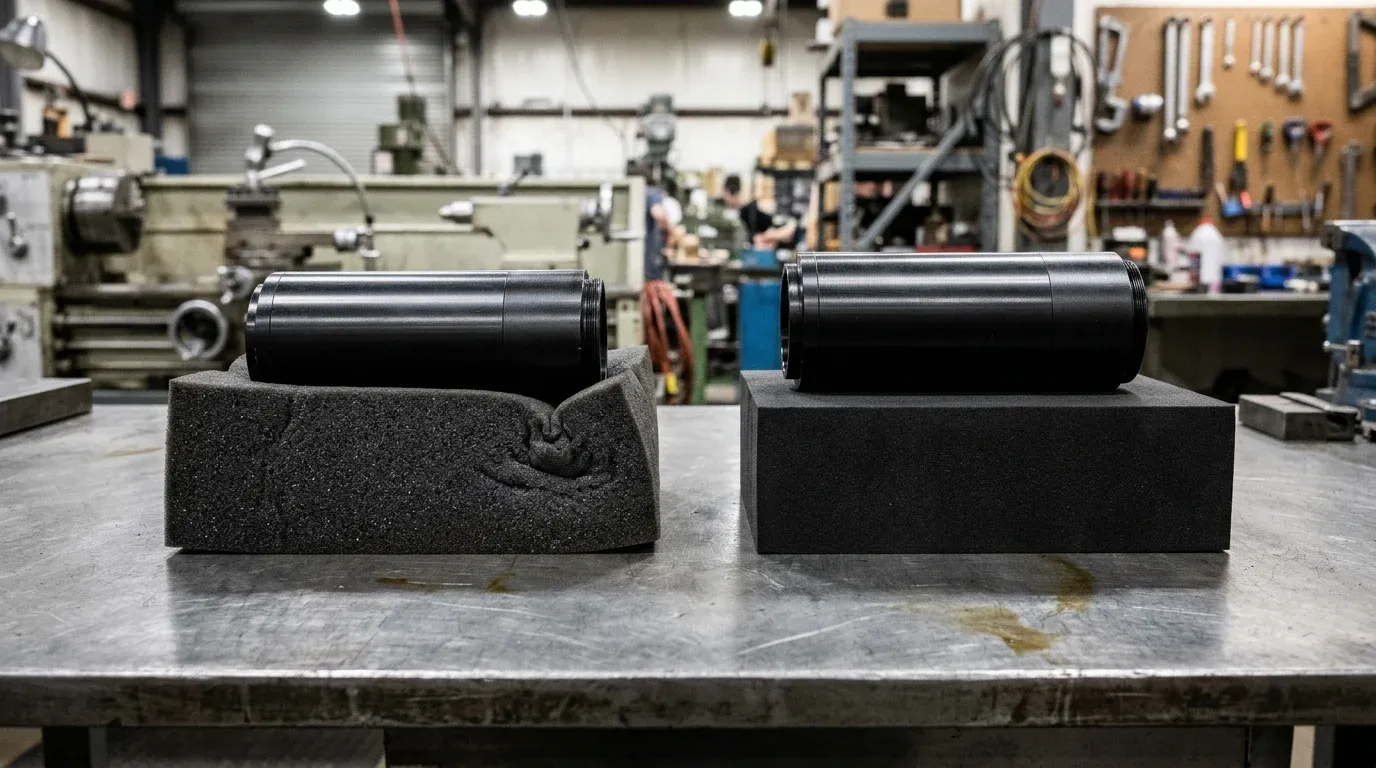
Heavy instruments with small contact footprints exert concentrated bearing pressure on the bottom pad and lower side walls of a case. If the static load exceeds the supporting range of the foam, the insert compresses continuously under gravity, leaving the payload with reduced shock travel during a drop.
Compressive deflection, compression set, and creep across PE, XLPE, and EVA
Compare how compressive strength, permanent compression set, and long-term compression creep scale across extruded polyethylene, cross-linked polyethylene, and copolymer grades:
- For The Foam Factory extruded closed-cell polyethylene foam (ASTM D 3575) in 1.2 LB, 1.7 LB, and 2.2 LB densities (18, 20, and 24 cells/inch), compressive strength at 25% / 50% is 7 / 12 LB/in sq (1.2 LB), 7 / 14 LB/in sq (1.7 LB), and 8 / 14.5 LB/in sq (2.2 LB); compression set at 2 hours / 24 hours is 30% / 24% (1.2 LB), 21% / 16% (1.7 LB), and 22% / 16% (2.2 LB); compression creep is 5% (1.2 LB), 6% (1.7 LB), and 6% (2.2 LB); water absorption is 0.06 LB/sq ft (1.2 and 1.7 LB) and 0.04 LB/sq ft (2.2 LB); and service temperature is -30 to 180 °F.
- For The Foam Factory high-density extruded closed-cell polyethylene foam (ASTM D 3575) in 4.0 LB, 6.0 LB, and 9.0 LB grades (30 cells/inch), compressive strength at 25% / 50% rises to 16.5 / 20 LB/in sq (4.0 LB), 28 / 39.5 LB/in sq (6.0 LB), and 46 / 66 LB/in sq (9.0 LB); compression set at 2 hours / 24 hours drops to 9% / 6% (4.0 LB), 10% / 7% (6.0 LB), and 20% / 11% (9.0 LB); compression creep drops to 0.8% across all three grades; and water absorption is 0.02 LB/sq ft (4.0 and 6.0 LB) and 0.05 LB/sq ft (9.0 LB).
- Sealed Air Cellu-Cushion closed-cell polyethylene foam (ASTM D3575-00) across 1.2 pcf, 1.7 pcf, 2.2 pcf, 4.0 pcf, and 6.0 pcf grades provides vertical compressive strength (Suffix D) at 25% of 3.1 to 9 psi and at 50% of 10.9 to 21 psi, compression set (Suffix B) of < 15% to < 30% (19% and 14% for 6.0 pcf), and machine-direction tensile strength (Suffix Tmd) from 39–85 psi (1.2–2.2 pcf) up to 90–120 psi (4.0 pcf) and 130–155 psi (6.0 pcf).
- For The Foam Factory cross-linked polyethylene foam (XLPE, ASTM D3575) in 2.0 LB and 3.0 LB grades, tensile strength is 55.4 PSI and 70.4 PSI, tear resistance is 12.5 lbf/in and 17.7 lbf/in, elongation at break is 290% and 319%, Shore 00 hardness (ASTM D2240) is 50 and 58, compression deflection at 25% / 50% is 8.2 / 17.1 PSI (2.0 LB) and 10.5 / 19.8 PSI (3.0 LB), 24-hour compression set at 50% is max 16% (2.0 LB, with 7% at 25% 24 hr) and 13% (3.0 LB), 7-day water absorption is max 1% Vol, and working temperature range is -76 to 194 °F (2.0 LB) and -94 to 194 °F (3.0 LB).
- For The Foam Factory cross-linked polyethylene foam (XLPE, ASTM D3575) in 4.0 LB and 6.0 LB grades, tensile strength rises to 99.0 PSI and 137 PSI, tear resistance rises to 21.8 lbf/in and 30.1 lbf/in, elongation at break is 306% and 268%, Shore hardness (ASTM D2240) is 71 (00) and 27 (A), compression deflection at 25% / 50% rises to 21.2 / 31.8 PSI (4.0 LB) and 25.2 / 37.7 PSI (6.0 LB), 24-hour compression set at 25% / 50% drops to max 3.5% / 12.5% (4.0 LB) and 3% / 11% (6.0 LB), 7-day water absorption is max 1% Vol, and working temperature range is -76 to 194 °F.
- For The Foam Factory 8.0 LB cross-linked polyethylene foam (XLPE, ASTM D3575), tensile strength is 251.8 PSI, tear resistance is 37.4 lbf/in, elongation at break is 228.8%, Shore 00 hardness (ASTM D2240) is 83, compression deflection at 25% / 50% is 37.4 / 63.0 PSI, 50% compression set at 1/2 hr / 24 hr is max 19.4% / 10.2%, working temperature range is -40 to 212 °F, and flammability (>1/4”, 4”/min) passes FMVSS302.
- Minicel Type L200 and Type LF200 cross-linked polyethylene foams (ASTM D3575) have a density of 2.0 LB/cubic ft, 25% / 50% compression strength of 7 / 15 LB/in sq (L200) and 6 / 15 LB/in sq (LF200), machine-direction tensile strength of 57 LB/in sq (L200) and 43 LB/in sq (LF200), elongation of 192% (L200) and 145% (LF200), tear resistance of 8 LB/in, compression set of 12%, and Type LF200 contains fire retardant additives passing FMVSS-302, FAR 25.853(a), and UL94 (Rating HF-1).
- Volara cross-linked polyethylene foam (ASTM D 3575) in Type 2A (2 LB/cubic ft) and Type 4EO (4 LB/cubic ft) provides 25% / 50% compression strength of 5 / 14 LB/in sq (2A) and 6 / 16 LB/in sq (4EO), machine / cross-machine tensile strength of 69 / 42 LB/in sq (2A) and 170 / 111 LB/in sq (4EO), machine / cross-machine tear resistance of 7 / 12 LB/in (2A) and 18 / 22 LB/in (4EO), and compression set of 31% (2A) and 13% (4EO).
- Minicel Type T closed-cell EVA copolymer foams (ASTM D 3575) across Type T200 (2.0 LB/cubic ft), Type T300 (3.0 LB/cubic ft), Type T380 (3.8 LB/cubic ft), and Type T600 (6.0 LB/cubic ft) provide 25% / 50% compression strength of 4 / 11, 6 / 11, 8 / 13, and 16 / 30 LB/in sq, machine-direction tensile strength of 62, 83, 92, and 186 LB/in sq, tensile elongation of 337%, 340%, 330%, and 347%, tear resistance of 9, 11, 13, and 24 LB/in, and compression set of 16% (T200) and 4% (T600).
Notice the sharp reduction in compression creep when moving from lower-density extruded polyethylene into high-density extruded polyethylene grades.
Dynamic cushion curves, static loading windows, and equipment fragility bands
Matching foam thickness and density to an instrument requires checking both static bearing stress and the peak deceleration the item can survive:
- Index Packaging PolyPlank LAM laminated polyethylene dynamic cushion curves for 0.9 pcf, 1.2 pcf, 1.7 pcf, and 2.2 pcf grades plot peak deceleration (G’s, Avg 2nd - 5th drop) across 12”, 18”, 24”, 30”, 36”, 42”, and 48” drop heights and 1”, 2”, 3”, 4”, and 5” foam thicknesses over a Static Loading (psi) range of 0.2, 0.5, 1, 1.5, and 2 psi.
- Index Packaging PolyPlank EXT extruded polyethylene dynamic cushion curves plot 1.7 pcf and 2.2 pcf over a 0.2, 0.5, 1, 1.5, and 2 psi static loading range, whereas PolyPlank EXT 4 pcf shifts the static loading axis to 0.2, 0.5, 1, 2, and 3 PSI and PolyPlank EXT 9 pcf shifts the static loading axis to 1, 2, 3, 4, and 5 psi.
- Under MIL-STD-2073-1E Section 3.8 and Section 3.9, Electrostatic Discharge Sensitive (ESDS) items are electronic items susceptible to damage from an electrostatic discharge event, and the fragility factor is the maximum force acceleration or deceleration expressed in units of gravity (G’s) that can be applied to an item in its non-operating state without causing physical damage or changes in operational characteristics.
- Under MIL-STD-2073-1E Sections 4.9, 4.10, and 4.11, loose fill materials are prohibited in military packages (except for peculiar hazardous materials), shock and vibration absorption shall be provided by cushioning materials or isolators placed as close to the contents as practicable with a non-corrosive wrap between the item and corrosive cushioning media, and Table I criteria are used to approximate G factors when item specification fragility factors are not established.
- MIL-STD-2073-1E Table I (Approximate fragility factors) classifies equipment into seven shock fragility bands: 15 G’s or less (Some inertial guidance platforms and space vehicles), 16 - 24 G’s (missile guidance systems, precision aligned test equipment, gyroscopic instruments), 25 - 39 G’s (mechanically shock-mounted instruments, vacuum tube electronics), 40 - 59 G’s (most solid state electronics, oscilloscopes, computer components), 60 - 84 G’s (TV receivers, generators, starters, some circuit cards), 85 - 110 G’s (appliances, some electromechanical equipment, cable assemblies), and 110 + G’s (machinery, aircraft structural parts, hydraulic equipment).
- While foam is generally the first choice for protection, heavy or extremely fragile equipment sometimes requires fabrication of custom deck mount suspension systems; cradle mounts are the choice when equipment can only be supported in precise locations; for vibration control Pelican uses elastomer shock mounts, cable shock isolators, hard mounts, and foam; and Pelican conducts compression and tensile testing on an Instron compression tester, model 3367, with a load range of 6600 lbs on small items.
When a heavy assembly creates bearing stress above the lower-density polyethylene window, stepping up to denser plank or structural shock mounts prevents bottoming out on impact.
Pre-Scored Grid Wall Tearing, Case Foam Stacks, and Perimeter Margins
Comparing closed-cell tear strength alongside factory case foam stacks and military pad sizing rules clarifies how wide perimeter and partition walls should be.
Perimeter foam rules, solid-foam long cases, and OEM multi-layer stacks
Review the manufacturer perimeter rules, solid-foam case assignments, hybrid divider kits, and multi-layer foam stacks:
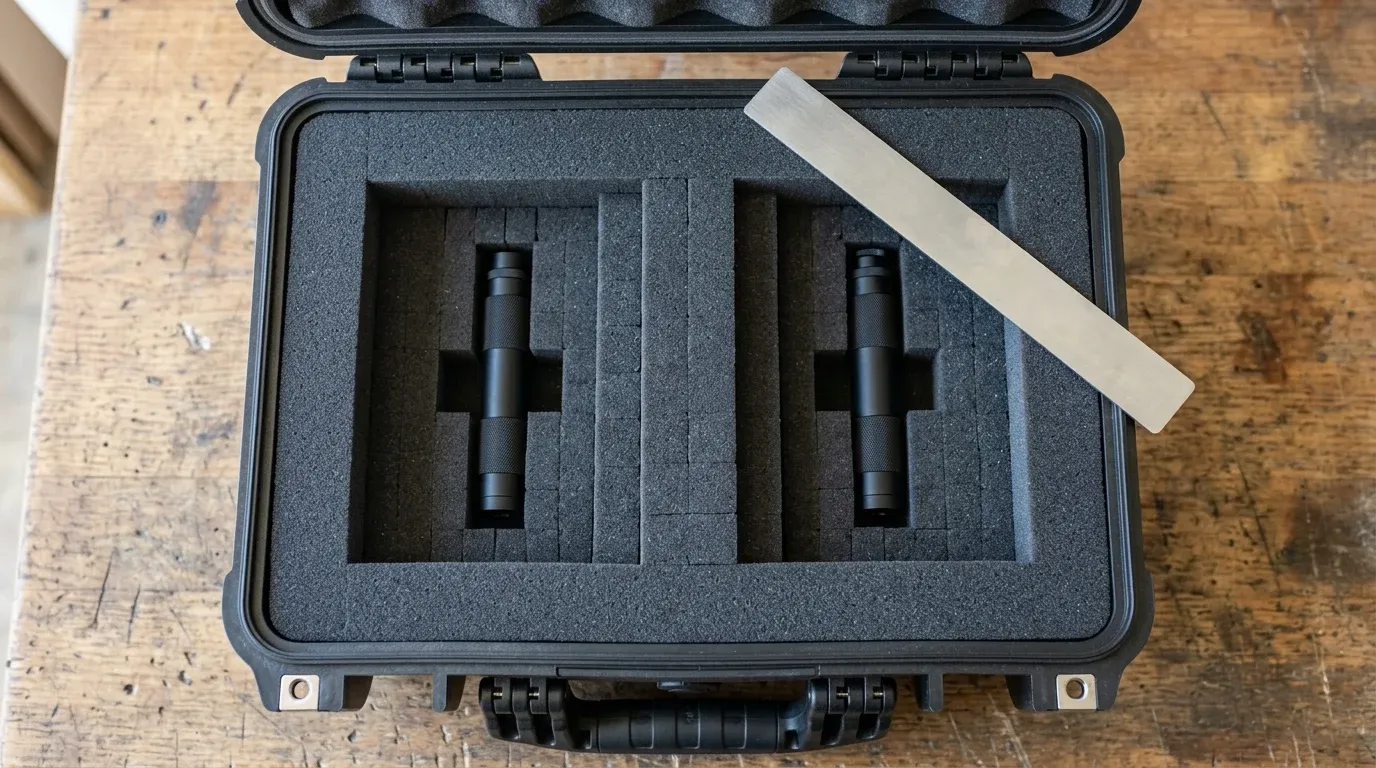
- Pelican Pick N Pluck™ interior foam uses pre-scored 1/2” or 1” cubes and requires leaving at least one inch of foam between the equipment and the wall of the case.
- Solid foam (cut with an electric knife or coping saw) is preferred for oversize items such as long guns, and Pelican cases 1700, 1720, 1740, 1750, 1770, iM3100, iM3200, iM3220, iM3300, and iM3410 ship with solid foam instead of Pick N Pluck™ foam.
- Pelican’s TrekPak™ Divider System laminates closed-cell foam to corrugated panels with perimeter wall sections and locking pins, and is combined with Pick N Pluck™ foam in Hybrid interiors for the Pelican 1510 Protector Case (Cat No.1510TPF) and Pelican 1535 Air case (Cat No.1535TPF).
- The Pelican 1485 Air Case weighs 5.39 lbs (2.4 kg) with foam and 4.57 lbs (2.1 kg) empty, with a 3-layer foam stack consisting of Layer 1 (Lid) 1.80” Convolute, Layer 2 (Base) 3.38” Pick N Pluck, and Layer 3 (Base) 0.70” Pad.
- The Pelican 1510 Carry On Case ships with Pick ‘N’ Pluck™ with convoluted lid foam, weighs 13.6 lbs. (6.17 kg) with foam versus 11.99 lbs. (5.44 kg) without foam, and uses Cat. # 1511 as its 4 pc Replacement Foam Set.
- The Pelican 1650 Case uses 2 level Pick ‘N’ Pluck™ with convoluted lid foam, weighs 35.49 lbs. (16.1 kg) with foam versus 29.1 lbs. (13.2 kg) without foam, and offers a 4 pc Replacement Foam Set (Cat. # 1651) or Pick ‘N’ Pluck™ Sections Only set of 2 (Cat. # 1652).
- The Pelican 1637 Air Case weighs 19.40 lbs (8.8 kg) with foam versus 15.20 lbs (6.9 kg) empty, and uses Cat. # 1637AirFS as its 7 pc Replacement Foam Set.
- The NANUK Cubed Foam Insert drawing (935NANUK / 00935FVNANUK) specifies PUF 1.5 BLACK across four layers: PUF 1.5 BLACK 1/2” THICK (Item 1 base pad), PUF 1.5 BLACK 2 1/8” THICK (Item 2A pre-scored layer), PUF 1.5 BLACK 2 1/2” THICK (Item 2B pre-scored layer), and PUF 1.5 BLACK CV 2 3/8” THICK with a 5/8” BASE (Item 3 lid eggshell).
- The NANUK Cubed Foam Insert drawing (935NANUK / 00935FVNANUK) specifies tolerances of CUTOUTS +/- 1/16 inch and OVERALL FOAM THICKNESS & CAVITY DEPTHS +/- 1/8 inch, and explicitly warns that FOAM DENSITY MAY VARY.
Closed-cell tear resistance, cut-cushioning geometry, and shell manufacturing allowances
Compare closed-cell polyethylene tear resistance, military cut-cushioning pad formulas, thickness codes, and rotomolded shell size allowances:
- Sealed Air Cellu-Cushion closed-cell polyethylene foam (ASTM D3575-00) across 1.2 pcf to 6.0 pcf grades exhibits tear resistance (Suffix Gmd / cmd) of 7 / 13 lb/in (1.2 pcf, 1/2”), 10–12 / 15–19 lb/in (1.7 pcf), 14 / 18 lb/in (2.2 pcf, 1/2”), 18–19 / 23–25 lb/in (4.0 pcf), and 44–45 / 48–57 lb/in (6.0 pcf); density ranges of 1.1 - 1.4, 1.5 - 1.9, 2.0- 2.4, 3.5 - 4.5, and 5.5- 6.5 lb/ft³; water absorption (Suffix L) of < 0.1 lb/ft² (< 0.2 lb/ft² for 4.0 pcf); None for contact corrosivity on aluminum plate (Method 3005, FEDSTD 101); and for anti-static grade, Static Decay < 2 sec (EIA Std 541).
- MIL-STD-2073-1E Appendix A Table A-V (Calculation of material sizes and weights) defines Cut Cushioning geometry as Bottom & Top Pads of Length = Item Length and Width = (Item Width) + (2 x Cushion Thickness), End Pads of Length = (Item Width) + (2 x Cushion Thickness) and Width = (Item Height) + (2 x Cushion Thickness), Side Pads of Length = Item Length and Width = Item Height, and total Cut Cushioning Weight = 2 x (Area of Bottom Pad + Area of End Pad + Area of Side Pad) x (Cushion Thickness) x (Cushion Density in lbs/cu in).
- MIL-STD-2073-1E Appendix J Table J-VI (Thickness of cushioning or dunnage codes) defines minimum cushioning thicknesses in 1/4-inch increments from Code A (1/4 inch thick), Code B (1/2 inch thick), Code C (3/4 inch thick), Code D (1 inch thick), Code H (2 inches thick), Code M (3 inches thick), and Code R (4 inches thick) up to Code V (5 inches thick) and Code W (5-1/4 inches thick).
- In Pelican rotationally molded Single Lid cases, nominal case size tolerances are ±0.12 in (1/8”) for dimensions from 1 to 5.99 in, ±0.19 in (3/16”) for 6 to 36.99 in, ±0.25 in (1/4”) for 37 to 72.99 in, ±0.31 in (5/16”) for 73 to 90.99 in, ±0.38 in (3/8”) for 91 to 108.99 in, and ±0.44 in (7/16”) for 109 to 134.00 in.
Account for both insert cutout allowances and shell dimensional variations when ordering custom-machined closed-cell inserts so the finished block fits snugly without buckling against the case walls.
Moisture Absorption, Solvent Exposure, Cleanroom Particulates, and Electrostatic Control
Field cases opened in rain, boat spray, or humid coastal air trap moisture inside the shell once the latches close. Because open-cell polyurethane allows air and vapor to move freely through its interconnected pores, damp inserts must be dried and managed using the workflow in the equipment-case condensation and moisture return guide, whereas exterior shell and seal selection follows the waterproof equipment case selection checklist.
When specifying inserts for sensitive circuit assemblies or military packaging contracts, review the published anti-static polyethylene specifications and military cushioning material codes:
- Pink 1.7LB Polyethylene Foam is Anti-Static and meets EIA 541 specifications with an Electrostatic Decay of less than 2.0 seconds and Surface Resistivity of >1.00 x 10^5 <1.00 x 10^12 Ohms.
- MIL-STD-2073-1E Appendix J Table J-V assigns cushioning material codes GA (A-A-59136 closed cell foam plank), GM (A-A-59136 Type I, Class 1, Grade A standard polyethylene closed cell foam plank), and GN (A-A-59136 Type I, Class 1, Grade B static dissipative polyethylene closed cell plank) for polyethylene, alongside GD (MIL-PRF-26514 Type I, Class 1 rigid polyurethane foam), GE, GF, and GH (MIL-PRF-26514 Type I, Class 2, Grades A, B, and C flexible polyurethane foam for light, medium, and heavy load ranges), and GK and GL (MIL-PRF-26514 Type III, Class 2, Grades A and B Anti-static flexible polyurethane foam for light and medium load ranges).
- MIL-STD-2073-1E Table J-V (Continued) assigns cushioning material codes MA, MB, and MD to MIL-PRF-83671 flexible and rigid foam-in-place polyurethane, NA to PPP-C-795 closed cell plastic cushioning, A-A-3129 open cell plastic cushioning, or PPP-C-1797 polypropylene foam cushioning, NB to A-A-3129 Type I, Grade B static dissipative open cell plastic cushioning, NC to PPP-C-1797 Type II electrostatic protective resilient low density polypropylene foam, and NG to A-A-3129 Type I, Grade A open cell plastic cushioning.
Custom Hard Case Foam Insert Selection Worksheet
Download the protective case foam density, static loading, and partition margin worksheet to document your payload bearing pressure, material grade, and cavity layout before cutting foam or sending a drawing to a fabricator.
Complete the worksheet in sequence for each instrument kit:
- Weigh each unpacked item and measure the flat bottom and side contact faces that will rest against the foam cavity.
- Divide the item weight by the bottom bearing contact area to determine the static loading pressure acting on the base pad.
- Match the calculated static bearing pressure and equipment fragility against the open-cell urethane, laminated polyethylene, extruded polyethylene, cross-linked polyethylene, or copolymer specifications above.
- Record the required perimeter foam margin along every exterior case wall and the partition bridge width between adjacent cavities.
- Specify closed-cell polyolefin or static-dissipative grades whenever the kit is exposed to rain, lubricants, cleanroom inspection, or electrostatic discharge risk.
- Perform a dry layout check on top of the uncut insert before plucking cubes, peeling laminated layers, or approving waterjet production.
For additional procurement checklists and receiving records across field gear, visit the equipment checklists and templates hub.
Frequently Asked Questions
How much perimeter wall margin does Pelican Pick N Pluck foam require?
Pelican Pick N Pluck™ interior foam uses pre-scored 1/2” or 1” cubes and requires leaving at least one inch of foam between the equipment and the wall of the case.
Which long Pelican cases ship with solid foam instead of Pick N Pluck foam?
Solid foam (cut with an electric knife or coping saw) is preferred for oversize items such as long guns, and Pelican cases 1700, 1720, 1740, 1750, 1770, iM3100, iM3200, iM3220, iM3300, and iM3410 ship with solid foam instead of Pick N Pluck™ foam.
How is FastCap Kaizen Foam constructed and how does it react to liquids and curing glues?
FastCap Kaizen Foam is a closed-cell polyethylene foam laminated in 1/8” layers, sold in 2’ x 4’ (24”x48” plus/minus 1”) sheets in 3 thicknesses (with +3mm / -1mm tolerance); because it is a closed-cell foam, liquids and oils do not absorb into it, while glues that create a heat reaction when curing could melt the foam.
How does compression creep compare between lower-density and high-density extruded closed-cell polyethylene foam?
For The Foam Factory extruded closed-cell polyethylene foam (ASTM D 3575) in 1.2 LB, 1.7 LB, and 2.2 LB densities (18, 20, and 24 cells/inch), compressive strength at 25% / 50% is 7 / 12 LB/in sq (1.2 LB), 7 / 14 LB/in sq (1.7 LB), and 8 / 14.5 LB/in sq (2.2 LB); compression set at 2 hours / 24 hours is 30% / 24% (1.2 LB), 21% / 16% (1.7 LB), and 22% / 16% (2.2 LB); compression creep is 5% (1.2 LB), 6% (1.7 LB), and 6% (2.2 LB); water absorption is 0.06 LB/sq ft (1.2 and 1.7 LB) and 0.04 LB/sq ft (2.2 LB); and service temperature is -30 to 180 °F.
For The Foam Factory high-density extruded closed-cell polyethylene foam (ASTM D 3575) in 4.0 LB, 6.0 LB, and 9.0 LB grades (30 cells/inch), compressive strength at 25% / 50% rises to 16.5 / 20 LB/in sq (4.0 LB), 28 / 39.5 LB/in sq (6.0 LB), and 46 / 66 LB/in sq (9.0 LB); compression set at 2 hours / 24 hours drops to 9% / 6% (4.0 LB), 10% / 7% (6.0 LB), and 20% / 11% (9.0 LB); compression creep drops to 0.8% across all three grades; and water absorption is 0.02 LB/sq ft (4.0 and 6.0 LB) and 0.05 LB/sq ft (9.0 LB).
Sources
- Pelican Products, Inc. — Pelican Product Catalog
- Pelican Products, Inc. — Rotationally Molded Single Lid Cases Catalog
- Pelican Products, Inc. — 1485 Air Case Datasheet
- Pelican Products, Inc. — 1510 Carry On Case Specification Sheet
- Pelican Products, Inc. — 1637 Air Case Datasheet
- Pelican Products, Inc. — 1650 Case Specification Sheet
- NANUK / Plasticase Inc. — 935 NANUK Cubed Foam Drawing
- U.S. Department of Defense — Practice for Military Packaging
- FastCap, LLC — Kaizen Foam Official Product Page
- Sealed Air Corporation — Cellu-Cushion Polyethylene Foam Products Technical Brochure
- The Foam Factory, Inc. — Open-Cell Polyurethane, Polyethylene, Cross-Linked Polyethylene, Minicel, and Volara Technical Datasheets
- Index Packaging, Inc. — Polyurethane, PolyPlank LAM, PolyPlank EXT, and Packaging Foam Selector Specifications
- ZwickRoell — Flexible Foam Testing Overview
- Infinita Lab — Flexible Cellular Polyolefin Foam Testing Overview
- Bergad Specialty Foams & Composites — Flexible Cellular Foam Property Testing Overview
Downloads
- Protective case foam density, static loading, and partition margin worksheet CSV Record payload weight, bearing contact area, static loading pressure, foam polymer family, target density, perimeter wall margin, and moisture or cleanroom requirements.
Next steps
Hard Case Sizes Chart & Measurement Guide: Interior Dimensions, Lid-to-Base Depth Split, and Foam Wall Margins
Compare hard case interior dimensions, lid-to-base depth splits, foam wall margins, and wheeled floor clearance using a Pelican case sizes chart and worksheet.
Specifying Hard Equipment Cases: Foam, Wheels and Transport
Specify a hard equipment case by interior fit, foam layout, loaded handling and shipping requirements, with documented dimensions and a receiving checklist.
Do Pelican Cases Keep Moisture Out? A Condensation and Return-to-Storage Guide
A watertight case can still contain damp gear and humid air. Use this return-to-storage record to investigate condensation, inserts and desiccant instructions.
Choosing a Waterproof Equipment Case: A Procurement Checklist
A procurement checklist for waterproof equipment cases: dimensions, seals, latches, valves, rating claims, test report scope, spares and maintenance documents.
Equipment Cases & Protection
Decide how to protect and transport field equipment by reading protection claims, specifying a case and verifying the evidence behind it.