Milwaukee Work Light M18 and M12 Battery Runtime and Shift-Rotation Chart
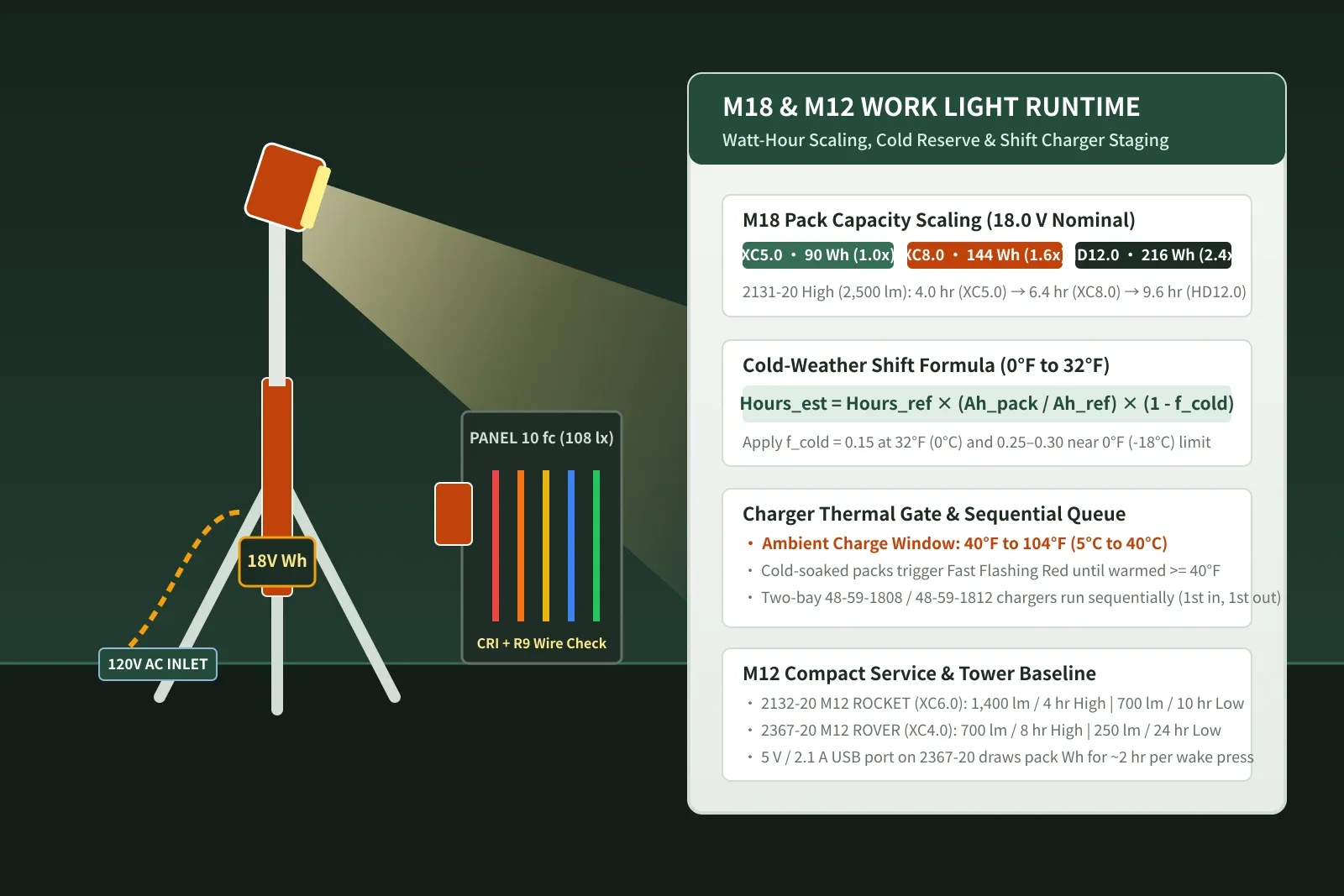
Selecting a milwaukee work light by its peak lumen headline without pairing the output mode to battery watt-hours causes unexpected mid-shift blackouts and costly maintenance downtime. Field crews that deploy 18V and 12V cordless tower lights, 360° site lanterns, and magnetic inspection floods need a mode-by-mode energy budget that accounts for pack capacity, cold-weather capacity derating, and charger turnaround queues.
Scroll horizontally to see all columns.
| Cat. No. & Model | Platform & AC Input | Reference Pack (Nominal Wh) | High Mode Output & Runtime | Medium Mode Output & Runtime | Low Mode Output & Runtime | Ingress, Temp & Mounting |
|---|---|---|---|---|---|---|
| 2131-20 M18 ROCKET Dual Power Tower Light | M18 (18 V DC) + 120 V AC (0.5 A) | M18 XC5.0 (90 Wh) | 2,500 lm / 4 hr (22.5 W avg) | 1,100 lm / 8 hr (11.25 W avg) | 700 lm / 13 hr (6.92 W avg) | 0°F to 125°F; tripod tower, 4–7 ft height, 22.97 lb |
| 2132-20 M12 ROCKET Dual Power Tower Light | M12 (12 V DC) + 120 V AC (0.5 A) | M12 XC6.0 (64.8 Wh nom) | 1,400 lm / 4 hr (16.2 W avg) | Two-mode switch (High / Low only) | 700 lm / 10 hr (6.48 W avg) | 0°F to 125°F; tripod tower, 5 ft 8 in height, 6.65 lb |
| 2145-20 M18 RADIUS Compact Site Light | M18 (18 V, 2.5 A max) + 120 V AC In/Out | M18 XC5.0 (90 Wh) | 4,400 lm / 2 hr (45.0 W avg) | 2,100 lm / 4 hr (22.5 W avg) | 1,000 lm / 8 hr (11.25 W avg) | IP54; 360°/180° lantern, 4-1/4 in overhead hook, 12.3 lb |
| 2144-20 M18 RADIUS Site Light w/ Flood Mode | M18 (18 V DC) + 120 V AC (0.6 A) | M18 XC5.0 (90 Wh) | Area: 2,200 lm / 4 hr; Flood: 1,000 lm / 6 hr | Area: 1,100 lm / 8 hr; Flood: 500 lm / 12 hr | Area: 550 lm / 16 hr; Flood: 250 lm / 24 hr | 360° area + 90° task flood, 4-1/4 in rafter hook, 4.96 lb |
| 2366-20 M18 ROVER Dual Power Flood Light | M18 (18 V, 2 A max) + 120 V AC (0.65 A) | M18 XC5.0 (90 Wh) | 4,000 lm / 3 hr (30.0 W avg) | Intermediate mode (3-mode switch) | Up to 12 hr on XC5.0 | IP54; 0°F to 125°F; 120° rotating head, keyholes, 5.77 lb |
| 2368-20 M18 ROVER Triple-Panel Flood & Area | M18 (18 V DC) + 120 V AC In | M18 XC5.0 (90 Wh) | 4,500 lm / 3 hr (30.0 W avg) | 3 brightness × 3 panel options | Up to 30 hr on lowest setting | IP54, 9 ft drop; hook, magnets, keyholes, 6.75 lb |
| 2367-20 M12 ROVER Service & Repair Flood | M12 (12 V DC) + 5 V / 2.1 A USB Out | M12 XC4.0 (43.2 Wh nom) | 700 lm / 8 hr (no USB load) | Two-mode switch (High / Low only) | 250 lm / 24 hr (no USB load) | IP54, 9 ft drop, 0°F to 125°F; rear magnet, keyhole, 0.73 lb |
For mounting geometry, magnetic surface checks, and cord routing on close-range inspection fixtures, pair this runtime table with the maintenance task-light selection guide. For multi-brand procurement criteria across outdoor sites, see the portable work light buying guide and the portable power and lighting hub.
Catalog M18 and M12 work-light runtime baseline
Every runtime claim in Milwaukee’s catalog is anchored to one specific battery pack and one brightness setting. Across the M18 lighting lineup (2131-20, 2145-20, 2144-20, 2366-20, and 2368-20), the reference pack is the M18 REDLITHIUM XC5.0 (48-11-1850), which holds 5.0 Ah at 18.0 V nominal (90 Wh). Across the M12 lineup, the M12 ROCKET Dual Power Tower Light (2132-20) is benchmarked on the M12 REDLITHIUM XC6.0 (48-11-2460), while the compact M12 ROVER Service and Repair Flood Light (2367-20) is benchmarked on the M12 REDLITHIUM XC4.0 (48-11-2440).
Two operational details in the operator manuals govern how those baseline numbers behave on a jobsite:
- Automatic AC/DC Dual Power switchover: In the operator manuals for the M18 ROCKET (
58-14-0106d4) and M12 ROCKET (58-14-2132d2), plugging a 120 V AC extension cord into the inlet port automatically switches the luminaire off battery discharge and onto mains power (0.5 Amax AC draw). Note that Dual Power work lights are not battery chargers; plugging an extension cord into2131-20,2132-20,2145-20,2366-20, or2368-20preserves the inserted pack’s state of charge but does not recharge it. - Daisy-chain AC pass-through vs single-fixture AC inlets: The M18 RADIUS Compact Site Light (
2145-20, manual58-14-2145d2) draws up to1 Aat120 V ACand provides an AC outlet rated up to11 Aso crews can string multiple overhead site lights along one branch circuit. By contrast,2131-20,2132-20,2144-20,2366-20, and2368-20feature an AC inlet only. When running corded in damp or outdoor locations, follow the GFCI and cord-protection requirements covered in the temporary construction lighting guide. - Auxiliary USB load on service floods: The M12 ROVER (
2367-20, manual58-22-2367d1) includes a5 V DC / 2.1 A(10.5 W) USB Type-A port that remains active for approximately 2 hours each time the USB wake button is pressed. Because the LED head draws only5.4 Won High (43.2 Wh / 8 hr), charging a phone or inspection camera at10.5 Wfor 2 hours consumes21 Wh—nearly half of an M12 XC4.0 pack’s capacity—cutting High-mode lamp runtime from 8 hours to roughly 4.1 hours.
Takeaway: Record the reference battery SKU, mode lumens, and whether auxiliary USB ports or AC inlets are active before entering any runtime figure into a shift plan.
Converting battery amp-hours to watt-hours and fixture power draw
As the U.S. Energy Information Administration defines electrical units, watts (W) measure instantaneous power demand while watt-hours (Wh) measure cumulative energy over time (1 Wh = 1 W sustained for 1 hour). Because 12V and 18V battery packs operate at different cell-series voltages, amp-hours (Ah) cannot be compared across platforms until converted into watt-hours:
Wh_nom = V_nom × Ah_pack
- M18 REDLITHIUM packs (5S lithium-ion architecture): Five series cell groups at
3.6 Vnominal per cell equal18.0 Vnominal (18.0 V × 5.0 Ah = 90.0 WhforXC5.0;18.0 V × 8.0 Ah = 144.0 WhforXC8.0;18.0 V × 12.0 Ah = 216.0 WhforHD12.0). - M12 REDLITHIUM packs (3S lithium-ion architecture): Three series cell groups equal
10.8 Vnominal (12.0 Vpeak label voltage). At10.8 Vnominal,M12 XC4.0holds43.2 Wh(48.0 What 12 V label rating) andM12 XC6.0holds64.8 Wh(72.0 What 12 V label rating).
Dividing the reference pack’s nominal watt-hours by the published mode runtime reveals the fixture’s average DC power draw (P_avg, including driver conversion efficiency):
P_avg (W) = Wh_ref / Hours_ref
- M18 ROCKET (
2131-20): On anXC5.0(90 Wh) pack, High mode (2,500 lm,4.0 hr) draws90 / 4.0 = 22.5 Waverage; Medium mode (1,100 lm,8.0 hr) draws90 / 8.0 = 11.25 W; Low mode (700 lm,13.0 hr) draws90 / 13.0 = 6.92 W. - M18 RADIUS (
2145-20): High mode (4,400 lm,2.0 hronXC5.0) draws90 / 2.0 = 45.0 W, which matches the operator manual’s electrical nameplate rating of18 V DC × 2.5 A = 45 W. - M18 ROVER Triple-Panel (
2368-20): High mode (4,500 lm,3.0 hronXC5.0) draws90 / 3.0 = 30.0 Waverage; the lowest single-panel setting (30 hronXC5.0) draws90 / 30.0 = 3.0 W.
Knowing P_avg also lets you size an AC power station when recharging tool batteries or running Dual Power lights off an inverter, using the worksheet in the portable power station sizing guide.
Takeaway: Convert battery amp-hours to nominal watt-hours (18.0 V × Ah for M18; 10.8 V × Ah for M12) so fixture draw and pack energy sit on the same unit scale.
Scaling cordless tower light runtime across XC5.0, XC8.0, and HD12.0 packs
Because LED work lights present a constant, regulated DC power load (11 W to 45 W—roughly 0.6 A to 2.5 A at 18 V), they discharge lithium-ion packs at a fraction of the current drawn by circular saws or rotary hammers. Across constant-power lighting loads at normal ambient temperatures, runtime scales proportionally with pack amp-hour (and watt-hour) capacity within the same voltage platform:
Hours_scaled = Hours_ref × (Ah_pack / Ah_ref)
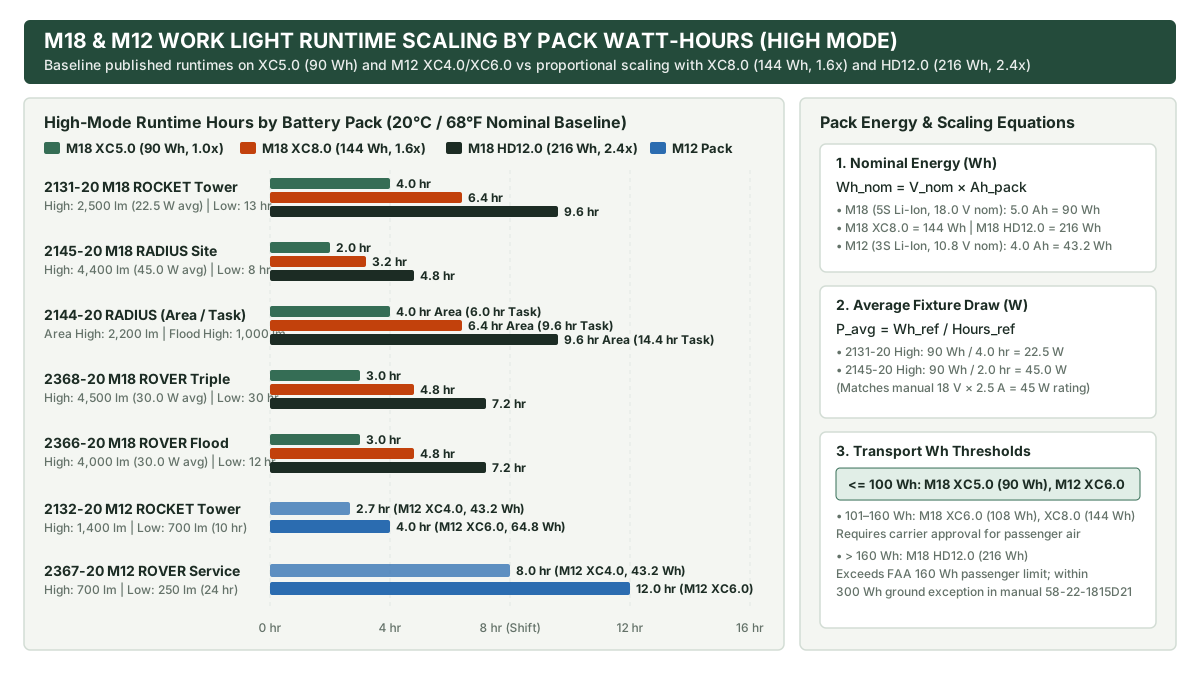
The table below combines Milwaukee’s published battery pack specifications (48-11-1850, 48-11-1865, 48-11-1880, 48-11-1812, 48-11-2440, and 48-11-2460), recharge times across the three charger tiers, and the resulting scaled runtimes for key tower and flood fixtures at room temperature (68°F / 20°C):
Scroll horizontally to see all columns.
| Battery Pack SKU & Model | Architecture & Nominal Capacity | Scaling Multiplier | Pack Weight | Recharge: Standard (48-59-1812) / Rapid (48-59-1808) / Super | Scaled Runtime: 2131-20 ROCKET (High / Med / Low) | Scaled Runtime: 2368-20 ROVER Triple (High / Low) | Transport Tier (Manual 58-22-1815D21 & FAA) |
|---|---|---|---|---|---|---|---|
| 48-11-1850 M18 REDLITHIUM XC5.0 | 5S2P 18650 · 5.0 Ah (90.0 Wh) | 1.00x (M18 ref) | 1.54 lb | 105 min / 60 min / 60 min | 4.0 hr / 8.0 hr / 13.0 hr (published) | 3.0 hr / 30.0 hr (published) | <= 100 Wh (unrestricted carry-on tier) |
| 48-11-1865 M18 HIGH OUTPUT XC6.0 | 5S2P 21700 · 6.0 Ah (108.0 Wh) | 1.20x vs XC5.0 | 2.30 lb | 125 min / 65 min / 35 min | 4.8 hr / 9.6 hr / 15.6 hr | 3.6 hr / 36.0 hr | 101–160 Wh (requires airline approval) |
| 48-11-1880 M18 HIGH OUTPUT XC8.0 | 5S2P 21700 · 8.0 Ah (144.0 Wh) | 1.60x vs XC5.0 | 2.53 lb | 153 min / 83 min / 45 min | 6.4 hr / 12.8 hr / 20.8 hr | 4.8 hr / 48.0 hr | 101–160 Wh (requires airline approval) |
| 48-11-1812 M18 HIGH OUTPUT HD12.0 | 5S3P 21700 · 12.0 Ah (216.0 Wh) | 2.40x vs XC5.0 | 3.42 lb | 241 min / 130 min / 60 min | 9.6 hr / 19.2 hr / 31.2 hr | 7.2 hr / 72.0 hr | > 160 Wh (forbidden on passenger aircraft; under 300 Wh US ground exception) |
| 48-11-2440 M12 REDLITHIUM XC4.0 | 3S2P 18650 · 4.0 Ah (43.2 Wh) | 1.00x (2367-20 ref) | 0.88 lb | 90 min / 60 min / 60 min | 2132-20: 2.7 hr High / 6.7 hr Low | 2367-20: 8.0 hr High / 24.0 hr Low (published) | <= 100 Wh (unrestricted carry-on tier) |
| 48-11-2460 M12 REDLITHIUM XC6.0 | 3S2P 18650 · 6.0 Ah (64.8 Wh) | 1.50x vs M12 XC4.0 | 0.88 lb | 134 min / 103 min / 103 min | 2132-20: 4.0 hr High / 10.0 hr Low (published) | 2367-20: 12.0 hr High / 36.0 hr Low | <= 100 Wh (unrestricted carry-on tier) |
Rule of thumb: when a magnetic light such as the 2368-20 M18 ROVER Triple-Panel (6.75 lb bare tool) is mounted vertically or inverted on painted structural steel, check total hung mass before inserting an HD12.0 pack (3.42 lb, bringing total assembly mass to 10.17 lb). Using an XC5.0 (1.54 lb, 8.29 lb total) or XC8.0 (2.53 lb, 9.28 lb total) reduces shear load on the magnetic base while keeping spare packs below the 160 Wh passenger aviation ceiling detailed in the air-travel battery screening guide.
Takeaway: Multiply XC5.0 baseline hours by 1.6x for XC8.0 and 2.4x for HD12.0, but check total assembly weight on magnetic mounts and 100 Wh / 160 Wh transport limits before standardizing on HD12.0.
Cold-weather derating and the 40°F charger thermal gate
Winter night shifts expose a critical operational gap between fixture discharge limits and battery charger temperature limits:
- Discharge operating window (
0°F to 125°F/-18°C to 52°C): Operator manuals for the M18 ROCKET (58-14-0106d4), M12 ROCKET (58-14-2132d2), M18 ROVER (58-14-0172d2), and M12 ROVER (58-22-2367d1) specify a Recommended Ambient Operating Temperature of0°F to 125°F(-18°C to 52°C). - Charger ambient window (
40°F to 104°F/5°C to 40°C): The M18 and M12 Li-Ion Battery Pack Manual (58-22-1815D21) and the charger manuals (58-14-1808D8for the48-59-1808Rapid Charger;58-14-1815D13for the48-59-1812Multi-Voltage Charger) specify a Recommended Ambient Charging Temperature of40°F to 104°F(5°C to 40°C).
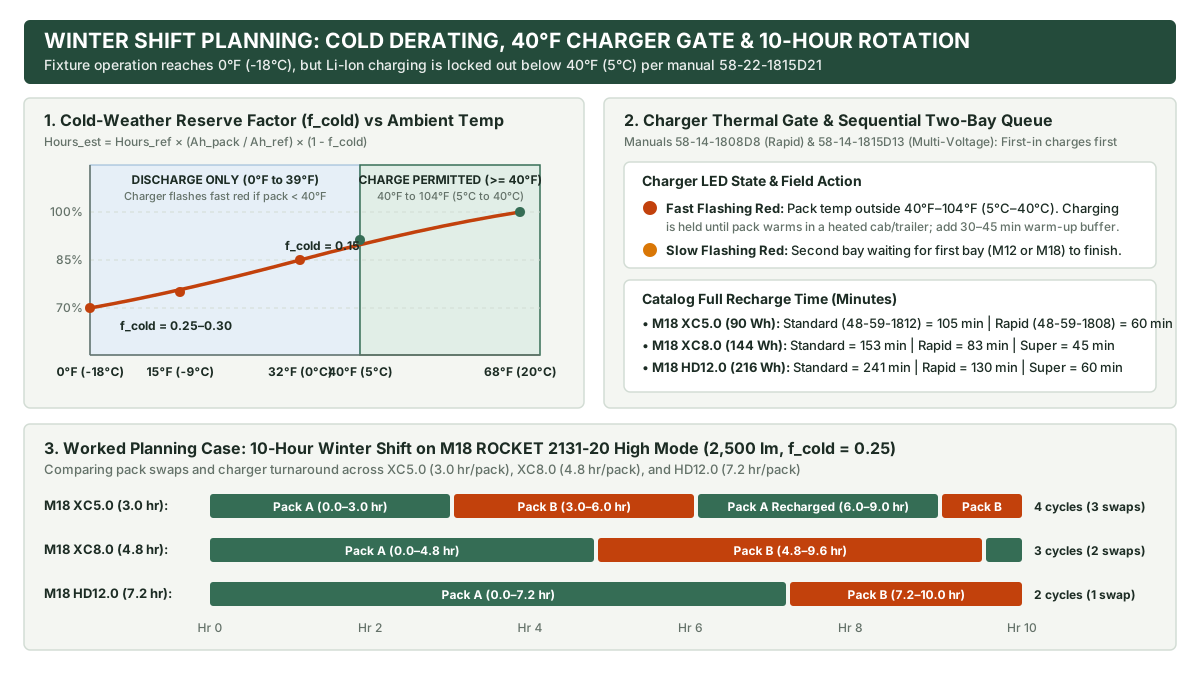
When an M18 or M12 pack sits on an open tripod leg in 10°F (-12°C) air, two physical mechanisms affect shift rotation:
- Cold electrolyte resistance and early low-voltage cutoff (
f_cold): Increased internal impedance lowers terminal voltage under load, causing the pack’s low-voltage cutoff (indicated by 4 rapid flashes of the fuel gauge LED per manual58-22-1815D21) to trip before all nominal watt-hours are extracted. To prevent unscheduled darkness, apply an explicit cold-weather and cell-aging reserve factor (f_cold, typically0.15at32°F / 0°Cand0.25to0.30between0°Fand15°F):Hours_est = Hours_ref × (Ah_pack / Ah_ref) × (1 - f_cold) - Thermal hold lockout and sequential charger bays: If a depleted pack is pulled off a
10°Ftower light and plugged directly into a charger, the charger indicator flashes fast red, signaling that cell temperature is outside the permitted charging window. Charging will not start until the pack warms into the acceptable range inside a heated job trailer or truck cab. Furthermore, standard two-bay M18/M12 chargers (48-59-1808and48-59-1812) charge one bay at a time on a first-in, first-served basis: inserting an M12 pack and an M18 pack simultaneously puts the second pack into a pending queue (indicated by a slow flashing red LED) until the first pack finishes its full charge cycle. For companion cold-weather rules on larger lithium power stations, see the winter shift and charging plan.
Takeaway: Never stage M18/M12 battery chargers in unheated tents below 40°F (5°C), and account for both pack warm-up time (30–45 min) and sequential bay queueing when calculating turnaround time.
Worked planning case: 10-hour winter tower shift rotation
Consider a maintenance crew running one M18 ROCKET Dual Power Tower Light (2131-20) on High mode (2,500 lm) for a 10-hour winter night shift at 12°F (-11°C) where no 120 V AC generator drop is available. The crew applies a 25% cold-weather and battery-aging reserve (f_cold = 0.25):
- Option A — M18 XC5.0 (
48-11-1850,90 Wh):Hours_est = 4.0 hr × (5.0 / 5.0) × (1 - 0.25) = 3.0 hr per packN_cycles = ceil(10.0 hr / 3.0 hr) = 4 pack cycles (3 swaps during the shift)With twoXC5.0packs per light and a heated trailer (65°F) housing a48-59-1808Rapid Charger (60 minrecharge), Pack 1 comes off the tower at Hour 3.0, warms for 35 minutes, and finishes charging in 60 minutes (total turnaround95 min, ready at Hour 4.6—well before Pack 2 depletes at Hour 6.0). - Option B — M18 HIGH OUTPUT XC8.0 (
48-11-1880,144 Wh):Hours_est = 4.0 hr × (8.0 / 5.0) × (1 - 0.25) = 4.8 hr per packN_cycles = ceil(10.0 hr / 4.8 hr) = 3 pack cycles (2 swaps: at Hour 4.8 and Hour 9.6)On the48-59-1808Rapid Charger (83 minrecharge +35 minwarm-up =118 minturnaround), twoXC8.0packs per tower easily leapfrog the 10-hour shift, or three pre-chargedXC8.0packs cover the entire night without bringing a charger onsite. - Option C — M18 HIGH OUTPUT HD12.0 (
48-11-1812,216 Wh):Hours_est = 4.0 hr × (12.0 / 5.0) × (1 - 0.25) = 7.2 hr per packN_cycles = ceil(10.0 hr / 7.2 hr) = 2 pack cycles (1 mid-shift swap)Two pre-chargedHD12.0packs carried to the work zone provide14.4 hoursof cold-derated High-mode light with only one swap at Hour 7.2 and zero field charging required.
Takeaway: Two pre-charged HD12.0 packs (14.4 hr derated total) or three pre-charged XC8.0 packs (14.4 hr derated total) eliminate field recharging on a 10-hour winter High-mode shift with the 2131-20 tower light.
Comparing Milwaukee M18/M12 work lights with Harbor Freight alternatives
Maintenance buyers frequently compare Milwaukee’s M18/M12 work lights against lower-upfront-cost shop fixtures such as the Harbor Freight BAUER 20V Cordless 2,000 Lumen Dual Power Work Light (Item 56527) and the BRAUN 500 Lumen LED Rechargeable Magnetic Slim Bar Work Light (Item 59536). Evaluating the published documentation side by side highlights where each tier fits—and which engineering parameters remain unprinted in public catalogs.
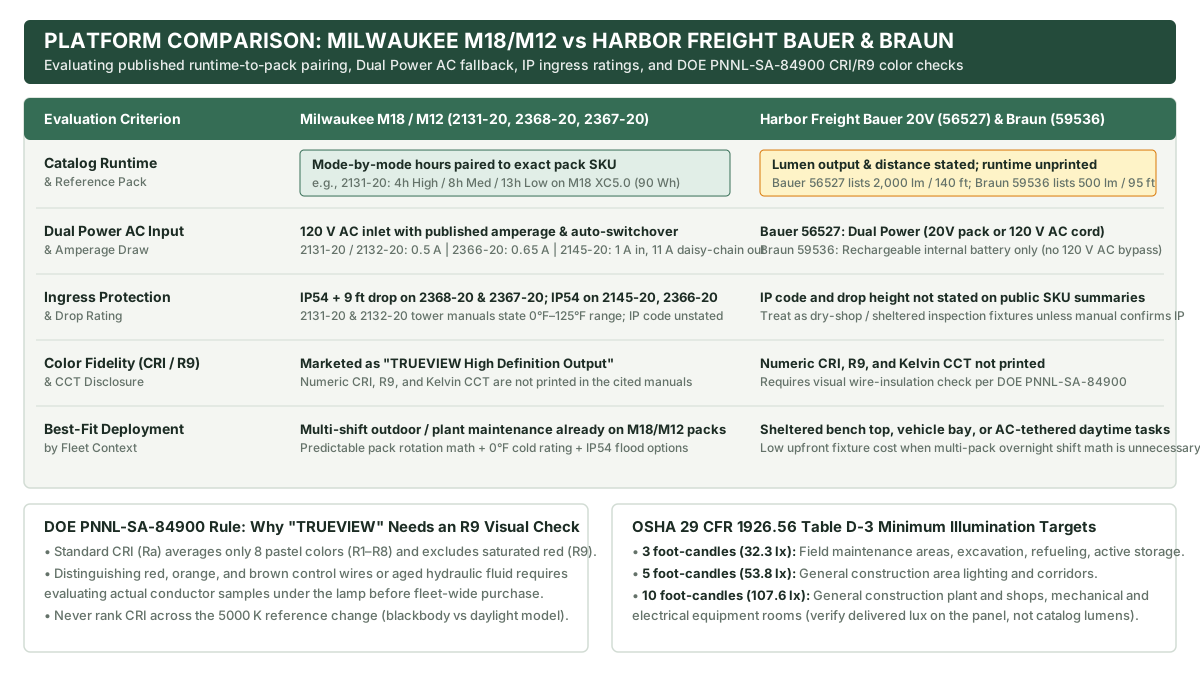
Scroll horizontally to see all columns.
| Comparison Dimension | Milwaukee M18 / M12 Lineup (2131-20, 2366-20, 2368-20, 2367-20) | Harbor Freight BAUER 20V Dual Power (Item 56527) | Harbor Freight BRAUN 500 lm Magnetic Slim Bar (Item 59536) |
|---|---|---|---|
| Catalog Output & Beam Distance | 700 lm (2367-20) to 4,500 lm (2368-20) across 2 or 3 stepped modes | 2,000 lm max output; 140 ft published beam distance; 360° rotating head | 500 lm output; 95 ft published illumination distance; 360° vertical / 180° horizontal swivel |
| Runtime-to-Pack Pairing | Explicitly paired per mode to M18 XC5.0 (90 Wh), M12 XC6.0 (64.8 Wh), or M12 XC4.0 (43.2 Wh) | Per-mode runtime hours and reference battery Ah/Wh capacity not printed on public SKU summary | Runtime hours and internal rechargeable cell Wh capacity not printed on public SKU summary |
| Power Supply Architecture | Removable M18/M12 tool packs + 120 V AC inlet (0.5 A–1.0 A) on Dual Power models | Dual Power: removable Bauer 20V Li-Ion pack (sold separately) or 120 V AC household extension cord | Integrated rechargeable battery only; no 120 V AC mains bypass |
| Ingress & Drop Claims | IP54 on 2145-20, 2366-20, 2368-20, 2367-20; 9 ft drop rating on 2368-20 and 2367-20; 0°F–125°F ambient rating | IP ingress code, drop height, and ambient temperature range not printed on public SKU summary | IP ingress code, drop height, and ambient temperature range not printed on public SKU summary |
| CRI, R9 & CCT Disclosure | Marketed as TRUEVIEW High Definition Output; numeric CRI, R9, and Kelvin CCT not printed in cited manuals | Numeric CRI, R9, and Kelvin CCT not printed on public SKU summary | Numeric CRI, R9, and Kelvin CCT not printed on public SKU summary |
Three verification rules govern how engineering teams interpret these disclosures:
- Do not substitute marketing names for CRI or R9: Milwaukee describes its LED optics as “TRUEVIEW High Definition Output,” while neither the Milwaukee operator manuals nor the Harbor Freight SKU pages print a numeric Color Rendering Index (
CRI), a saturated-red score (R9), or a Correlated Color Temperature (CCTin Kelvin). As the U.S. Department of Energy’s LED Color Characteristics fact sheet (PNNL-SA-84900) explains, standardCRIaverages only eight pastel test samples (R1–R8) and excludesR9(saturated red). When electricians must distinguish red, orange, and brown conductor insulation inside a control cabinet, follow the DOE fact sheet’s rule: perform a side-by-side visual evaluation on actual wire samples before approving a fleet purchase. - Verify delivered lux against OSHA 29 CFR 1926.56 Table D-3: Catalog lumens measure total light leaving the fixture, whereas OSHA 29 CFR 1926.56 Table D-3 sets minimum work-surface illuminance in foot-candles:
3 foot-candles(32.3 lx) for field maintenance and excavation areas,5 foot-candles(53.8 lx) for general construction areas, and10 foot-candles(107.6 lx) for mechanical and electrical equipment rooms. Use the contour equations in the work light LED lumens, CRI, and beam-angle guide to verify that the chosen mode delivers required lux at your mounting distance. - Match ingress protection to exposure: While
2145-20,2366-20,2368-20, and2367-20publish anIP54dust-and-splash statement, the tripod tower manuals (2131-20and2132-20) and the Harbor Freight SKU pages do not state an IP code. Review the IP ratings guide for outdoor equipment before deploying non-IP-rated tower lights in rain or washdown zones.
Takeaway: Choose Milwaukee M18/M12 fixtures when your crew already carries M18/M12 packs and needs published mode runtimes, 0°F cold ratings, and IP54 flood options; consider Bauer 56527 when 120 V AC cord tether is primary and cordless operation is occasional.
Shift battery rotation and receiving worksheet
Before deploying cordless tower or task lights on an overnight outage, record the fixture SKU, operating mode, pack watt-hours, cold-weather reserve, and charger staging location on one handover sheet. Download the Milwaukee work light battery shift-rotation worksheet (CSV), which is also indexed on the checklists and templates page.
Scroll horizontally to see all columns.
| Field on Shift Worksheet | Example Entry (2131-20 Winter Outage) | Why It Prevents Shift Blackouts |
|---|---|---|
| Fixture ID & Catalog No. | Tower #2 · Milwaukee 2131-20 M18 ROCKET | Links the runtime row to the exact manual (58-14-0106d4) |
| Selected Mode & Reference Runtime | High (2,500 lm) · 4.0 hr on M18 XC5.0 (90 Wh) | Prevents copying Low-mode hours (13 hr) onto a High-mode task |
| Assigned Pack SKU & Nominal Wh | 48-11-1880 M18 HIGH OUTPUT XC8.0 (144 Wh, 1.6x) | Establishes proportional baseline runtime (6.4 hr at 68°F) |
Cold Reserve (f_cold) & Net Runtime | f_cold = 0.25 at 12°F → 4.8 hr usable per pack | Accounts for early low-voltage cutoff in sub-freezing air |
| Shift Duration & Pack Cycles | 10.0 hr shift → ceil(10 / 4.8) = 3 pack cycles (2 swaps) | Sets the exact number of charged packs staged per tower |
| Charger SKU, Warm-Up & Turnaround | 48-59-1808 Rapid Charger in 65°F trailer · 35 min warm + 83 min charge | Prevents Fast Flashing Red thermal lockout below 40°F (5°C) |
Takeaway: Keep the completed shift worksheet with the charger bay so incoming crews know which packs are warming, which are charging, and when each tower requires its next swap.
Frequently asked questions
Does plugging an extension cord into a Milwaukee Dual Power work light charge the M18 or M12 battery?
No. Plugging a 120 V AC extension cord into a Dual Power work light such as the M18 ROCKET (2131-20), M12 ROCKET (2132-20), M18 RADIUS (2145-20 or 2144-20), or M18 ROVER (2366-20 or 2368-20) automatically switches the light onto AC mains power (0.5 A to 1.0 A draw) and stops battery discharge, but these fixtures do not contain an onboard battery charger. Only specialized charger-integrated lanterns that explicitly list battery charging in their manual recharge an inserted pack from AC power.
How long does a Milwaukee M18 work light last on an 8.0Ah or 12.0Ah HIGH OUTPUT battery?
At normal ambient temperatures, runtime scales proportionally with nominal watt-hours relative to the XC5.0 (90 Wh) reference pack: an XC8.0 (144 Wh) multiplies baseline runtime by 1.6x, and an HD12.0 (216 Wh) multiplies baseline runtime by 2.4x. On the M18 ROCKET 2131-20, High mode (2,500 lm) increases from 4.0 hours on XC5.0 to 6.4 hours on XC8.0 and 9.6 hours on HD12.0, while Low mode (700 lm) increases from 13.0 hours to 20.8 hours and 31.2 hours.
Why is my Milwaukee charger flashing fast red when I bring a work light battery in from the cold?
According to Milwaukee’s battery and charger operator manuals (58-22-1815D21 and 58-14-1808D8), a fast flashing red indicator means the battery pack temperature is outside the permitted charging range of 40°F to 104°F (5°C to 40°C). Even though M18 and M12 work lights can discharge down to 0°F (-18°C), a cold-soaked battery pack must sit in a heated room or vehicle cab until its internal cells warm above 40°F before the charger will initiate current flow.
How much does the USB port on the M12 ROVER 2367-20 reduce light runtime?
The 5 V DC / 2.1 A USB port on the M12 ROVER Service and Repair Flood Light (2367-20) can deliver up to 10.5 W for approximately 2 hours per wake-button press, whereas the LED lamp itself draws about 5.4 W on High (700 lm) or 1.8 W on Low (250 lm). Drawing 10.5 W from the USB port for 2 hours consumes 21 Wh from an M12 XC4.0 pack (43.2 Wh nominal), reducing High-mode illumination from 8 hours down to roughly 4.1 hours.
Can crews fly on commercial passenger aircraft with M18 HD12.0 or XC8.0 work-light batteries?
FAA PackSafe regulations and Milwaukee’s battery manual (58-22-1815D21) divide lithium-ion packs by watt-hour rating: M12 packs and the M18 XC5.0 (90 Wh) sit at or below the 100 Wh unrestricted carry-on threshold, whereas M18 XC6.0 (108 Wh) and XC8.0 (144 Wh) fall into the 101–160 Wh band that requires airline approval and a limit of two spare packs in carry-on baggage. The M18 HD12.0 (216 Wh) exceeds the 160 Wh passenger aircraft ceiling and must travel via ground transport or regulated cargo.
Downloads
- Milwaukee work light battery shift-rotation worksheet (CSV) CSV Blank planning sheet for recording fixture mode, reference runtime, assigned pack watt-hours, cold-weather reserve, and charger turnaround.
Sources and versions
- M18 ROCKET Dual Power Tower Light (2131-20) Product Page , Milwaukee Tool Supports: Catalog lumen output and runtime by mode with an M18 REDLITHIUM XC5.0 battery pack: High 2,500 lumens for 4 hours, Medium 1,100 lumens for 8 hours, Low 700 lumens for 13 hours; dual power (M18 battery or 120 V AC extension cord); 4 to 7 ft extension, 44.8 in collapsed length, 22.97 lb tool weight.
- M18 ROCKET Dual Power Tower Light (Cat. No. 2131-20) Operator's Manual (58-14-0106d4) , Milwaukee Tool Supports: Cat. No. 2131-20 electrical and environmental specifications: 18 V DC (M18 battery pack), 120 V AC input at 0.5 A, automatic switchover to AC power when an extension cord is plugged in, and Recommended Ambient Operating Temperature of 0°F to 125°F (-18°C to 52°C).
- M12 ROCKET Dual Power Tower Light (2132-20) Product Page , Milwaukee Tool Supports: Catalog output and runtime by mode with an M12 REDLITHIUM XC6.0 battery pack: High 1,400 lumens for 4 hours, Low 700 lumens for 10 hours; dual power with AC extension cord inlet; 5 ft 8 in extended height, 31 in collapsed length, 210° rotation and 270° pivot, 6.65 lb weight.
- M12 ROCKET Dual Power Tower Light (Cat. No. 2132-20) Operator's Manual (58-14-2132d2) , Milwaukee Tool Supports: Cat. No. 2132-20 electrical and temperature specifications: 12 V DC (M12 Li-Ion battery packs only), 120 V AC input at 0.5 A, double-insulated two-prong construction, and Recommended Ambient Operating Temperature of 0°F to 125°F.
- M18 RADIUS Compact Site Light (2145-20) Product Page and Operator's Manual (58-14-2145d2) , Milwaukee Tool Supports: Catalog output and runtime by mode with an M18 XC5.0 pack: High 4,400 lumens for 2 hours, Medium 2,100 lumens for 4 hours, Low 1,000 lumens for 8 hours; 180° and 360° electronic light control; IP54 ingress protection; 18 V DC at 2.5 A (45 W) max DC input; 120 V AC input (1 A) and daisy-chain AC output (11 A max), 12.3 lb weight.
- M18 RADIUS Compact Site Light w/ Flood Mode (2144-20) Product Page , Milwaukee Tool Supports: Catalog dual-function runtimes with an M18 XC5.0 pack: 360° Area Mode delivers 2,200 lumens for up to 4 hours (High) and 1,100 lumens for up to 8 hours (Medium); 90° Flood (Task) Mode delivers 1,000 lumens for up to 6 hours (High), 500 lumens for up to 12 hours (Medium), and 250 lumens for up to 24 hours (Low); 120 V AC inlet (0.6 A), 4.96 lb weight.
- M18 ROVER Dual Power Flood Light (2366-20) Product Page and Operator's Manual (58-14-0172d2) , Milwaukee Tool Supports: 4,000 lumens of TRUEVIEW output on High, three brightness modes, up to 12 hours runtime on Low with an M18 XC5.0 battery pack; 120 V AC port (0.65 A max AC input) or 18 V DC (2 A max DC input); 120° head rotation, integrated keyholes, IP54 rating, 0°F to 125°F operating range, 5.77 lb weight.
- M18 ROVER Dual Power Triple-Panel Flood & Area Light (2368-20) Product Page , Milwaukee Tool Supports: 4,500 lumens on High mode for 3 hours with an M18 XC5.0 pack; up to 30 hours on the lowest setting with an M18 XC5.0 pack; 3 brightness settings and 3 light-head power options; 120 V AC extension cord inlet; integrated hook, magnets, and keyholes; IP54 and 9 ft drop rating; 6.75 lb weight.
- M12 ROVER Service and Repair Flood Light w/ USB Charging (2367-20) Product Page and Operator's Manual (58-22-2367d1) , Milwaukee Tool Supports: 700 lumens on High for up to 8 hours and 250 lumens on Low for up to 24 hours with an M12 XC4.0Ah battery pack; rear-facing magnet, integrated keyhole, 120° pivoting head, IP54 rating, 9 ft drop rating, 0.73 lb weight; 5 V DC / 2.1 A USB output port that stays active for about 2 hours per wake-button press; 0°F to 125°F ambient operating temperature.
- M18 REDLITHIUM XC5.0 (48-11-1850), HIGH OUTPUT XC8.0 (48-11-1880), and HIGH OUTPUT HD12.0 (48-11-1812) Battery Pack Pages , Milwaukee Tool Supports: Catalog amp-hour ratings, weights, cold-weather operation claims (below 0°F / -18°C), and full recharge times across Standard (48-59-1812), Rapid (48-59-1808), and Super Chargers: XC5.0 (5 Ah, 1.54 lb: 105 / 60 / 60 min), XC8.0 (8 Ah, 2.53 lb: 153 / 83 / 45 min), HD12.0 (12 Ah, 3.42 lb: 241 / 130 / 60 min), and M12 XC6.0 (6 Ah, 0.88 lb: 134 / 103 / 103 min).
- M18 & M12 Li-Ion Battery Pack Operator's Manual (58-22-1815D21) and Rapid Charger (48-59-1808) / Multi-Voltage Charger (48-59-1812) Manuals , Milwaukee Tool Supports: Recommended Ambient Charging Temperature of 40°F to 104°F (5°C to 40°C); sequential two-bay charging behavior (slow flashing red indicates pending second pack; fast flashing red indicates battery/charger outside charging temperature range); fuel-gauge bands; and 100 Wh / 300 Wh transport thresholds.
- BAUER 20V Cordless 2000 Lumen Dual Power Work Light (Item 56527) and BRAUN 500 Lumen LED Rechargeable Magnetic Slim Bar Work Light (Item 59536) , Harbor Freight Supports: Public Harbor Freight SKU summaries: Bauer Item 56527 states 2,000 lumens, 140 ft beam distance, 360° rotating head, and Dual Power (Bauer 20V Li-Ion battery or 120 V AC cord); Braun Item 59536 states 500 lumens, magnetic stand-up base, 360° vertical / 180° horizontal head swivel, and 95 ft illumination distance.
- Measuring electricity , U.S. Energy Information Administration Supports: Watts measure electric power at a specific moment; watt-hours measure electrical energy over time (1 Wh = 1 W for 1 hour).
- LED Color Characteristics fact sheet (PNNL-SA-84900) , U.S. Department of Energy, Building Technologies Program Supports: CRI averages eight standard test colors (R1-R8) on a 0-100 scale against a reference source at a similar CCT (reference changes at 5000 K); R9 measures saturated red rendering outside the eight-sample CRI average, which matters for distinguishing red/orange/brown conductor insulation.
- 29 CFR 1926.56 Illumination , Occupational Safety and Health Administration Supports: Table D-3 minimum workplace illumination levels in foot-candles: 3 fc for field maintenance areas, 5 fc for general construction areas, and 10 fc for general construction plant and shops (including mechanical and electrical equipment rooms).
Next steps
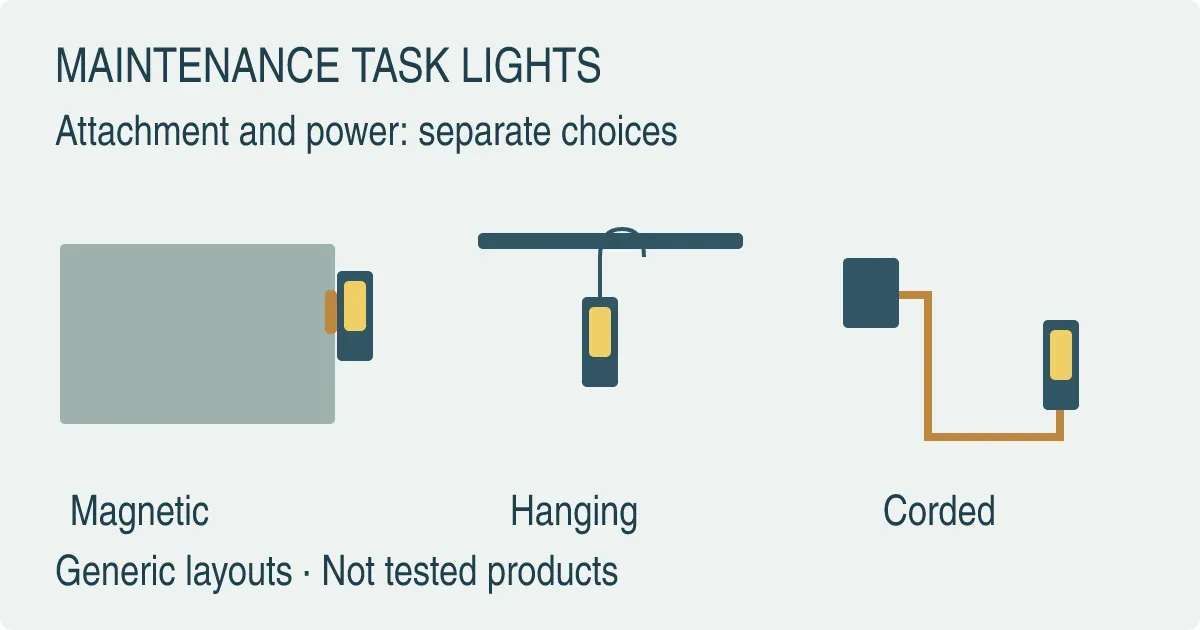
Maintenance Task Lights: Magnetic, Hanging or Corded
Choose a magnetic, hanging or corded maintenance light by its mounting point, cable route and documented limits. Includes three manual examples and a buyer checklist.
Portable Work Lights: A Buying Guide for Outdoor Teams
How outdoor teams can compare portable work lights: lumens vs lux, beam pattern, runtime claims, mounting, protection ratings, plus a supplier comparison sheet.
Work Light LED Output: Lumens, CRI, and Beam Angle
Read work-light lumens, lux, CRI, CCT and beam angle, then calculate the 50% intensity contour and the lumens a surface must receive.
Portable Power Stations Below −15°C: A Winter Shift and Charging Plan
Plan a winter shift below −15°C using three model manuals: separate discharge, charging, storage and cold-protection recovery, then record each handover.